Agroforestry, Pastoralism: A Revolution in Our Regions
This event has already taken place!
In honor of the International Year of Pastoralism 2026, discover how pastoralism and agroforestry contribute to sustainable livestock systems, ecological land management, and fire prevention, by addressing both the scientific aspects—environmental ecology, biodiversity, and plant-animal interactions—as well as the economic challenges associated with these practices, such as the promotion of local products and the sustainable management of resources.
To better understand this phenomenon and its implications, we invite you to a unique event:
“Agroforestry and Pastoralism: A Revolution in Our Regions”
During this lively evening, the public is invited to chat over a drink with experts on the topic at this fifth event of the Bar des Sciences—2026 edition.
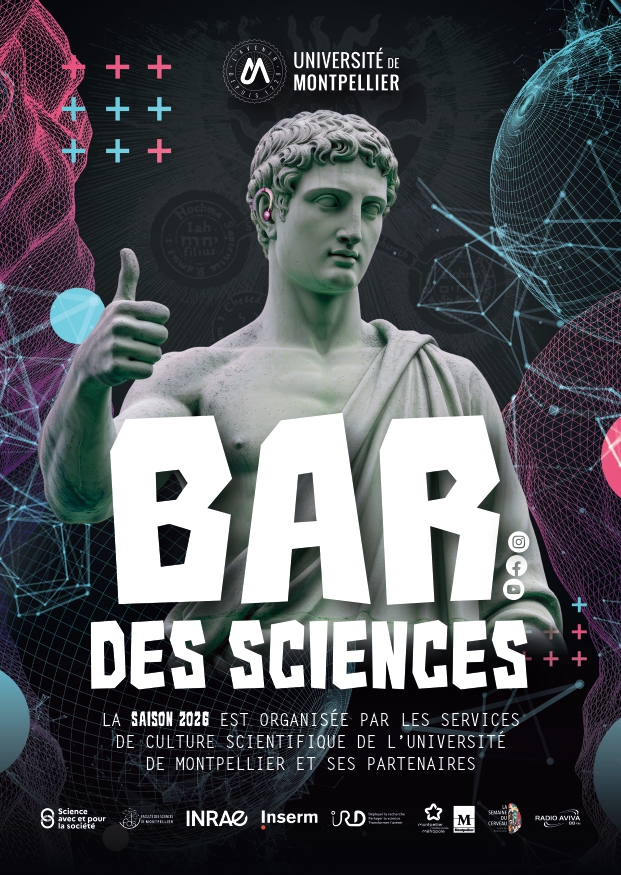
To discuss this topic, three experts from various disciplines will answer questions from the audience live:
- Véronique Ancey is a research director in sociology at CIRAD within the research laboratory Actors, Resources, and Territories in Development (ART-Dev—CIRAD, CNRS, Paul-Valéry University of Montpellier, University of Perpignan Via-Domitia, and University of Montpellier). She conducts research on knowledge, social practices, and policies related to pastoralism in arid regions.
- Julien Blanco is an ethnoecologist at the IRD, working in the Savoirs, ENvironnement, Sociétés (SENS) research laboratory (IRD, CIRAD, and Paul Valéry Montpellier 3 University). His research focuses on community forests and forest governance in Morocco, as well as on the territorial dynamics resulting from conservation projects in Madagascar.
- Fabien Stark is a livestock science researcher at INRAE in the research laboratory on Livestock Systems in Mediterranean and Tropical Environments (SELMET—INRAE, CIRAD, and the Agro-Montpellier Institute). His research focuses on the design and evaluation of diversified livestock systems that address the challenges of agroecological transition and adaptation to climate change.
The Bar des sciences has become one of Montpellier’s flagship events for scientific culture, offering a participatory, community-driven discussion on all aspects of science once a month from January through June. Throughout the season, scientists are invited to engage in a dialogue where their knowledge and practices are shared and discussed.
Once again this year, the Bar des Sciences is receiving support from the University of Montpellier through the ministerial “Science with and for Society” (SAPS) initiative. As part of this initiative, the commitment to making scientific culture increasingly accessible continues.
Special attention will be paid to ensuring the inclusion of deaf and hard-of-hearing individuals at every Bar des Sciences event. As such, this event will feature French Sign Language (LSF) interpretation provided by Des’L Interprétation, as well as a collaboration with students from Lycée Joffre taking the LSF elective and their teachers, who will open the event.
Can't join us? Watch highlights of the discussions on the Écran de savoirs YouTube channel, in a video produced by the Cosciences association.
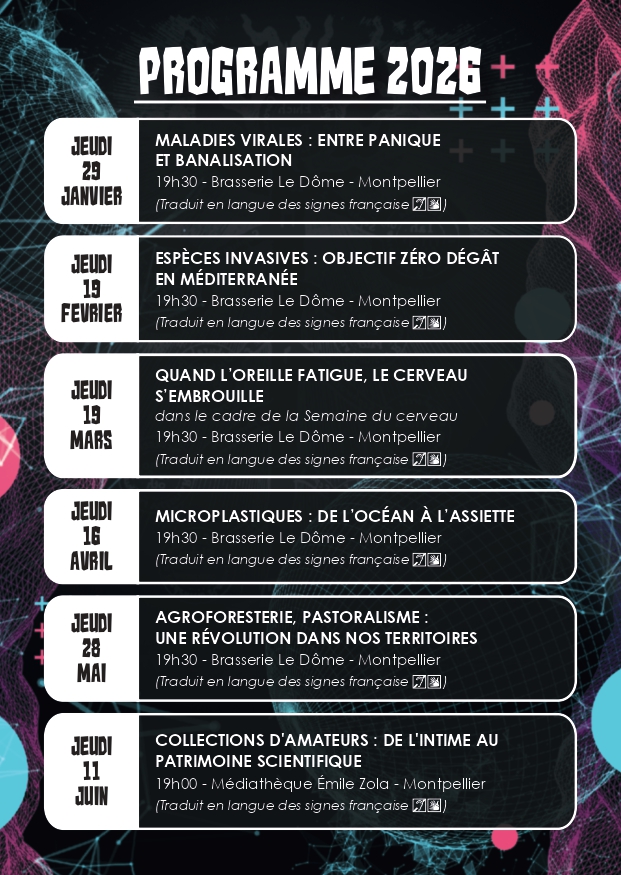
Upcoming Schedule:
- June 11, Amateur Collections: From the Personal to Scientific Heritage. 7:00 p.m.,
Émile Zola Media Library, Montpellier. Translated into French Sign Language.
The season is co-produced by the scientific outreach departments of theUM and its partners: INRAE, INSERM, IRD, the Montpellier Faculty of Sciences, Radio Aviva, and Radio Divergence.
Receive a weekly summary of theUM 's schedule
* By entering your email address, you agree to receive a weekly summary of the “UM ” calendar via email and acknowledge that you have read ourprivacy policy. You can unsubscribe at any time by using the unsubscribe linkor by contacting us via email.
News
Science at theUM [S06-ep03]: Nuclear Waste at the Bottom of the Sea
Published on: October 9 , 2026
This week on *A l’UM * Science, Benoit Ildefonse, a researcher at the Geosciences Laboratory…