Synergies Between Crop and Livestock Farming: How Diet Shapes the Landscape
The lecture series “CROSS-PERSPECTIVES ON LIFE IN SOCIETY” brings together experts from the humanities and social sciences on one hand, and ecology and the environment on the other, to explore major environmental issues and broaden perspectives toward an interdisciplinary approach.
Inaugural Lecture for the 2026–2027 Season : “Synergies Between Crop and Livestock Farming: How What’s on Our Plates Shapes the Landscape.”
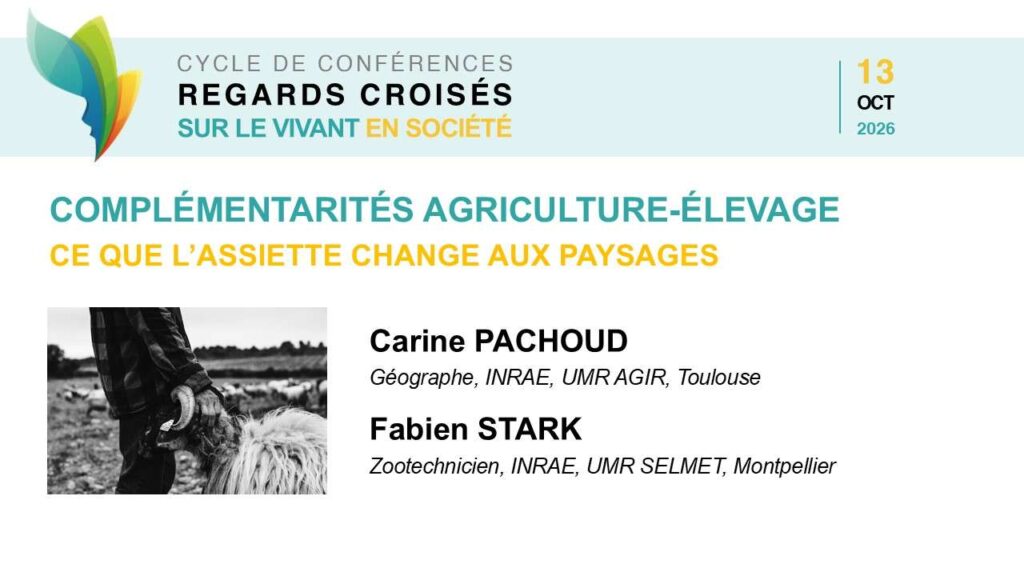
What if the issue were not just a choice between a meat-based or plant-based diet, but more broadly, the balance between crop farming and livestock raising for the “overall” health of ecosystems, humans, and regions?
Behind the debates on the role of livestock farming lies a fundamental question: How can we organize our regions to better feed their populations while preserving the diversity and autonomy of those regions? Agricultural specialization has gradually separated crop farming from livestock farming, homogenizing landscapes and undermining regional autonomy. Diversification allows for complementarity between crop and livestock production: but how can we initiate these transformations in specialized systems and regions that are locked into their current structures, both technically and economically?
Carine Pachoud will present a regional approach, focusing on the challenges of agricultural and food autonomy and the power dynamics among stakeholders. Fabien Stark will address the issue through the lens of agricultural practices that leverage the synergies between crop and livestock farming, and the benefits these practices provide to local communities. For to question our food is inevitably to question its production and, ultimately, our relationship to living things and to the regions we inhabit.
Eight doctoral schools in Occitanie (ED58, ED60, and Gaïa in Montpellier; SEVAB and SDU2E in Toulouse; ED305 and ED544 in Perpignan; and ED Risques et société in Nîmes) offer this program to their doctoral students as part of their training (registration required via ADUM).
The primary goal is therefore “acculturation,” particularly for young researchers (although the seminars will be open to the entire scientific community), and to demonstrate how the same subject can be studied in very different ways by different scientific disciplines. In the longer term, the goal is to encourage emerging researchers to integrate interdisciplinary approaches into their day-to-day work.
The series, offered in a hybrid format, is broadcast live from the Maison des sciences de l’Homme.
Receive a weekly summary of theUM 's schedule
* By entering your email address, you agree to receive a weekly summary of the “UM ” calendar via email and acknowledge that you have read ourprivacy policy. You can unsubscribe at any time by using the unsubscribe linkor by contacting us via email.
News
Call for Proposals: ExposUM Master's Internship Support
Published on: August 28 , 2026
ExposUM is an initiative of the University of Montpellier and its partners[1] aimed at…