Physics-Based AI Models for Edge AI
This presentation will be based on current insights into the environmental footprint of artificial intelligence (AI) and the challenges associated with the transition to Edge AI—that is, AI executed as close as possible to where data is collected and decisions are made. It will focus in particular on the challenges specific to edge AI and some promising avenues of research for significantly improving energy efficiency and enabling on-device learning (on the system itself).
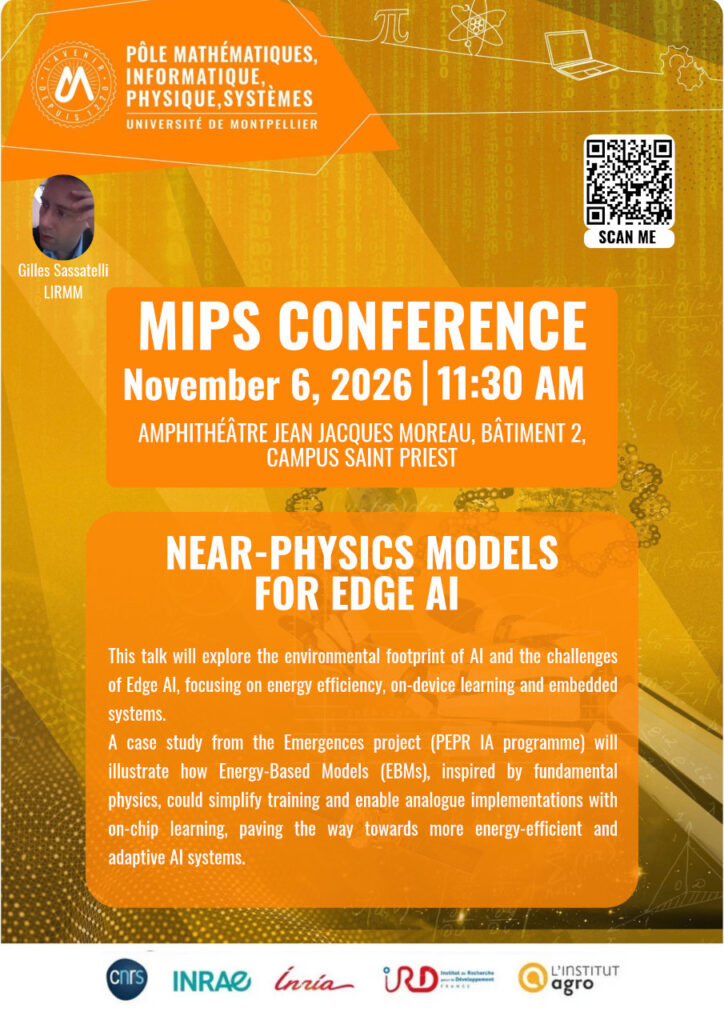
The presentation will draw on a case study from the Emergences project, conducted as part of the PEPR AI initiative, which explores the potential of energy-based models (EBMs). Inspired by concepts from fundamental physics, these models describe AI computation as dynamic systems. This approach offers promising prospects for simplifying model training and enabling their implementation on primarily analog architectures equipped with on-chip learning capabilities. It could thus pave the way for AI systems at the network edge that are both more energy-efficient and more adaptive.
This event is part of the MIPS Center's monthly seminar series, which aims to foster scientific exchange and highlight new research topics and technological innovations.
Receive a weekly summary of theUM 's schedule
* By entering your email address, you agree to receive a weekly summary of the “UM ” calendar via email and acknowledge that you have read ourprivacy policy. You can unsubscribe at any time by using the unsubscribe linkor by contacting us via email.
News

The AAP TALENTS – PTL CARLA and CHIMENE from the Chemistry Division
Published on: October 6 , 2026
As part of the I-SITE Program of Excellence (PEI) at the University of Montpellier (UM) and the…