Nature Discovery Workshops: Observing Local Nature
As part of a voluntary outreach initiative, the University of Montpellier has organized free botany and entomology workshops open to all staff members. The workshops are led by Professors from the Faculty of Sciences and a botanist-gardener from the Jardin des Plantes.
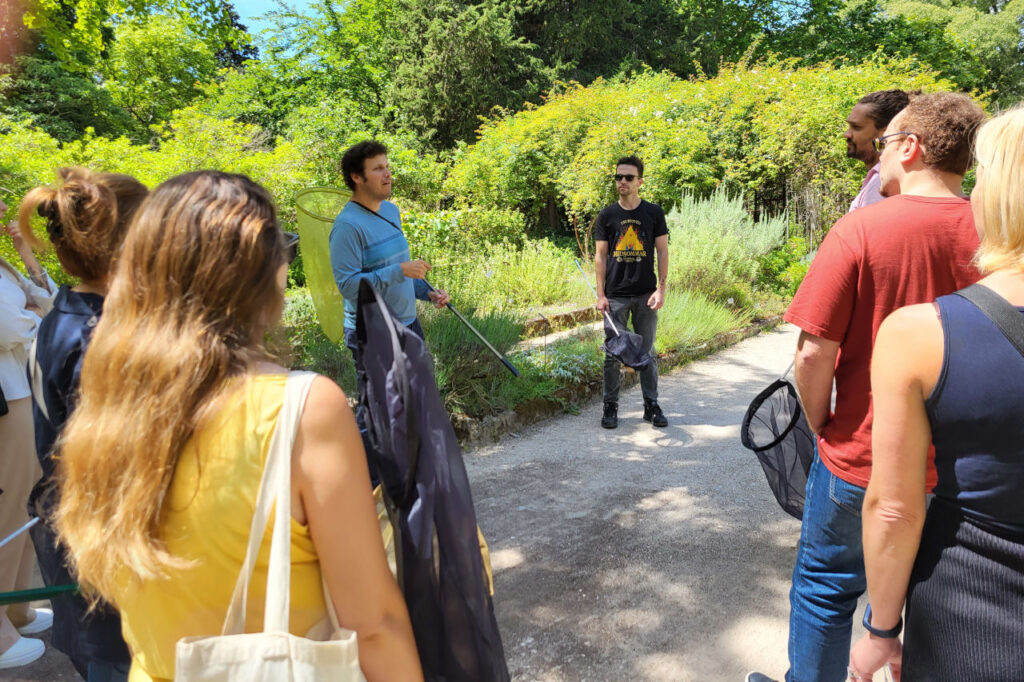
Fun workshops open to all staff members
Protecting nature means, above all, understanding it and realizing that it is everywhere, all the time, right here with us. Equipped with magnifying glasses for the botany workshops or netts for the entomology workshops, staff members from the University of Montpellier spent an hour exploring the Jardin des Plantes to discover the biodiversity hidden right in the heart of Montpellier. This environmentally friendly adventure also provided an opportunity for the presenters to explain the various interactions between ecosystems and animal and plant species, such as bees.
Wild or domestic bees
France is home to more than 900 species of wild bees, the majority of which live underground in very small colonies and in tiny hives. Contrary to popular belief, it is now not recommended to set up hives of domestic honeybees—used for honey production—in order to preserve biodiversity. In fact, their hive-based lifestyle—which involves colonies of several thousand individuals—creates intense competition for access to pollen and other resources, thereby threatening wild species.
Another problem for wild bees is the disappearance of local plant species, which are being replaced by exotic species chosen to add color to our towns and villages. Many bee species have a very specific diet consisting solely of pollen from certain plants. If those plants disappear, the bees will disappear as well.
Promoting Biodiversity
With this in mind, it is therefore important to consider how to design natural spaces so that they meet the needs of local biodiversity. In particular, we can increase the variety of habitats: sunny rocky areas, tall grasses, flower-filled and shaded areas, wetlands, and bare ground. Varying habitats means creating more natural habitats for all types of species and improving the health of ecosystems, which function thanks to the relationships that living organisms form. There are also specific ways to manage natural spaces to promote their ecological health. Late mowing, for example, encourages the development of biodiversity and the emergence of wildflower species, which in turn provide food and habitat for insects. In this way, the entire ecosystem is strengthened, enriched, and restored to health.
What's next?
This is the second consecutive year that the University has organized these workshops. Due to their popularity with an increasingly diverse audience, and encouraged by the positive feedback they have received, the University of Montpellier—as part of the initiatives outlined in the Ecological Transition Master Plan (SDTE)—is making these workshops a permanent feature with biannual sessions in the fall and spring. The registration process for future workshops will be the same as before: they will be free and open to all University staff.