Welcome to Coronaland! Are humans heading toward zombification?
By constantly tapping intothe public’s imagination, the theme of a zombie apocalypse has raised awareness. The relentless barrage of scenarios depicting outbreaks and images of the undead trigger fears that—more so than the coronavirus itself—are spreading like wildfire across the globe.
Abdel Aouacheria, University of Montpellier

Allociné
To ensure we don’t give in to the virus—including, and above all, in our own humanity—why not listen to what the zombies have to say about us?
Images from apocalyptic movies
Far from the official rhetoric about the stages of the epidemic (1, 2, and soon 3), the anxiety is palpable, and tensions are flaring up here and there.
Special broadcasts follow one after another, and news channels provide real-time statistics (number of infected, deaths, and recoveries). Images ofdeserted airports and quarantined cities, with people buried alive, seem straight out of a movie, reminiscent of *World War Z* (Marc Forster), *Dawn of the Dead* (George Romero), and *28 Days Later* (Danny Boyle).
The fight against COVID-19 already has its martyr: Li Wenliang, a doctor who became a hero for being the first to warn of the virus’s dangers, before dying from it.
Surgical masks and hand sanitizer are flying off the shelves at pharmacies, while essential goods are disappearing from supermarkets. Everywhere, events are being canceled and schools are closing. Financial markets are plummeting.
With the outbreak of the coronavirus, the world seems to have turned into a life-size film set for a new zombie movie: Welcome to Coronaland (inspired by Ruben Fleischer’s *Welcome to Zombieland* ).
The viral threat is breaking down social ties
With viral threats and zombies, both daily habits and living spaces are rooted in conflicting realities. While the coronavirus, like a horde of zombies, appears as a homogeneous threat, it nevertheless reveals heterogeneity and divisions among humans. This is because the virus, like a zombie, can infect anyone—loved ones, neighbors, colleagues—turning others into potential dangers.
Even Pope Francis has been asked to prove his good faith, as the Vatican has not been spared. The threat is no longer just the virus itself—which is invisible—but also the sick person, who is very visible and with whom coexistence becomes problematic.
Social bonds are unraveling in a centripetal movement radiating from the virus to the clan. The virus—a barbarian from the “infravies” (the world of shadowy beings who do not fully or consistently meet the criteria of life)—exacerbates paranoia and the rejection of outsiders. This has brought to mind recent incidents of anti-Chinese racism and even the assault on European tourists in Martinique. Panic also leads to the stigmatization of migrants.
New preventive guidelines are being implemented to regulate social interaction, such as the prohibition of physical contact (“greet people without shaking hands; avoid hugging,” as stated on the government’s website ), which effectively encourages people to keep their distance.
Just as in a zombie apocalypse, dynamics of division begin to take precedence: the uninfected versus the infected, priority patients versus other patients, sedentary residents versus migrants, those in control versus those under control, white-coated professionals versus ordinary citizens…
The Rise of Biopolitics
As clearly illustrated by the film *Land of the Dead* (2005) and the television series *The Walking Dead*, a “zombified” space involves overcrowded urban areas and confined spaces. We thus see the presence of bunker-like shelters, where a small group of uninfected humans has barricaded itself, driven by a survivalist mindset.
Author Max Brooks has, in fact, compiled a lighthearted list of these places and practices in his Zombie Survival Guide. This logic of confinement is not new: it echoes the political threats of the Cold War and the looming specter of the atomic bomb (one might recall George Pal’s *The Time Machine* or Kurosawa’s *Live in Fear* ).
Next came the establishment of quarantine sites, which allowed for the control of populations through medical and disciplinary measures: temperature checks and monitoring of movements. Civil liberties may be suspended in the name of the state’s interest, which has become the guarantor of public health.
This is the biopolitical era: what takes precedence is the establishment of a “double disciplinary logic,” to use Michel Foucault’s term—namely, to stop evil and improve the exercise of power. The requisitioning of mask stockpiles is a symbol of this.
Cellular Processes and Crisis Management
These reactions fall somewhere between collectiveapoptosis —when a cell isolates itself and self-destructs in a controlled and methodical manner through a genetic program—and the cellular danger response.
The purpose of this process, introduced by the American pathologist Robert K. Naviaux, is to help the cell protect itself from stress or danger and to initiate the healing process. When this process becomes blocked, the cells behave as if the threat were still present, thereby preventing the healing cycle from being completed.
However, responses to crises raise the question of a return to normalcy—that is, of resilience. Can our societies truly recover from these situations, which are perceived as exceptional and temporary? It is worth noting that the “neo-zombie” (decaying, cannibalistic, catatonic, etc.) emerged and became entrenched in the post-9/11 era, from which we have still not emerged.
There is therefore reason to fear that the current crisis, following on the heels of the SARS and avian flu outbreaks, will continue to lower the public’s tolerance for security-driven and segregationist measures.
A Reflection of Our Anxieties
Zombies reflect our fears —particularly our fear of death—while also serving as a possible representation of our own demise.
The coronavirus, much like the zombie threat, is fueling conspiracy theories and rumors, whichthe World Health Organization (WHO) has decided to combat.
The former generally depict experiments that have gone wrong (as in the Resident Evil franchise) or that serve hidden agendas (to the point of accusations that Article 49-3 was rammed through). Mystical explanations are put forward, with the infection being likened to a punitive punishment or a “Gaia response” intended to limit the human population.
The latter come up with miracle cures: chloroquine,children’s urine, cocaine, and garlic (already popular as a remedy against vampires). These disinformation campaigns also blame scapegoats such as the pangolin or the ever-present bat, which may be subjected to reprisals.
Virality at the Heart of “Coronaland”
Commercial offers from hospital vendors are also spreading at the speed of light, with the sale of mask kits. This virality is what makes up Coronaland. Anything and everything can spread there quickly and unpredictably.
From the precautionary principle to misinformation, anything goes when it comes to alleviating unbearable uncertainty. The search for “patient zero,” as depicted in the movie *Contagion* (minus the zombies), is also part of this approach—to the point of raising concerns at the Davos Forum.
Although the authorities are stepping up their efforts in the hunt, it is bound to amount to nothing, especially since there are asymptomatic carriers of the coronavirus.
Moreover, what is the point of trying to define the initial scope of the outbreak in an era of globalized ecosystems? This can be seen as an attempt to exert control over a viral threat perceived as irrational, devoid of consciousness, ever-shifting, and mutating. This is, in fact, what led the Pentagon to publish a contingency plan for a zombie invasion ( CONPLAN 8888-11), a sort of hyperbolic take on a viral pandemic.
The zombie embodies change
If the infection was able to spark the zombie fantasy so quickly, it may be because that fantasy is actually alive within us today.
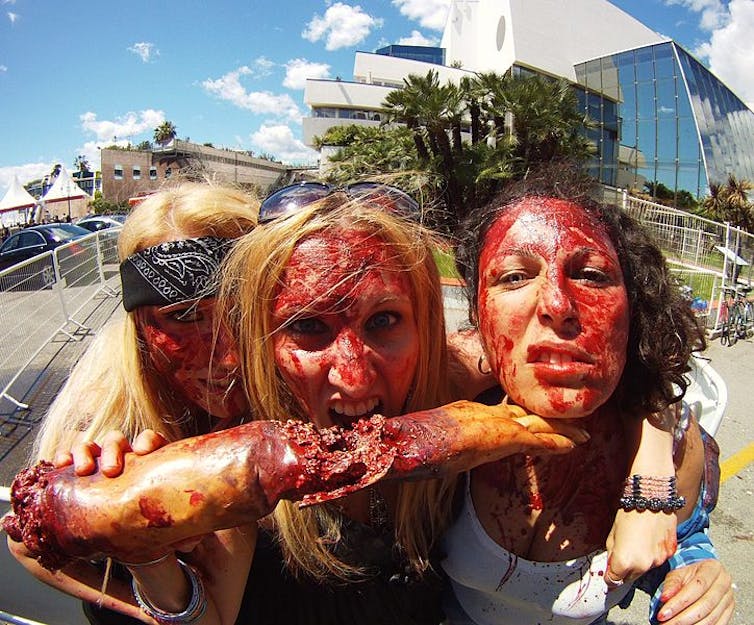
What if, in the midst of the current crisis, the main threat were not so much that of “zombification” as that of the de-civilization of human beings? “The zombie embodies change,” director George Romero told *Positif* magazine in 2008.
For the father of modern zombies, what matters is how people react to the disaster, not the threat itself.
Olivier06400/Wikimedia, CC BY

What the zombie metaphor tells us is that it is up to us to alleviate the burden of our primal fears, to free ourselves from the dictates of the survival instinct, from primal fantasies, and from the consumerism to which we are prey (just as much as we are to viruses).
Ultimately, “complex” entities like zombies place in our hands the “Gospel of Perdition” so dear to Edgar Morin. They are complex entities because zombies manifest themselves not only as a social phenomenon (notably with the recent trend of “zombie walks”), as transmedia products (film, literature, comics, video games, and music) but also in medicine—with conditions whose symptoms evoke the putrefaction of zombies (such as Buruli ulcer)—in the natural sciences (with the manipulation of their hosts by certain parasites), and in philosophy (with the concept of the philosophical zombie).
Sharing the Earth with an infinite number of microbes has always been humanity’s lot, and will continue to be so for a long time to come. Moreover, the living world displays a blind indifference to the fate of its components. If humanity were to disappear (or at least change its behavior), the rest of the biosphere would likely be all the better for it, as suggested by the dramatic decline in pollution levels in China.
In the face of infectious diseases that remind us of our animal nature, we must respond not only with stricter hygiene measures and more research, but also with greater humanity—that is, with brotherhood, solidarity, creativity, and collective intelligence.
This article was co-authored by Joachim Daniel Dupuis, Ph.D., a film professor and author of the book *Romero and the Zombies: Autopsy of an Undead* (L’Harmattan, 2014).
Abdel Aouacheria, biologist, research fellow at the CNRS, specialist in cell life and death, University of Montpellier
This article is republished from The Conversation under a Creative Commons license. Readthe original article.