Is “Let’s Block Everything” really Season 2 of the Yellow Vests movement?
Social unrest and political crisis. Amid echoes of recent struggles and persistent political tensions, “Let’s Block Everything” reveals the vulnerabilities of a representative system facing multiple sources of social anger.
François Buton, ENS Lyon and Emmanuelle Reungoat, University of Montpellier
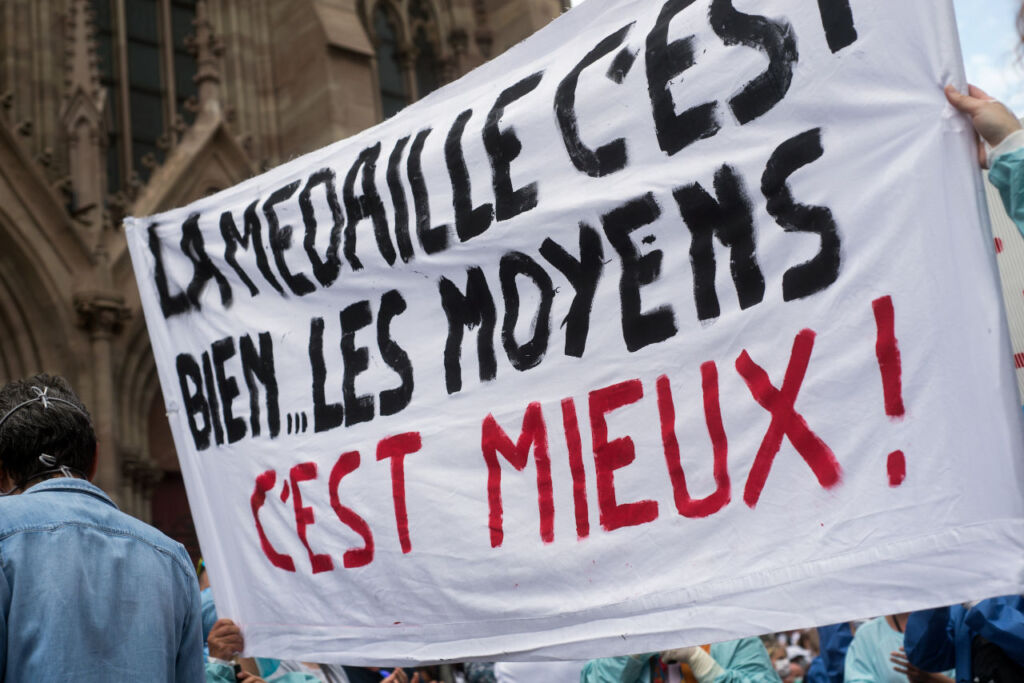
Launched in July, the “September 10 Movement” or “Let’s Block Everything” has become the focus of attention from society, the government, politicians, the media, and local intelligence agencies. Several aspects of this movement clearly echo those of the Yellow Vests movement, which emerged in November 2018. It is a grassroots mobilization, launched by various pre-existing organized groups but amplified by social media (especially Telegram), lacking leadership but structured around websites (Indignons-nous and Les essentiels ), which immediately reveal a marked diversity among protesters—ranging from those with a strong sovereignist stance and advocates of a Christian France to others identifying with the radical left.
Opposition to the budget proposal
While the protest movement has put forward numerous demands—some more elaborate than others—at first glance it appears to be driven by concerns over purchasing power and the condemnation of inequality: Opposition to Prime Minister François Bayrou’s proposed budget—criticized for shifting the burden of deficit reduction (40 billion euros in cuts) onto workers, the unemployed, salaried employees, those in precarious employment, and the sick—echoes the sense of injustice felt by the Yellow Vests following the announcement of a new fuel tax. The draft finance bill is criticized by all political forces opposed to the government and appears to be poorly received by the public, who support the upcoming movement, according to a widely cited poll conducted on August 20 and 21 (Toluna Harris Interactive for RTL).
Thus, 59% of French men and women support the goal of reducing public spending, but 63% support the movement (70% say they favor protests, 58% favor blockades), with 75% opposing the elimination of two public holidays and 71% in favor of a “solidarity contribution paid by the wealthiest French citizens.” For several weeks now, the organization of local assemblies, the creation of maps showing upcoming rallies, and the variety of planned actions—ranging from civil disobedience to blockades of production sites—have also been reminiscent of the 2018 protests.
The Yellow Vests and Other Struggles
The comparison with the Yellow Vests therefore makes sense, and is frequently drawn in the comments: the Yellow Vests are on “everyone’s mind,” whether as positive or negative role models, or as sources of hope or concern. For those of us who have long studied this movement, the comparison is relevant but a delicate one to navigate. A direct comparison should not obscure the historical context of these struggles: the Yellow Vests movement serves as a precedent; potential protesters on September 10 may have participated in it, acquired protest skills, and learned lessons about the movement’s effectiveness, its limitations or dead ends, its duration, and the repression it faced.
But the history of social struggles is rich with other protests, both before (Nuit debout) and, above all, after 2018: massive demonstrations against pension reform, farmers’ protests (some wearing “yellow hats”), occupations against highway projects (A69) or agricultural projects (Sainte-Soline), various strikes, the movement opposing the health pass, and even a massive petition (with over 2 million signatories) against the Duplomb law last July. It is therefore necessary to take into account the lessons learned from all these mobilizations as preparations are made for September 10 in various parts of the country.
Comparing the “profiles” of the Yellow Vests and potential “blockaders” is no easier, not only because, by definition, we do not yet know who the blockaders are, but at best only a portion of those who are mobilizing on social media and who agree to answer questionnaires, or those who gather in assemblies—but also because we still need to define who qualifies as a Yellow Vest before presenting their profiles.
The Yellow Vests are here, but not all of them
In our own research, for example, we chose to focus on “super Gilets”—most often first-time protesters who were intensely committed (sometimes to the point of self-sacrifice) and involved for a long time (some still are!) in a local group. These “Yellow Vests” are not representative of the movement as a whole, where others were more experienced activists, and the vast majority of whom participated in only a few protests or assemblies: surveys estimate that 3 million citizens took part in at least one Yellow Vest protest in 2018–2019.
When we contact them to ask what they think of “Bloquons tout,” what they’re doing, and what they plan to do, the answers vary widely. Some, decked out in their vests, have taken over local assemblies or Telegram channels, just as they have in most protests over the past seven years; others, on the contrary, are following from a distance or up close, waiting to see what happens—disillusioned by the supposed political “co-optation,” skeptical about the chances of success for yet another street protest, or disheartened by the lack of public support and the severity of the crackdown, including judicial measures, during the 2018 movement (“let others take the plunge”).
There are many different stances, which we can explain in detail in each case, but we know that they do not all represent “the” Yellow Vests. One thing is certain: some Yellow Vests are there, and others are ready to join in.
But one major difference from the Yellow Vests—precisely because this movement began earlier—lies in the intense media attention the “Let’s Block Everything” movement has been receiving over the past few weeks. While failing to mention the protesters’ immense distrust of the media (we can bet this issue will resurface with the first demonstrations), the media are providing extensive coverage of the preparations, asking the usual questions: Who are the blockaders? Who can represent the movement or even serve as its leaders? Who is “behind” it? What do they want? What should we expect—or even fear? However, the intense media attention has undoubtedly had the effect of rattling political and union leaders of all stripes—if they hadn’t already taken the initiative themselves.
Beyond "co-optation"
Another major difference from 2018—when political parties and unions had ignored or even condemned the November 17 protests—lies in the early politicization of the upcoming protests. The term, which has several meanings, does not refer for us to the “co-optation” of the movement by any particular political force—an expression that is widely used but falls into a stigmatizing political category. Rather, it refers to the idea that all forces in the political arena are agreeing, despite their differences, to redefine the movement and its demands as political—that is, as falling under “political” democracy (elected officials and parties) and “social” democracy (unions). On the one hand, the labor confederations are calling for another “mass mobilization” on September 18, amplifying the strikes announced here and there; on the other hand, since the “political return” following the summer universities in mid-August, party leaders have been taking sides—either in support of or against the movement—and debating the legitimacy of its demands and methods of action.
The most spectacular political move, of course, came from Prime Minister François Bayrou, who announced on August 25 that he would put his government’s responsibility on the line by calling for a vote of confidence in the National Assembly on September 8 on his controversial budget bill. This dramatic decision effectively brought the political agenda back to the forefront: praise or criticism of the move (a return to parliamentary democracy, according to Jean-Luc Mélenchon), various consultations, and statements on specific points of the bill (notably the elimination of two public holidays). The rejection of the confidence motion—which is a foregone conclusion—will plunge the country into a political, if not institutional, crisis likely to dominate the media agenda at the expense of the social “crisis.”
So today, it seems as though elected officials are regaining control at the expense of ordinary citizens. François Hollande’s latest remark ( “I cannot associate myself with something I do not control”) reveals, in this regard, a kind of unconscious attitude on the part of the political class, which claims to “hear the exasperation” but is willing to engage only in what it controls—namely, political and institutional games—and to give the people a voice only through the electoral process.
Social Movements as Forces for Change
In doing so, elected officials are displaying a blindness that never ceases to amaze. Another lesson from the Yellow Vests movement, in fact, is that it has profoundly transformed its initial protesters —if not into activists, then at least into citizens who feel they are finally worthy of being heard, capable of debating and taking a stand on political and even institutional issues (such as the RIC) that affect the country, and who refuse to settle for simply casting a ballot every five years.
What we read today in Telegram channels or hear in the first local assemblies attests to the same resolve not to be treated like children and sent back to our daily toil on the grounds of a supposed lack of “credentials to speak” (Jacques Rancière). Distrust of national elected officials, which was strong in 2018, is even stronger today: the so-called “popularity ratings”—to the extent that they have any meaning at all—indicate that the most “popular” opposition figures enjoy the trust of, at best, one in three citizens.
It is doubtful that the French are fascinated by the petty maneuvering of an institutional and political crisis, since those in power do not listen to them—neither when they demonstrate en masse (against pension reforms) nor when they vote against the majority (in 2024, which is reminiscent of the 2005 referendum), and respond with citizens’ conferences or major debates —the results of which they ignore—and with increasingly violent repression.
In this context, “Block Everything” can mean many things: for some, it means creating chaos in a country that is already “blocked”; for others, the real problem is the stagnation or closure of the political arena, which seeks to reserve decision-making solely for representatives (unions and political parties). The Yellow Vests didn’t just protest a tax; they also learned along the way to propose a different form of democracy. Perhaps it is time to recognize that social movements offer solutions, not just problems.
François Buton, Research Director at the CNRS, ENS Lyon and Emmanuelle Reungoat, Associate Professor of Political Science, University of Montpellier
This article is republished from The Conversation under a Creative Commons license. Readthe original article.