COVID-19: Is This the Straw That Breaks the Camel's Back?
Protests and the crisis in Hong Kong (a key hub for wine in Asia) in 2019, Brexit, U.S. sanctions (Trump tariffs), and now COVID-19: developments in international trade in recent months have been anything but boring, and the wine industry—which relies heavily on exports—is inevitably feeling the impact.
Carole Maurel, University of Montpellier

The wine market has weathered many crises and has proven to be resilient. However, according to forecasts by IWSR, global wine sales could decline by 13% in 2020 due to the current crisis, reflecting a more severe impact than during the 2008 financial crisis.
These cyclical challenges are creating significant uncertainty among businesses—many of which are small and medium-sized exporting companies—and are exacerbating certain structural challenges that these businesses had still been able to manage before the COVID-19 pandemic.
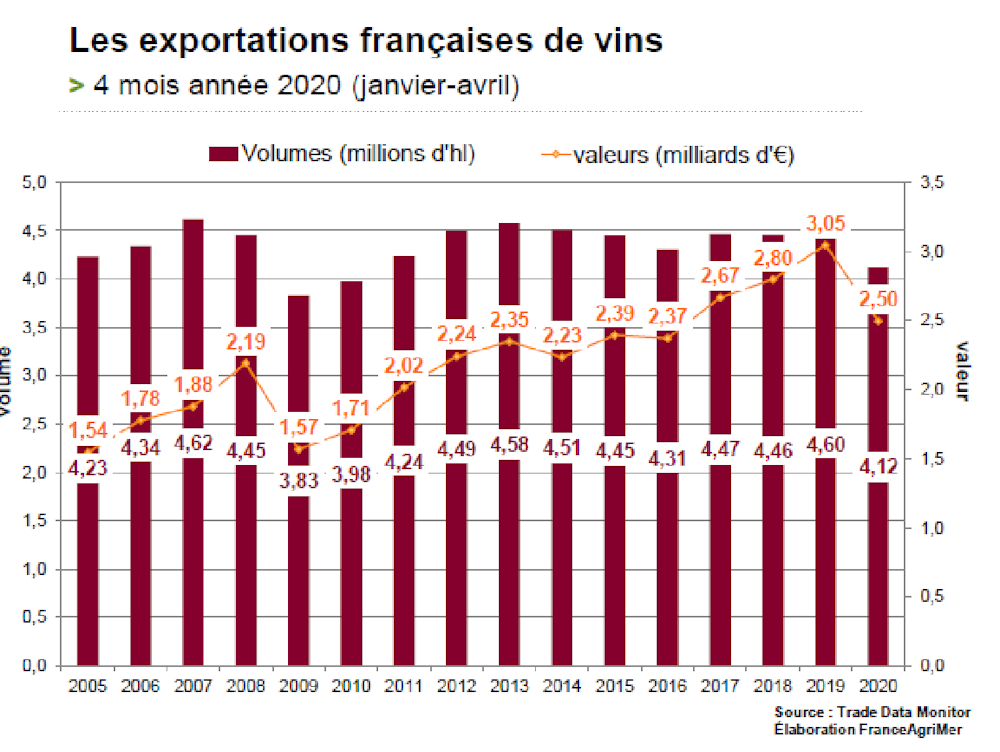
FranceAgrimer Economic Outlook Report
The latest economic report from FranceAgrimer (July 2020) confirms the downward trend in French exports over the first four months of 2020 (-16% in volume and -36% in value compared to April 2019) across all wine categories, with a sharper decline for Champagne.
Let’s take a look at France’s global rankings in 2019:3rd in terms of vineyard area,2nd in production and consumption,3rd in export volume, and, most notably,1st in export value, ahead of Italy and Spain.
Thus, the current situation unfortunately serves as a real-world example of the impact of the environment on export performance and the health of wine businesses, as well as the need to foster the resumption of trade relations and initiatives to develop and promote sales.
Website
Given this unprecedented situation, we analyzed the content of 238 articles retrieved using the search engine of Vitisphère—a portal offering news, networking opportunities, and specialized services dedicated to professionals in the “vine and wine” industry—over the period from March1, 2020, to July 26, 2020.
The goal of this initiative was to use a dynamic approach to assess the impact of the current health crisis on exporting companies in the French wine industry, as well as to examine the initiatives and responses of industry stakeholders to this crisis. Here are some of the key findings gathered during our study over the past five months.
International and domestic sales are sluggish
As a direct result of the lockdown and border closures—from China in January to Europe in February and March and the Americas in March—international business came to a standstill during this period. This is evidenced by the numerous postponements of international trade shows to the summer of 2020 or even 2021.
These events are essential for the business growth of companies in the sector, and their postponement further hinders their international operations—even though innovative initiatives, such as online trade shows, have emerged. These postponements result in reduced cash flow and missed opportunities to develop and maintain networks with both French and international clients.
Another sign of the halt in international activity is the disruption of the supply chain: overcrowded ports, and port and airport operations at a standstill.
Similarly, the lockdown and border closures forced sales teams to halt their travel, particularly for export-related activities, which were replaced by a shift to remote work—a necessary measure to maintain business relationships from a distance.
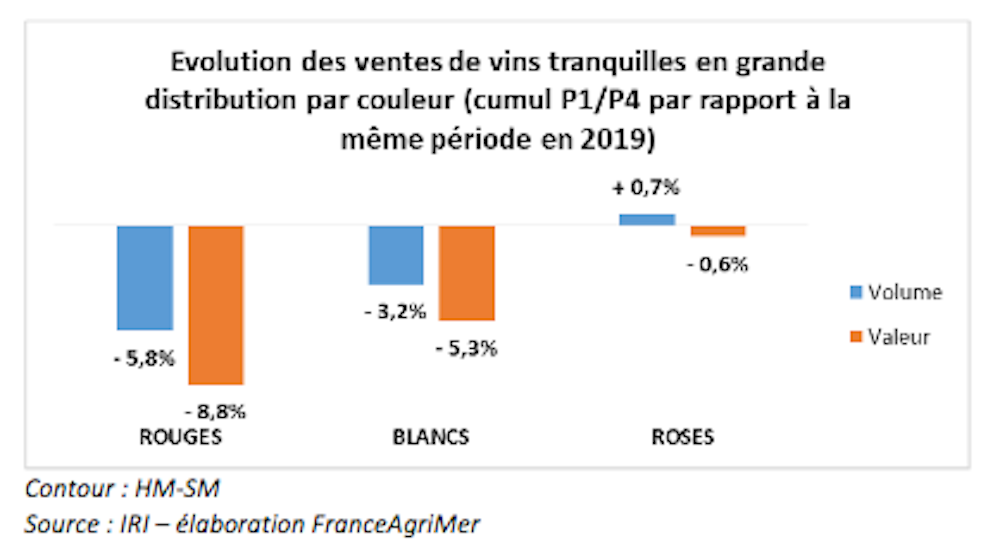
IRI for FranceAgriMer-CNIV
In addition to this halt in international trade, the health crisis has led to a decline and a shift in consumption in the domestic market: the cancellation of spring wine fairs at supermarkets, and the suspension of operations at cafés, hotels, and restaurants (CHR), as well as wine tourism.
See also:
What COVID-19 Reveals About Wine-Drinking Cultures Around the World
FranceAgrimer’s economic report confirms the decline in AOC (Appellation d’Origine Contrôlée) sales, the stability of PGI (Protected Geographical Indication) sales, and the sharp increase in “bag-in-box” sales (wine dispensers).
A sharper decline is expected in the high-end segments, particularly due to the closure of restaurants, hotels, and bars, as well as the cancellation of social gatherings caused by the lockdown. However, the impact on industry players varies depending on two factors: their level of dependence on these channels and the situation in the production region prior to the crisis.
In fact, private wineries appear to be more affected than cooperative wineries, due to their heavy reliance on sales at their own tasting rooms, to the hospitality sector, and to wine tourism—factors compounded by the slowdown in exports.
Furthermore, in Bordeaux, for example, this crisis is exacerbating the difficulties faced by the industry, which for the past two years has been experiencing a slowdown in domestic and Chinese consumption in particular, and is already grappling with structural overproduction due to changing consumer preferences and the need to shift toward more sustainable practices —not to mention the numerous weather-related challenges of 2020.
The Rise of Online Shopping
As early as the beginning of March, journalists were speculating that some of the lost international demand would shift to the domestic market and that this would present an opportunity for e-commerce (atrend confirmed bya study from IRI showing a 179% increase in online sales in March and April).
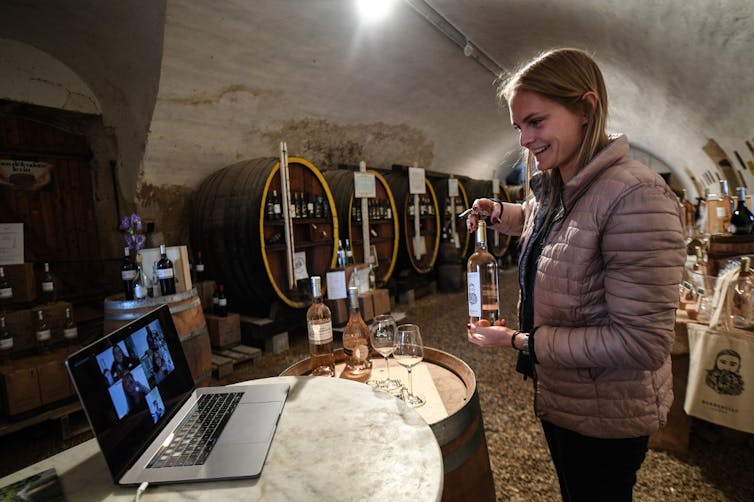
In addition, the lockdown provided an opportunity for some winemakers to innovate and launch their own online stores, enabling them to ship to customers in France and across Europe. Others began offering home delivery or “click-and-collect” service at their wine cellars.
Anne-Christine Poujoulat/AFP
The same upward trend can be seen in auctions. For example, in Hong Kong (the world’s leading market for online wine auctions), an increase in online sales—replacing in-person auctions—was already evident as early as March 2020. It remains to be seen whether these trends will continue in the coming months.
Surplus inventory is a cause for concern
One key factor is on everyone’s mind amid this decline in sales opportunities for wine both in France and abroad: excess inventory (estimated at 3 million hectoliters by industry experts).
Inventory is an essential part of the operating cycle for companies in the industry and significantly contributes to their cash flow needs.
Declining sales, lower yields, and unpredictable weather—all these factors are disrupting the balance of inventory management for industry players. We now fully appreciate how critical this is to the long-term viability of these businesses.
That is why the entire industry has been lobbying the European Union, the French government, the regions, and banks over the past five months to secure measures and assistance to manage these excess inventories, with an eye toward the 2020 harvest, for which storage capacity must be freed up.
Emergency distillation and private storage were at the center of the discussions, along with requests for exemptions from social security contributions due to a loss of business and for assistance with promotion and marketing.
Vitisphère website
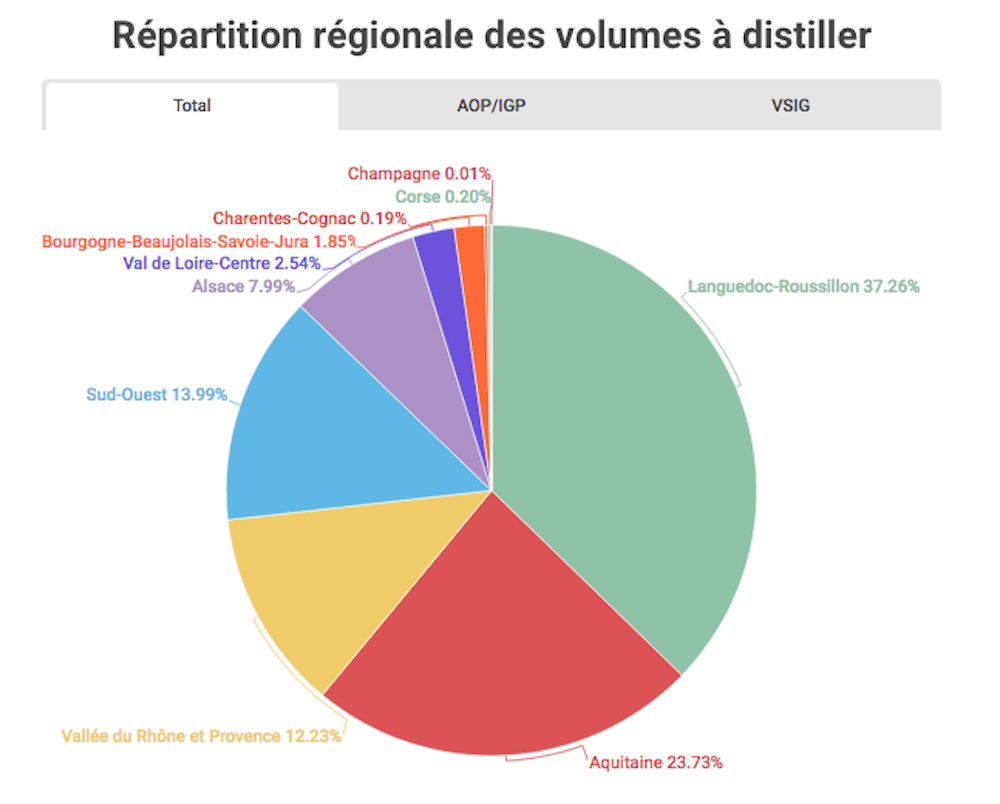
However, not all producers and regions have the same needs when it comes to assistance—the Bordeaux region and Languedoc have a greater need for distillation (they account for 60% of the requests) than regions such as Champagne, Burgundy, or Alsace, for example.
Other complementary measures are under consideration, such as individual supplemental quotas, the interprofessional reserve, and the possibility of increasing the proportion of the 2019 vintage in the 2020 vintage.
Given climate change and the likelihood of future crises, it is essential to develop a toolkit for managing both downward fluctuations (such as low harvests) and upward fluctuations in wine inventories, which affect companies’ financing needs and operational risk and threaten their long-term viability.
This toolkit will need to take into account the diversity of situations and the profiles of the stakeholders involved, as this crisis shows us once again that the wine industry has many facets and that a single, one-size-fits-all solution is not appropriate.
Finally, while for some the current crisis has provided an opportunity to demonstrate solidarity (donations of alcohol for the production of hand sanitizer, charity sales, and the promotion of wine tourism), this period above all represents an opportunity to reflect on the future, strategy, and business plans.
Moving forward, players in the wine industry have no choice but to draw conclusions from the trends revealed during the crisis: corporate social responsibility, online sales, and the expansion of “bag-in-box” sales in the hospitality sector to reduce the carbon footprint, among other things. These are all challenges that must be addressed during this period of uncertainty for the French wine industry and its long-term viability.
Carole Maurel, Associate Professor of Corporate Finance and International Management, University of Montpellier
This article is republished from The Conversation under a Creative Commons license. Readthe original article.