Crusoé: Mimicking Nature's Language to Repel Mosquitoes
In conjunction with the Innovation Awards ceremony taking place in July, theUM is honoring its past winners. Today, we feature Claude Grison, recipient of the 2020–2021 Innovation Award. As director of the ChimEco laboratory, this chemist and her team have developed an innovative mosquito repellent using a blend of natural molecules that are harmless to humans. Named Crusoé, this repellent draws direct inspiration from nature.
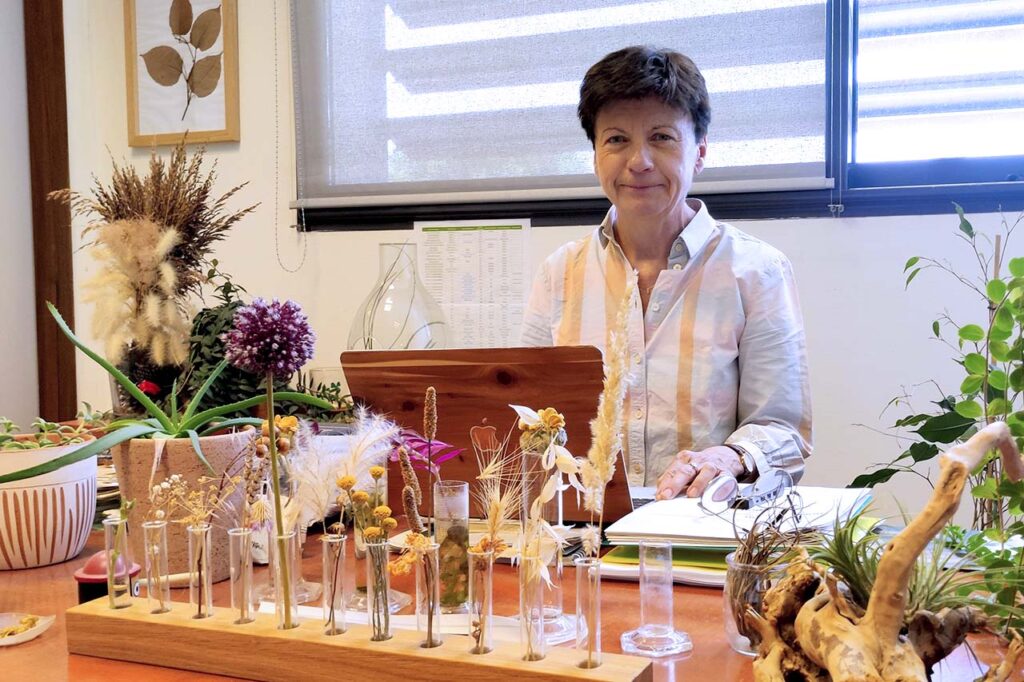
Claude Grison is the woman who whispers in the tiger mosquito’s ear. As director of the ChimEco laboratory for bio-inspired chemistry and ecological innovations (CNRS/University of Montpellier), the researcher embarked on this adventure in 2017. At the time, frustrated herself by this insect that ruins our summer evenings, she realized that the repellents on the market were either ineffective or entirely chemical-based. “The most effective molecule so far has been DEET. However, it’s a chemical molecule ill-suited to the mosquito’s biology. And recent studies have shown that it can be harmful to health,” explains Claude Grison. Conversely, she also noted that, in this area, no one had yet drawn inspiration from how nature works. “We understand nature’s communication methods when it comes to attraction, but I was surprised to see that the same reasoning hadn’t been applied to repellents.”
100% bio-based and with no environmental impact
Straddling the line between sustainable chemistry and ecology, Claude Grison has therefore made it her mission to address this scientific oversight. “The mosquito has more than 100 olfactory receptors, and numerous other receptors are involved in chemical communication with its environment. The goal, therefore, was to develop a repellent using a combinatorial approach to trigger a strong reaction—whether pleasant or unpleasant,” the researcher explains. Her goal at the time was to find the right combination of natural molecules so that they would be recognized by as many receptors as possible.
After promising initial trials, the CNRS awarded her a grant of 140,000 euros to fund the project’s “pre-development” phase. “It turns out that one of the most effective natural repellent molecules is also very rare. So we had to synthesize it. And my challenge—to stay true to my values and my work—was to produce it using entirely natural processes. Our syntheses are based solely on plant-derived materials. They are 100% bio-based and have no environmental impact, ” insists Claude Grison.
The Ecocatalysis Method
To achieve this, the ChimEco laboratory team used the ecocatalysis method, developed in situ by the researcher. The principle: “using the mineral resources of certain plants to transform them into catalysts.” This innovative process has resulted in 36 patents and earned Claude Grison numerous awards, including the CNRS Innovation Medal in 2014. Using this method, the researchers conducted more than 4,000 behavioral tests on over 24,000 insects. To refine their mixture, they also carried out 300 molecular syntheses. These experiments were conducted at Vectopôle Sud, a consortium comprising nine partners (including CIRAD, the CNRS,IRD,EID, the University of Montpellier, andANSES).
Specifically, the tests involved placing 10 mosquitoes in a cup attached to a membrane coated with repellent on one side and animal blood on the other. After an hour, the mosquitoes were asleep; they were then collected one by one and crushed on a sheet of paper so that researchers could examine the number of blood spots—that is, the number of insects that had actually bitten the skin… “We worked nonstop for two and a half years, with almost no vacations, since mosquito behavior differs between winter and summer, ” explains Claude Grison. In short, it was intense work—and it quickly hit the mark. The researchers soon identified two combinations of molecules with very strong repellent effects. According to Claude Grison, this product, named Crusoé, is about 90% effective, compared to 55% for DEET under the study’s conditions. And it’s also proving very promising against tick bites…
“I wanted it to be useful to society”
In 2021, through her startup Bioinspir—which had previously focused on invasive plant species—Claude Grison partnered with Technofounders. Together, they co-founded a company called Laboratoire Bioprotection to produce and market Crusoé. “I wanted it to be useful to society, so we needed to find a partner who shared our ethics to bring the repellent to market. The CNRS and the university, which jointly own the patents on ecocatalysis, never stood in our way—quite the opposite,” says Claude Grison. From a more pragmatic standpoint, this partnership allowed her to round out her expertise in regulatory and administrative matters; “That was the only thing we were missing, ” adds the scientist, and it also enabled her to increase the company’s capital through CNRS Innovation, which facilitated this on behalf of the CNRS and theUM as part of a debt-for-equity swap.
That same year, the team also received support through the “Companies And Campus” call for projects, launched as part of the University of Montpellier’s Muse program of excellence. The result: an additional budget of 50,000 euros—a crucial boost as the team was finalizing the last details before bringing the product to market. “It was incredibly important. It allowed us to make progress on the regulatory side, but also to validate our formulation on wild mosquito strains in tropical regions,” explains Claude Grison.
Shortly thereafter, in just six months, Crusoé obtained Ecogarantie certification and made its way onto pharmacy shelves. Since then, more than 400,000 products have been sold in France and internationally. At the same time, Claude Grison has also been showered with awards for her famous patents. In 2022, for example, she received the European Inventor Award from the European Patent Office, followed by the Influential Woman Award in the economics category in 2023. But between one award and the next, she never stopped working on what came next. Now, for instance, she aims to launch a version of Crusoé designed to repel bed bugs. Together with her team, she is also working to develop a diffusion technique for use in homes.