Cyberkinetosis, or Virtual Reality Headset Sickness
It’s a fact. We experience difficulties when we put on a virtual reality (VR) headset. Discomfort, sweating, drowsiness, headaches, and even nausea during prolonged use—we’re all pretty much in the same boat and find this experience quite unpleasant.
Benoit Bardy, University of Montpellier
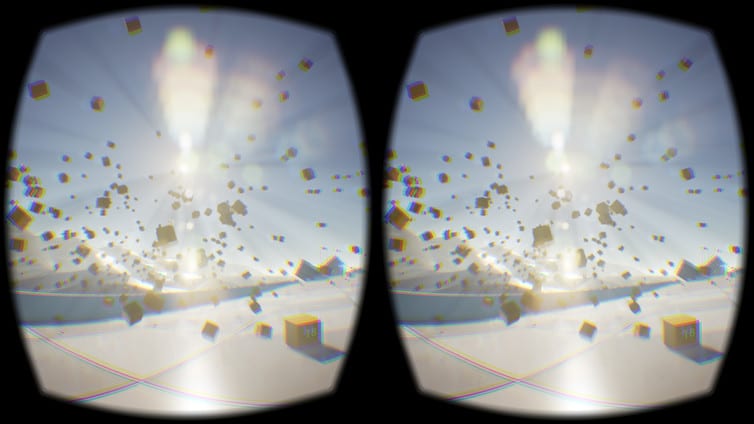
At a time when the great leap toward the virtual world seems to be taking hold, and virtual reality headsets are becoming more widespread, it’s all a bit of a mess. Let’s call this phenomenon “cyberkinetosis,” in reference to the English term cybersickness. The motion sickness refers more broadly to motion sickness, or travel sickness, since it occurs not only when traveling by boat, of course, but also by car, train, and sometimes by plane.
The causes of cyberkinetosis are partly specific to VR headset technology and partly common to other situations that cause motion sickness. Among the reasons specific to VR is the technology’s early stage of development, which introduces a series of inconsistencies. For example, the delay in the sensorimotor loop (between the moment we move our head and the moment the image inside the headset is updated) ranges from 50 to 200 milliseconds. This causes all sorts of neurophysiological disturbances. For example, the functioning of the vestibulo-ocular reflex which allows you to keep your gaze in the same direction when you turn your head.


Mikael Häggström — Image: ThreeNeuronArc.png, CC BY-SA

The headset’s interpupillary distance, the fixed distance between the eye and the screen, the long image refresh rate, the limited resolution, and the crude overlap of the right and left fields of view create numerous distortions that result in incorrect geometry of the virtual scene’s spatiotemporal structure. These inconsistencies are not merely intra-sensory or inter-sensory; they are also sensorimotor—or, we might say, motor-sensory. Indeed, it is our movements that reveal these inconsistencies, triggering an unrealistic, destabilizing action-perception loop that induces motion sickness.
These limitations are significant but not insurmountable. Technology is advancing. The new headsets on the market have already corrected the errors of their predecessors, offering new features such as eye-tracking, which allows the image rotation to follow the movement of the eyes. Latency and resolution have improved considerably, providing a realistic sensorimotor loop that helps limit our nausea responses.
Conflict Among the Senses
The second category of reasons is more fundamental: it concerns the relationships between our senses, a topic of great interest in cognitive science and neuroscience sometimes referred to as multisensory integration. The classic theory of the onset of motion sickness is based on the rarely questioned assumption of a conflict between our senses.
However, the idea that our senses are in conflict—and therefore can deceive us—is not easy to accept. How can we walk, run, grasp the objects around us, play sports, dance, drive our car, in short, perform hundreds of daily motor actions—sometimes with extreme precision—in an often-changing physical environment, such as in a car or on a train, while having to be wary of these sensory inputs that we ourselves have created and that are supposed to help us move efficiently? Something doesn’t add up.
Are we sick when we’re calmly driving our car on the highway? When we take the elevator? When we walk on a treadmill or on the beach against the wind? As a very general rule, the answer is no.

Clicsouris/Wikipedia, CC BY-SA

However, for example, walking on a treadmill means that the visual input reaching the eye results not only from the horizontal forces generated to move forward but also from the speed of the treadmill; the visual feedback is therefore clearly at odds with the proprioceptive and vestibular feedback. Basically, our eyes make us feel as though we’re moving twice as fast as our feet! And half as fast when we’re walking on the beach against the wind.
These examples suggest that the lack of redundancy among our senses is not abnormal: we could even say that it is more the rule than the exception, that every physical situation introduces multiple covariations (rather than conflicts) among our perceptual modalities. In fact, the subtle division of labor among our senses—each with different detection thresholds and sensitive to complementary physical quantities—exists precisely to cover the full range of situations we might encounter and, with rare exceptions, to provide us with accurate information about the reality of our interaction with the world.
Our movements are relative
Proponents of an explanation for motion sickness based on conflict theory often overlook the physics of the world we live in! It is possible to be simultaneously moving vertically relative to the Earth and stationary relative to the visual environment. This visuopropriocognitive configuration indicates that we are, for example, in an elevator. The reason, of course, is that our movements are relative; they depend on the reference frame (terrestrial, gravitational, inertial) in which they are observed, and it is quite common to be stationary relative to one reference frame while moving relative to another. Our senses, working in tandem, are highly effective at detecting these relative persistences and changes.
So why do we get seasick? Because these situations are unusual, they require new sensory interactions, and the sensorimotor connections involving this new relationship must be established—a process that requires a slow adaptation.
Acquiring a steady foot on the sea—enabling one to become a true sea dog—follows this path. On a ship’s deck, we must learn to control our balance based on these new sensory relationships, anticipate the deck’s movements and the disruptive effects of the swell, and build this new sensorimotor loop that is better adapted to the moving platform. This process takes time; it causes significant destabilization, and it is this loss of stability that causes motion sickness.
A new postural theory of motion sickness has gradually emerged over the past 25 years, attributing the causes of motion sickness to a loss of stability in the sensorimotor loop. This theory predicts that postural instabilities occur before the onset of motion sickness. In fact, it is not—or not solely—because we feel sick that we are unstable; it is also, and above all, because we are unstable that we feel sick. This theory simply explains why women are often more susceptible than men, due to a different distribution of body mass, and why children are more susceptible than adults, because their growth continuously alters their balance.
This theory simply explains why, in a car, we are more likely to feel sick as passengers than as drivers (the sensorimotor loop is absent in the former case but present in the latter), and why, on the deck of a ship, fixing one’s gaze on the horizon helps reduce seasickness. The horizon is, in fact, a stationary singularity in the optical flow; it provides a reference point that helps stabilize our postural oscillations.
Check Your Posture
When applied to the use of VR headsets, a postural theory of cyberkinetosis is currently being developed, drawing on experimental data as well as the subjective experiences of gamers and VR software developers. Technological tricks—such as a virtual nose positioned between the two visual fields or a fixed reference point—as well as scenarios that limit jerky head and eye movements and promote situations involving active postural control, are emerging intuitively. These techniques and scenarios, combined with the rapid evolution of headset technical specifications, improve motor control and thereby reduce cyberkinetosis.
A multisensory simulator unique in France—iMose—was recently installed at the EuroMov center in Montpellier.
 Thanks to its extraordinary dimensions (an RV gondola at the end of a 7-meter-high robotic arm) and its 6 degrees of freedom, it makes it possible to artificially create and manipulate all kinds of sensory relationships. Research programs on cyberkinetosis are underway, as well as broader studies on multisensory motion control, disorientation among pilots, the dynamics of adaptation to these unusual situations, individual and cultural differences, and the role that virtual reality can play in learning and rehabilitation. This technology platform is open to researchers and industry professionals in the field who wish to explore these scientific questions and test their virtual reality equipment.
Benoit Bardy, Professor of Movement Sciences, Director of the EuroMov Center, Senior Member of the Institut Universitaire de France (IUF), University of Montpellier
The original version This article was published on The Conversation.