[LUM#21] On the Island of the Cyclone
Leaves torn off, branches snapped, trunks broken, trees uprooted… When the wind blows at speeds approaching that of a TGV, how can trees withstand it? This is a crucial question for the forests of the Southwestern Pacific islands, which face between five and eight cyclones every southern summer—cyclones that shape these island ecosystems.
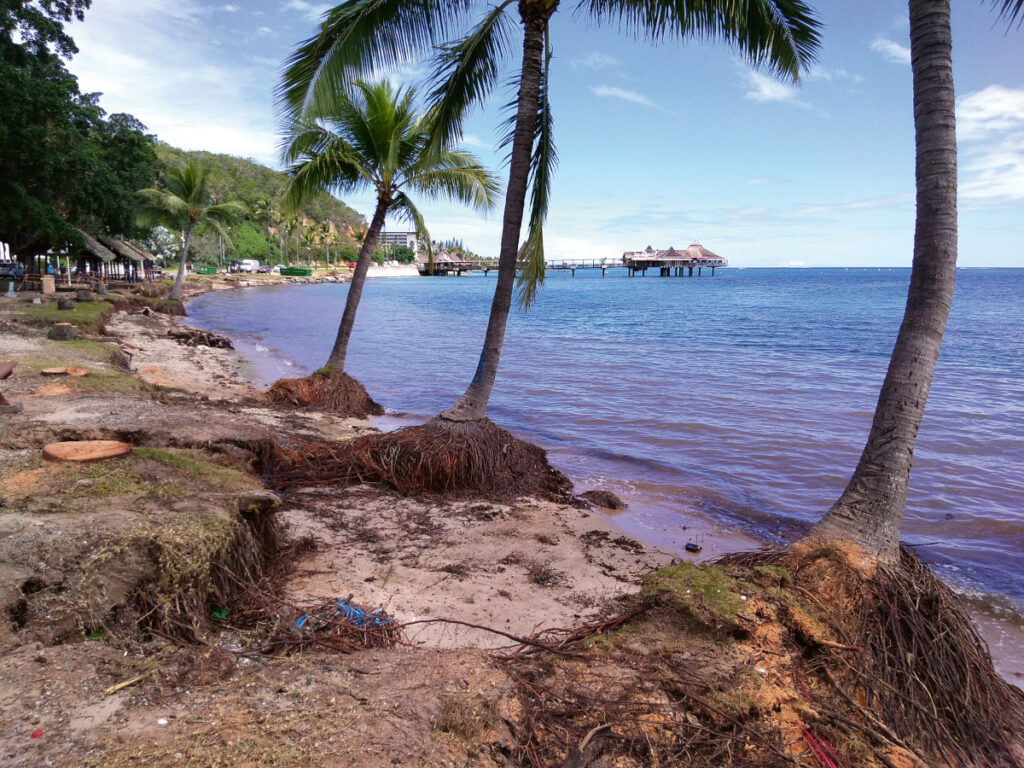
How do tropical forests survive hurricanes? To better understand these ecosystems, Thomas Ibanez, a researcher at the Amap laboratory1, took part in a study analyzing the resilience of forests to cyclones across 76 islands in New Caledonia, Vanuatu, Wallis and Futuna, Fiji, Samoa, and Tonga. Between 2000 and 2020, 74 cyclones swept through the region, with varying effects on the vegetation. “We wanted to characterize, in relation to the strength of the cyclones, the extent of the changes the vegetation underwent and the time it takes for it to recover to its previous state,” explains the tropical forest conservation specialist.
Forest Resilience
This study drew on several disciplines, from remote sensing to modeling, to reconstruct the paths of cyclones and wind speeds, and to visualize the condition of the forests before and after the storms. “For the strongest winds, which reach 280 km/h, vegetation loss reaches 40 percent and the regeneration time exceeds five months, ” explains Thomas Ibanez. And in 20 percent of the areas affected by these devastating winds, the forest still had not regenerated after one year.
“The resilience of forests has limits that may be exceeded in the future because, with global warming, the cyclones affecting this region could intensify—not in frequency but in strength,” explains Thomas Ibanez. The warming of surface waters, which are the birthplace of cyclones, will have another significant consequence: a change in their trajectory. “Some forests that have been spared until now are at risk of being swept away by these violent winds, ” the researcher points out.
Adaptation
How will trees that have been caressed by gentle breezes until now react to the storm? “Some are better adapted—the small, stocky ones, those with less foliage and therefore less surface area exposed to the wind,” explains Thomas Ibanez, who also discusses possible adaptation strategies in which trees would shed their leaves and branches more easily to increase the chances of saving the trunk.
“We also want to determine which characteristics of trees make them more resilient—height, diameter, wood density—but it is difficult to conduct experiments designed to simulate wind stress.” To get as close as possible to these island forests, Thomas Ibanez will be settling in New Caledonia for three years to study the impact of cyclones on the structure and functioning of the forests. “Islands are hotspots for biodiversity; they account for only 6.7% of the Earth’s land area but are home to 20% of the world’s biodiversity, 50% of species recognized as threatened, and 75% of known extinctions.”
Check out theUM podcasts, now available on your favorite platform (Spotify, Deezer, Apple Podcasts, Amazon Music, etc.).
- Amap (UM, CIRAD, CNRS, INRAE, IRD)
↩︎