[LUM#14] Canned Bluefin Tuna
A tireless traveler, the bluefin tuna covers thousands of kilometers over the course of its life. What does it do during its travels? To shed some light on the private life of this large fish and gain a better understanding of its population dynamics, marine biologists and microelectronics are working together.
It can grow to over 3 meters and weigh more than 600 kilograms— "the size of a cow." It lives for nearly 40 years and travels up to 200 kilometers in a single day. The bluefin tuna: a migratory fish whose name has long been associated with overfishing, but which is now thriving. “Atlantic bluefin tuna was overfished starting in the mid-1990s, but since 2012 the stock has been recovering, ” explains Tristan Rouyer. Overfished, and yet still poorly understood. “We still don’t know much about the population dynamics of tuna, ” says the researcher from the Marine Biodiversity, Exploitation, and Conservation Laboratory (Marbec*). The reason? The difficulty of tracking such a large and highly mobile animal.
“To study wild animals like bluefin tuna in their natural habitat, we use electronic tagging,” explains Vincent Kerzérho. The problem is that the systems used to track the fish are very expensive. “Between 3,000 and 4,000 euros per animal, ” says the researcher from the Montpellier Laboratory of Computer Science, Robotics, and Microelectronics (LIRMM**). That’s a hefty price tag for a single-use device. “And a major obstacle when you consider that studying a population on a large scale requires collecting a lot of data.” To overcome these challenges and improve our understanding of these large fish, researchers from both laboratories have decided to work together.
Fishing with the Experts
A collaboration that began in 2015 with the Popstar and FishNship projects. “We set out to find experts in microelectronics to develop new solutions, ” recalls Tristan Rouyer. Together with his colleague atIfremer, Sylvain Bonhommeau, the biologist then went in search of collaborators and secured the team led by Serge Bernard and Vincent Kerzérho at the LIRMM. “We hit it off right away, both scientifically and personally.”
Their mission? To develop cheaper and more comprehensive tracking devices. “Commercially available devices only include three sensors designed to measure pressure, temperature, and light in order to determine the fish’s location, ” explains Vincent Kerzérho. While these measurements make it possible to track the tuna’s movements, they provide no information about the animal’s physiology. “We know where it is, but we don’t know what it’s doing there. Is it hunting? Reproducing? Is it building up reserves or, on the contrary, using them up? Yet this information is crucial for understanding the life cycle of tuna and their migratory patterns,” explains Tristan Rouyer (see sidebar).
Libra
Microelectronics specialists have therefore developed a new sensor that not only tracks the fish’s location but also provides information on its fat content. “We use bioimpedance, a technique developed in the medical field—the very same one used in scales that measure body fat. ” These sensors must also withstand a hostile environment—saltwater and the pressure found at depths of up to 1,000 meters, where tuna frequently venture. And they must also meet the challenge of battery life. “Tuna spend a lot of time at depth, which makes continuous data transmission impossible. So we designed a system that detaches on its own after 6 months to 1 year. It then rises to the surface, where it finally transmits the collected data, ” explains Vincent Kerzérho.
Precise timing
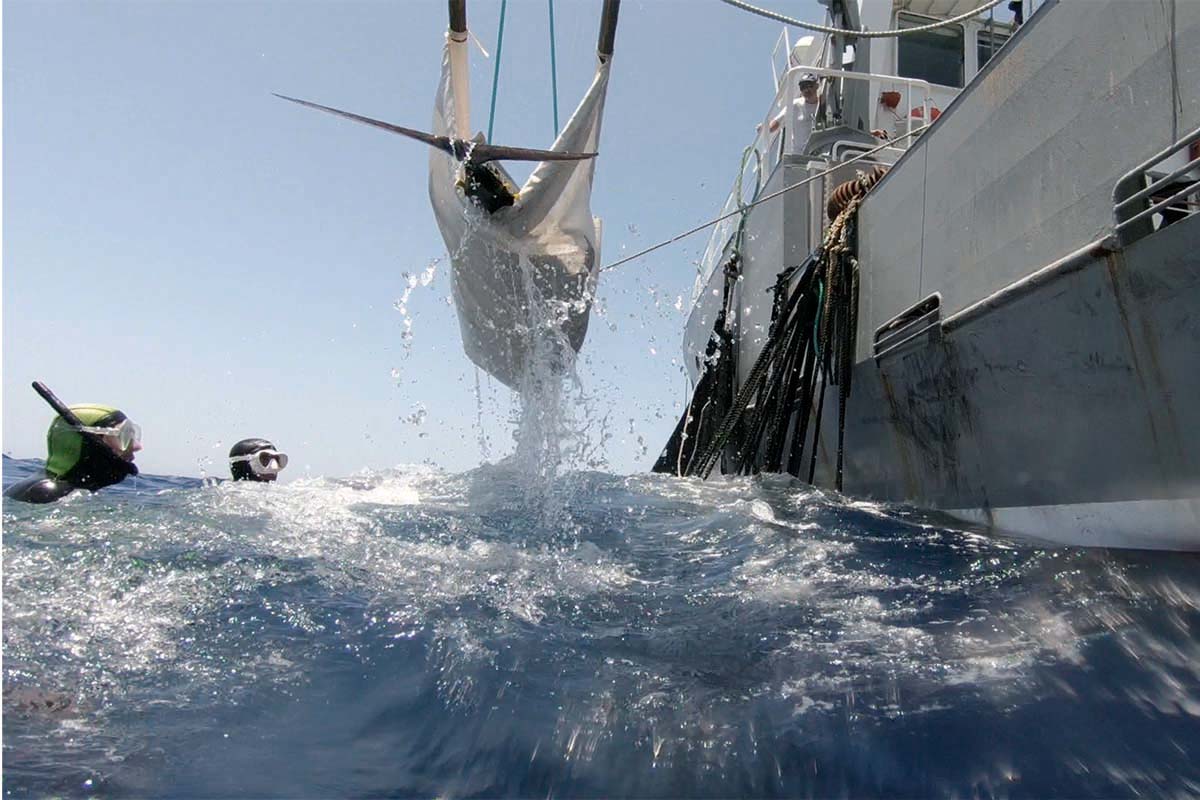
A technical challenge has been overcome, with a microelectronic device measuring just a few square millimeters, connected to electrodes that must be implanted in the fish’s flesh. That’s where another challenge begins… Because, as Tristan Rouyer points out, “tagging a 250-kilo tuna is complicated.” And for good reason: you have to pull this enormous fish out of the water. “Which is what we did with the help of the Sète fishermen from SATHOAN.” Tuna fishing is done using a seine—a massive net with which the boats encircle schools of fish. The researchers take advantage of this to capture individual fish during a meticulously timed operation. A line with a hook is cast into the seine; the tuna that bites is hoisted aboard on a stretcher and then intubated on the boat, where it spends less than two minutes— “just long enough to set up the equipment.” The fish is then released and continues on its way, with the researchers following in its wake.
Transatlantic
Since 2018, scientists have tagged eight tuna, thereby collecting valuable data. “One of the tuna tagged in the Mediterranean traveled as far as southern Iceland and then on to Canada before crossing the Atlantic again and returning to the Mediterranean, ” explains Tristan Rouyer. This year-long journey provides a more detailed understanding of the migration routes taken by these long-distance travelers.
And this is just the beginning: the researchers hope to tag more tuna to gather even more data. “This information is invaluable, because a better understanding of these populations’ migratory dynamics allows us to better understand how they use their habitat, particularly in relation to environmental conditions,” explains Tristan Rouyer, who also emphasizes the importance of this knowledge for anticipating potential changes linked, for example, to global warming. “The more we know about the species, the better we can protect it.”
Long-distance migrant
A long-distance traveler, the bluefin tuna has long kept the map of its journeys a secret. Its migrations serve two essential purposes: feeding and reproduction. “The bluefin tuna reproduces in the warm waters of the Mediterranean. Outside this breeding zone, it roams the colder waters of the Atlantic in search of food, traveling as far north as the coastal waters of Norway and Canada, where it hunts herring and mackerel,” explains Tristan Rouyer. During this time, it can gain 30% to 40% of its body weight, which it then loses during the breeding season.
See also
*Marbec (UM – CNRS – IRD – Ifremer)
**Lirmm (UM – CNRS)