From Facebook to Plant Growth: When Social Media Gets Involved
Telephone networks, social networks, road networks, professional networks… The term “network” has now become part of everyday language. A computer network consisting of interconnected computers, or a subway system in which stations are connected by lines, are two intuitive examples.
Jérémy Lavarenne, French National Research Institute for Sustainable Development (IRD)
Quinn Dombrowski/Flickr, CC BY-SA
The graph theory, when applied to the real world through network theory, teaches us that networks possess intrinsic mathematical properties. These properties make it possible to study them formally, thereby enabling us to better understand—and even anticipate—the behavior of the systems that networks describe.
What is a network?
Wiktionary defines a network as a “set of objects or people that are connected or linked,” but also as “the set of relationships thus established.” There are several ways to represent a network, the most common and intuitive of which is in the form of a mathematical object called a graph. A graph is defined as a set of nodes and edges connecting those nodes. It may include an additional layer of information, such as assigning a weight to nodes to represent the relative importance of an object, or the directionality of edges to distinguish the direction of the relationship between two objects. For example, on the microblogging network Twitter, the connection between a follower and the account being followed is not necessarily reciprocal: the interaction is directed and can be represented by an arrow extending from the follower and pointing toward the account being followed.
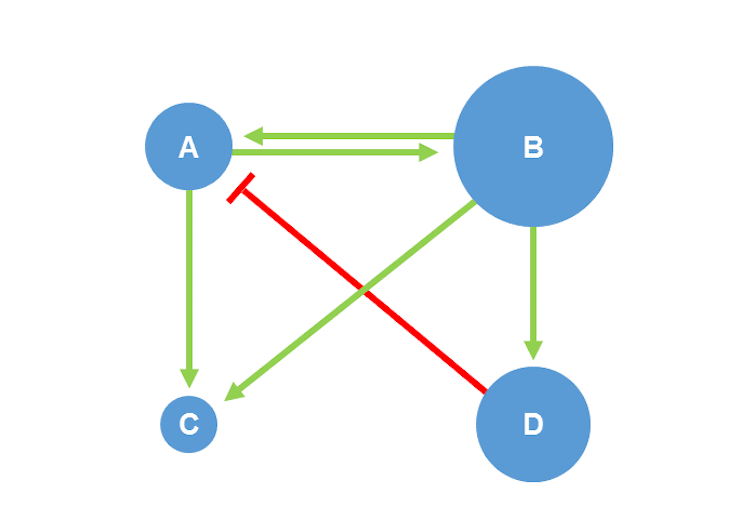
The Internet, ecosystems, the human brain, economic organizations… Graphs thus make it possible to represent—or “model”—and analyze a wide variety of complex systems. This makes these approaches all the more interesting, since complex systems are defined by behavior that is difficult to understand and predict based solely on individual knowledge of their components.
Network Analysis: A Wide Range of Applications
Combined with ever-increasing computational power, contributions from graph theory and advances in algorithmics provide us with a set of tools that enable us to extract information from large-scale networks. It is, in fact, common to encounter graphs composed of thousands of nodes and tens of thousands of edges, the information contained within which may seem difficult to grasp at first glance.
A well-known and amusing example illustrating the value of network analysis comes from the social sciences. Identified by Wayne W. Zachary between 1970 and 1972, “Zachary’s Karate Club” is a graph documenting 78 affinity links among 34 members of a martial arts club. Interested in the role of information and sentiment flows in the fragmentation of small groups, the author applied an algorithm that grouped members sharing the strongest affinities with one another to hypothesize about the formation of subgroups that might result from a potential conflict. Interestingly, such an event occurred during the study, causing an actual split in the group—identical, to within one person, to what was predicted by the affinity network analysis—and validating Zachary’s model with 97% accuracy.
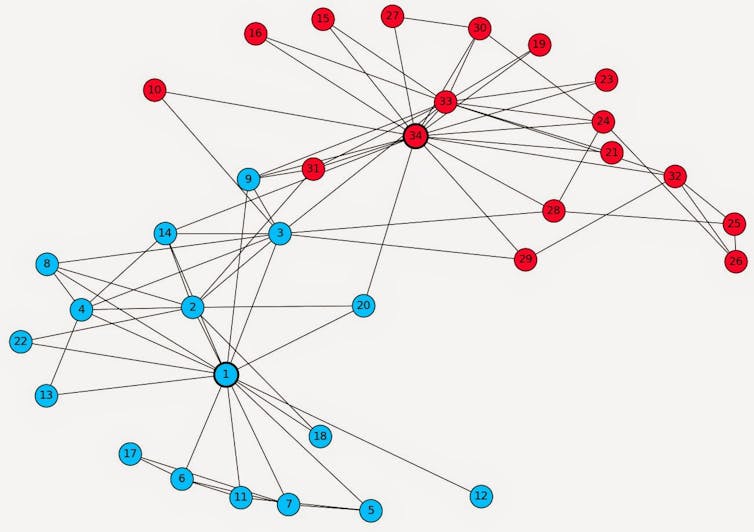
Historical DataNinjas Blog
Another example, drawn from the field of ecology and visualized in 2016 by Mauro Martino based on the research of Guo and colleagues, presents a network composed of different plant species (nodes) that share at least one species of symbiotic ants (edges). Here, analyzing the network as part of a simulation of the gradual and random disappearance of certain ant species as a result of climate change allows us to estimate the network’s resilience—that is, its ability to withstand environmental changes while remaining capable of performing its functions. This approach thus provides an additional indicator, alongside existing ones, to describe the fragility of ecosystems in the face of climate change.
Root Development in Cereals
Climate change is also expected to have a significant impact on agricultural activities and yields, due to changes in rainfall patterns that lead to more extreme weather events. To compensate for these fluctuations, agronomists and biologists agree on the importance of research focused on the root system—the “hidden half” of plants. The root system is on the front lines when the soil is water-deficient (drought) or contaminated by excessively high levels of sodium chloride (salinization). Cereals—and in particular the Poaceae family, which includes rice, corn, and wheat—constitute the direct or indirect source of nearly half of humanity’s dietary calories. To adapt plants to these consequences of global climate change, it is therefore strategically important to understand, on the one hand, the genetic determinants of root system architecture. These can control, for example, the number or diameter of roots, as well as the angle or depth of rooting. On the other hand, it is important to understand the role of this architecture in making plants tolerant to these stresses.
In this context, my doctoral research focuses on understanding the early stages of root development in rice. At first glance, there’s no network in sight! However, one branch of network science takes a close interest in biology: the study of gene regulatory networks.
During a developmental process such as rootorganogenesis, specific genes are translated into proteins. Some of these proteins are involved in regulating other genes. One way to study a biological process is to identify the links between, on the one hand, the genes encoding regulators and, on the other hand, the genes whose expression they regulate, in order to begin modeling a gene regulatory network.
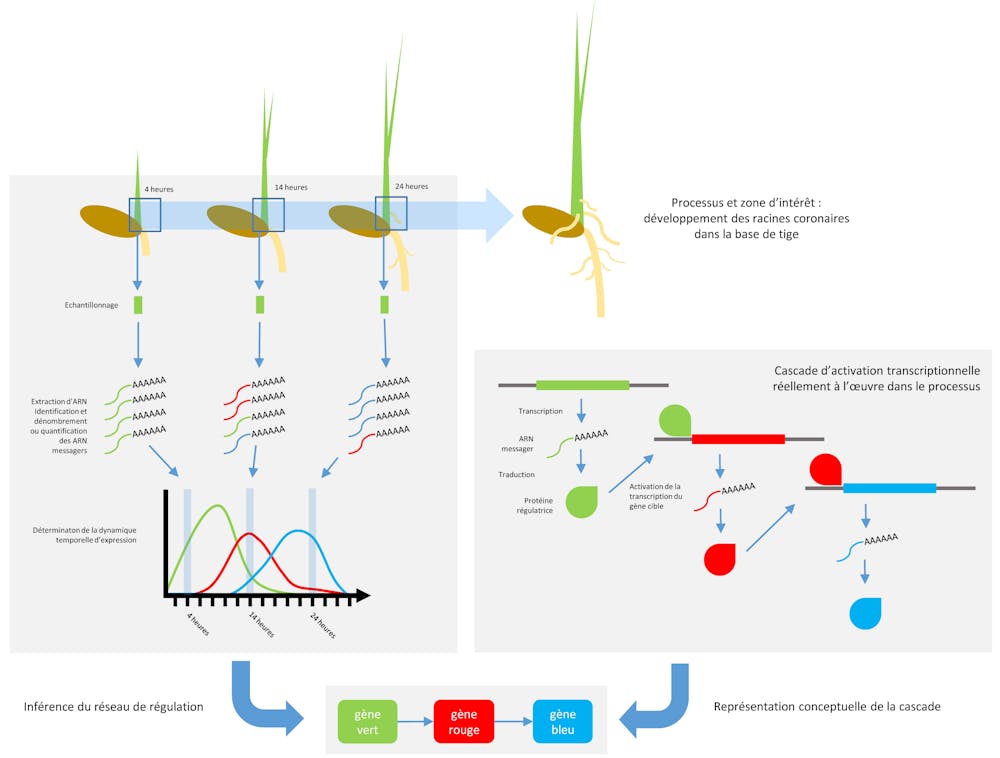
This is what we did to study and identify new genetic factors involved in the formation of crown roots—a type of root that emerges in a crown-like pattern from the stem internodes as the plant develops and constitutes the majority of the root system in cereals.
These crown roots make up the majority of the root system in cereals. To this end, and throughout the early stages of crown root formation in rice, we sampled the relevant organ at regular intervals. Thanks to recent advances in transcriptomics, we identified variations in gene expression levels during the developmental process of a crown root in rice. Using a subset of genes exhibiting significant variations in expression levels, we employed an algorithm that analyzes similarities and temporal shifts between gene expression profiles over time to predict which gene regulates which other gene. Based on this, we constructed a gene regulatory network model capable of explaining these variations in expression.
What apps?
From a fundamental perspective, the main benefit of analyzing this network is that it allows us to identify new connections between genes already known to be involved in root development, as well as genes whose role in this process was previously unknown. Furthermore, analyzing this network using clustering methods (as demonstrated in Zachary’s example) allows us to identify groups of genes that are more strongly connected to one another than to the rest of the network. Such sets, referred to as modules, are likely to play a role in a given biological function. Finally, identifying the most highly connected nodes in the network helps pinpoint the genes whose roles are crucial to the process as a whole.
In this regard, these so-called “systems biology” approaches—which consider a process as a whole rather than focusing on specific elements—are fundamentally valuable for formulating new hypotheses about how it functions. From an applied perspective, they can help identify new target genes for plant breeding—for example, in our case, to modulate root architecture and produce plants that are more tolerant to stresses such as drought. Finally, whether in basic or applied research, the predictive capabilities of systems-based approaches could reduce the time required to develop new plant varieties.
Recent advances in sequencing technologies (such as RNA-seq, for “RNA sequencing”) and methods for modeling and analyzing gene regulatory networks are making these technologies applicable to an increasingly broad range of crop species. This suggests that plant breeding activities—which until now have been based on selecting gene variants without considering their role in gene regulation—will be enriched by systems biology in the coming years. The role of the plant breeder could thus come to include functions related to “regulatory network engineering.” Varietal crosses and biotechnological tools would then have a role to play in adding or rewiring network nodes that control specific aspects of plant growth or stress response.
 To learn more about network science, we recommend reading the book *Network Science* by Albert-László Barabási, which is freely available on the author’s website. We would like to thank Antony Champion (IRD) for proofreading this text..
Jérémy Lavarenne, Agricultural Engineer, CIFRE Ph.D. Candidate at the University of Montpellier-Biogemma, French National Research Institute for Sustainable Development (IRD)
The original version This article was published on The Conversation.