[LUM#18] From the Sea to the Moon
Savoring cod aioli while overlooking Lake Félicité… A scene straight out of a science fiction novel that could one day become a reality thanks to the work of Cyrille Przybyla. His mission: to develop an autonomous, closed-loop aquaculture system to increase food security on Earth—even if it means reaching for the moon.
In 2015, astronauts on the International Space Station tasted the first lettuce grown in space (Sciences et avenir, March 6, 2020). Since then, radishes, wheat, and even chili peppers have taken root at an altitude of more than 400 kilometers. This is a luxury when most of the food available on board is irradiated, freeze-dried, or canned—but it’s not enough to satisfy hunger either, especially with an eye toward future missions to the Moon.
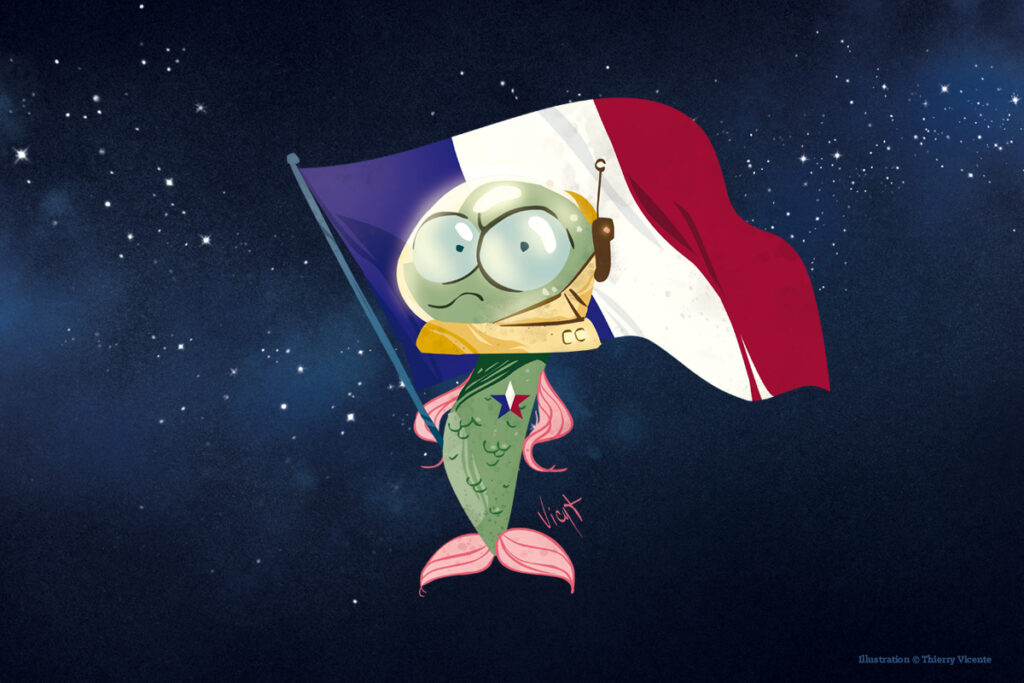
So how can we ensure that these astronauts get their share of protein—especially animal protein—as well as vitamins and omega-3s? Thanks to fish! Except that, barring a miraculous catch, there’s little chance of spotting even a fish’s tail in the Sea of Serenity. It’s to address this lunar challenge that Cyrille Przybyla, a marine biologist at the Ifremer L-3AS laboratory, a member of the Marbec* laboratory, and a specialist in integrated multitrophic aquaculture (IMTA), has taken his hands out of the water and reached for the sky. “I work on Earth. My goal is to successfully raise fish in a closed-loop system by integrating multiple organisms—hence the term ‘multi-trophic.’ It’s somewhat similar to the principle of a permaculture vegetable garden.”
Everything Changes
In this closed, controlled cycle, “nothing is lost, nothing is created, everything is transformed”—as Lavoisier might have said a second time. “The key word here is circularity,” explains the biologist. “Everything the fish excretes in solid and liquid form must be recoverable and reusable by having it converted by other organisms.” ” Thus, worms or sea cucumbers will be used to break down the fish’s feces while also serving as a potential food source for the fish.
The CO₂ released by the fish, like the ammonia produced by their digestive systems, can serve as a basis for microalgae cultivation. “These microalgae, in addition to purifying the water in the tanks, can be incorporated into feed, thereby eliminating the need to catch wild fish to feed farmed fish. And we’re the first to do this,” continues Cyrille Przybyla. In short, it’s a win-win system on every front: water savings, reuse of biologically valuable compounds, preservation of biodiversity, and, finally, an increase in global food security.
Land-based food
“The FAO (Food and Agriculture Organization) is very interested in this biologically autonomous system, which could therefore serve as an excellent source of nutrition in geographically isolated areas or in poor and extreme environments. ” And what could be more extreme than the Moon? Vibrations, hypergravity, microgravity, radiation… The researcher—who also holds a university diploma in celestial mechanics and is a graduate of the International Space University—had to set up a whole range of tests as part of the Lunar Hatch project to assess the resilience of fish in space. Or rather, fish eggs, “because what’s expensive in space is weight, and you can fit 200 eggs into a small 10×10 cm cube, whereas it would take more than 1 m³ to send 200 adult fish.”
This small cube in question is a CubeSat developed in collaboration with the Montpellier University Space Center (CSUM), with which the biologist is working to conduct these launch simulation tests. “We exposed sea bass eggs to the same vibrations as those experienced on a Soyuz spacecraft for ten minutes, then brought them back to Palavas to study the rest of the embryogenesis process. A total of 162 eggs hatched—the same results as in our test group—so this first step has been validated,” explains Cyrille Przybyla.
Aim for the Moon
To test resistance to hypergravity—that is, acceleration ranging from 1G to 5G— the European Space Agency funded the rental of a centrifuge and a microgravity simulator. “We based our tests on the Soyuz launch acceleration curve and observed no effect on the hatching rate of the eggs. ” While radiation tests conducted in collaboration with the Institute for Radiation Protection and Nuclear Safety (IRSN) are still underway at the Atomic Energy Commission’s facility in Cadarache, the initial results there are also encouraging, though new questions arise at every stage. “We’re able to hatch these eggs, but are our fish born stressed? Does radiation cause DNA damage? In short, are the tiny larvae we’re bringing into the world viable in a lunar environment?” wonders the biologist.
These are all questions he will need to answer before 2032, the scheduled date of the European Space Agency’s next biomission, which will carry nearly 2 metric tons of biological experiments to the Moon—among them, perhaps, our 200 little “fishonauts.” In the meantime, Cyrille Przybyla has flown to Florida for two months at NASA’s invitation. This is a major achievement for someone who admits to having “always had this idea in mind. I’ve combined my passion for space exploration with a conviction and expertise gained from 20 years of research on fish production systems in controlled environments. It is by confronting the extreme constraints of space that we will overcome challenges here on Earth.”
Check out theUM podcasts, now available on your favorite platform (Spotify, Deezer, Apple Podcasts, Amazon Music, etc.).