Debate: Smile—You're Being Watched!
In 2011, the former president of the CNIL, Alex Türk, predicted the end of privacy by 2020. Have we reached that point with the “StopCovid” app?
Florence Rodhain, University of Montpellier
The debate and vote scheduled for today in the National Assembly have drawn the ire of some 500 cybersecurity experts and civil liberties activists, who are warning of the potential abuses of such technology.
But beyond the use of such tools, the real issue at stake is the acceptability of widespread surveillance of the population. Will history remember COVID-19 as the moment when citizens en masse relinquished their civil rights for public health reasons?
Two tactics appear to be used in tandem to exert pressure on the population: fear (Big Brother) and entertainment (Big Mother), for it is true that, in psychoanalytic theory, the father or big brother is the one who enforces the law, while the mother is the one who cares for others in the broadest sense of the term (nourishment), but she is also the one who provides entertainment.
Toward Widespread Surveillance
Data surveillance is already, in a sense, widespread. Who can still believe that our conversations remain private, regardless of the medium used or the safeguards invoked?
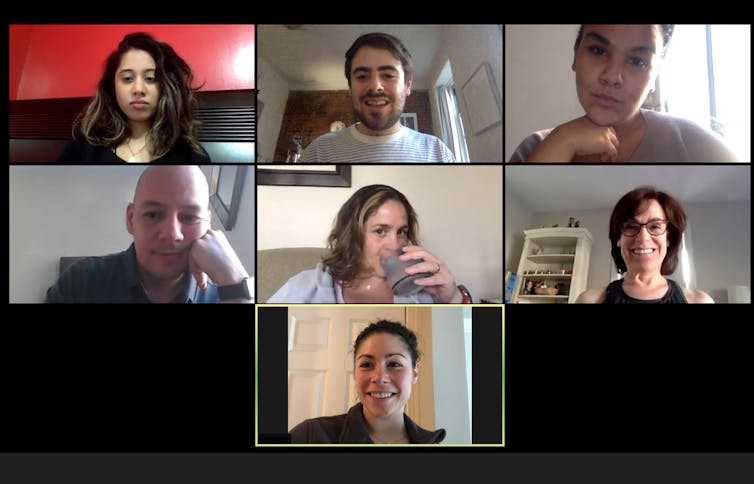
The lockdown saw a massive surge in downloads of video conferencing apps such as Zoom and Houseparty. With millions of downloads, Zoom is now among the top most-downloaded apps in the world. On March 22, 2020, alone, Zoom was downloaded more than 600,000 times. As of March 25, 2020, in France and dozens of other countries, Zoom was the most downloaded free app on smartphones. While Zoom had 10 million users in 2019, that number had grown to 200 million by March 2020.
Shutterstock
Zoom is used by many French universities as a platform for online classes and meetings. However, on March 26, 2020, it was revealed that Zoom had sent data about its users to Facebook without their consent, even though those users were not Facebook users. Furthermore, neither Zoom nor Houseparty encrypts conversations. In its privacy policy, Houseparty states that it:
"free to use the content of all communications sent through its services, including any ideas, inventions, concepts, or techniques," even for the purpose of "developing, designing, or selling goods and services."
Suzanne Vergnolle, a doctoral student in law specializing in personal data protection, explains:
"If you're a business, for example, and you plan to share confidential information, be aware that Houseparty and Zoom can access your conversations."
Furthermore, it is worth noting that these technologies are also used by the justice system, which recently approved the use of police drones to monitor lockdown compliance. French cities are now testing facial recognition for security purposes, with Nice leading the way in these experiments.
Implement "surveillance from below"
How can we compel people to accept such measures—or at least not to challenge them? The goal here is to foster voluntary compliance.
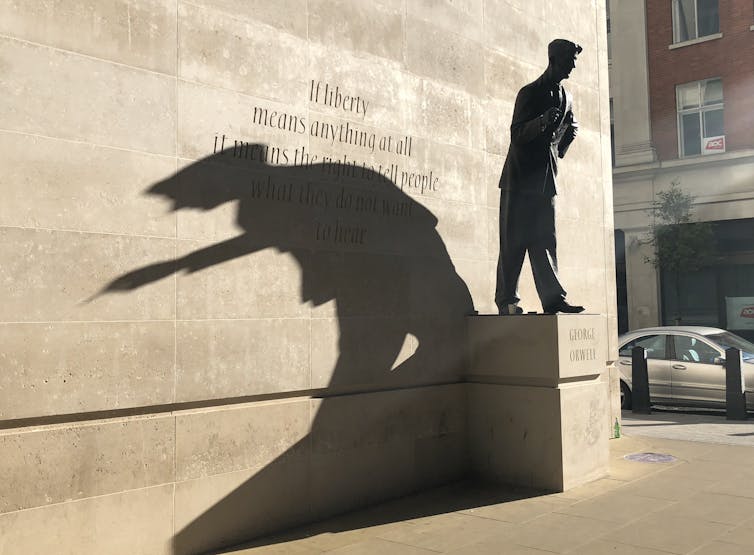
Rather than surveillance, we speak of the principle of “sousveillance,” in which the individual is no longer even being watched from above but rather is being watched from below through his or her digital traces—in a discreet, intangible, and omnipresent manner. In 1984, published in 1949, Orwell does not explain how Big Brother seized power, nor does he shed light on the process by which this society emerged; rather, he describes it in detail. And in many respects, we have already surpassed certain aspects of surveillance in that society.
Ben Sutherland/Wikimedia, CC BY-NC-ND

Thus, Orwell did not predict the portable telescreen or voluntary submission, but he had already warned against the idea of video surveillance (which, in his book, was carried out by the telescreen, similar to our contemporary connected screens). Nor did he predict that every individual would agree to submit to a widespread form of surveillance via a small, portable device that they would, moreover, have to pay for.
Big Mother: Entertain to Enslave
What Orwell did not predict was the recreational aspect attributed to this famous instrument of population control. If digital tools are so widely accepted, it is precisely because of this recreational aspect, which distracts users and, in doing so, lulls them into complacency.
This is where we need to draw on another, equally famous dystopia: Brave New World by Huxley, and the famous soma, which suppresses any inclination toward resistance. In this novel, citizens were strongly encouraged to use soma, which was officially presented to them as a simple medicine, when in fact it was a synthetic drug that, in high doses, could plunge them into a heavenly slumber.
Today's digital tools seem to combine the soma from *Brave New World * and the telescreen from *1984*.
Currently, teenagers between the ages of 13 and 18 spend 6 hours and 40 minutes a day in front of screens for entertainment, excluding any educational or serious use; this amounts to 100 days a year, or the equivalent of 2.5 school years.
More than 4 out of 10 students feel they can't go without their phones for even a single day.
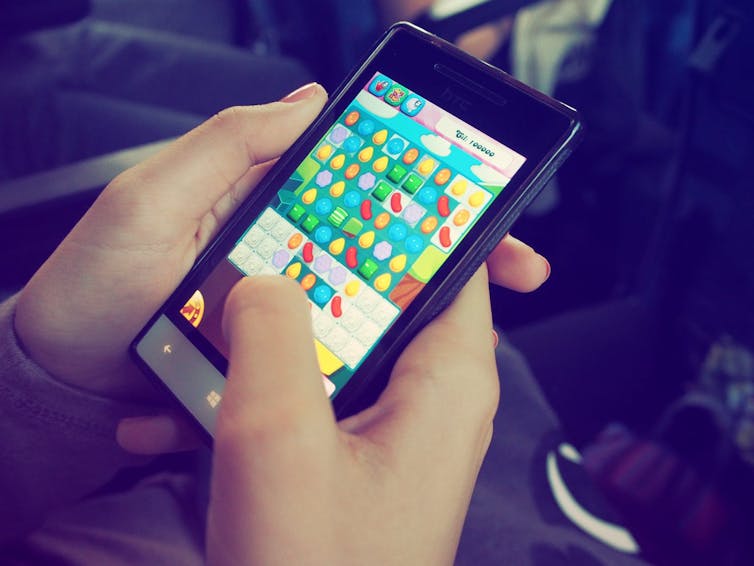
Digital devices have become an extension of the self, a prosthesis. In order to continue using their features—which are not only practical but also, and above all, entertaining—people are willing to sacrifice a little freedom, as if, on the benefit-risk scale, the benefits of using digital devices outweighed the risks of intrusion into their privacy.
Pexels, CC BY
Furthermore, digital devices are significant sources of distraction, detachment from learning, and academic difficulties in the classroom. An unpublished study we conducted over five years among post-baccalaureate students in France shows that students, using iPads distributed free of charge by higher education institutions, spend an average of 61 minutes out of every 1.5-hour class being distracted (by Facebook, video games, entertaining videos, etc.). Only 20% of their use of these devices is related to the class.
Every "like" received immediately triggers a release of dopamine— this is clearly evident when users are observed via MRI; it certainly corresponds to Huxley’s famous “soma”…
Big Brother: Scare to Subdue
National governments are invoking the language of war to combat COVID-19. Can this be a coincidence? War seems to justify behaviors that are prohibited in peacetime.
Every period of “war” is a time of risk for individual freedoms: it is a time of decisions made without consultation, a time of exceptions. But when it comes to digital surveillance, the exception quickly becomes the rule. This is what we have seen since September 11, 2001.
The most recent example in France: the state of emergency—an exceptional measure dating back to 1955 that is normally of short duration—was declared during François Hollande’s presidency on the evening of the November 13, 2015, attacks and was regularly extended until President Macron converted this emergency law into an organic law. This new law contains several new provisions regarding electronic surveillance; for example, suspects may be required to provide all of their usernames, passwords, etc.
As of November1, 2017, France officially emerged from a two-year state of emergency (a historic record) only to find itself subject to the anti-terrorism law. This law has been denounced as “a threat to civil liberties” by its opponents and criticized by UN experts.
However, the fear-mongering approach has found support among the public: 57% of French people supported the bill, even though 62% of them believed the law would “tend to erode their freedoms.”
Already, in the 2011 White Paper on Public Safety, the Ministry of the Interior highlighted the public’s likely resistance to new technologies that might be considered intrusive. For example, on page 180, it states:
"[...] the use of nanotechnology, particularly when combined with geolocation, is likely to raise concerns about the protection of individual freedoms."
The publication thus points out that:
“[…] the extent to which people perceive a ‘threat’ (whether for terrorist or commercial purposes) can contribute to a more favorable public perception of the company’s use of new technologies […].”
A Voluntary Easement
Fear of terrorism, fear of disease: this sentiment is fueled by uncertainty and a constant stream of carefully selected information—even information disseminated through popular entertainment. Proof of this is the success of old B-movies featuring zombies and other survivalist productions.
Entertainment, like fear, fosters a form of voluntary servitude that is also rooted in the pleasure of exhibitionist narcissism enabled by social media.
Benjamin Franklin is credited with the following quote: “If you are willing to sacrifice a little freedom to feel safe, you deserve neither.”
To which one might add: “If you’re willing to sacrifice a little freedom for a little entertainment, you don’t deserve either.”
Florence Rodhain, Associate Professor (HDR) in Information Systems, University of Montpellier
This article is republished from The Conversation under a Creative Commons license. Readthe original article.