[LUM#19] Sustainable Waste
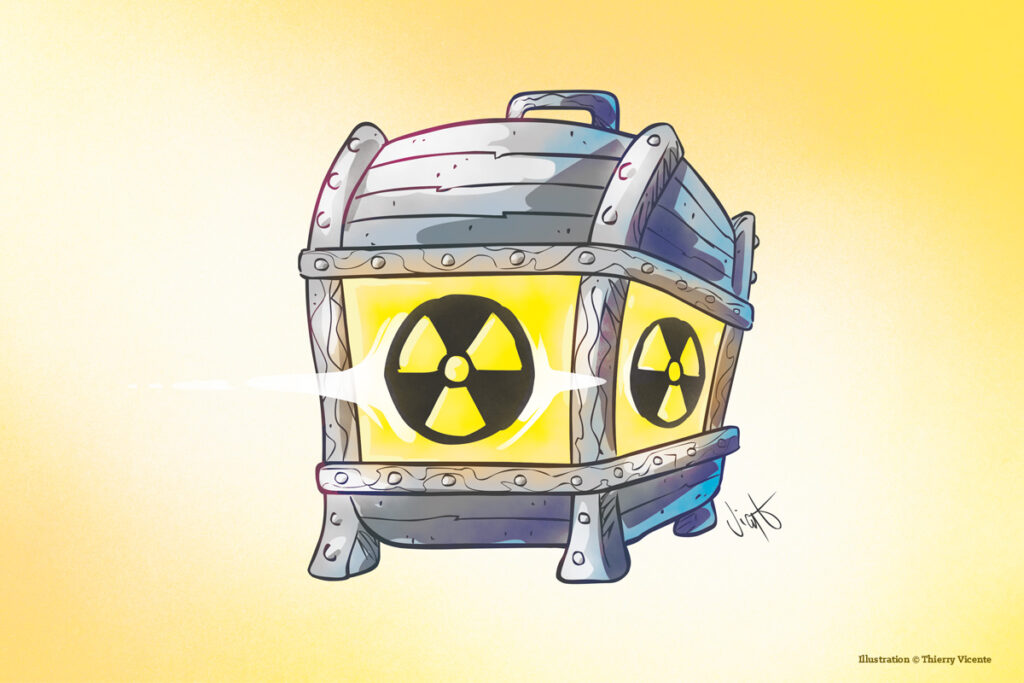
What should be done with the radioactive waste produced by nuclear power? This is a major challenge, given that some of it will continue to emit radiation for hundreds of thousands of years. The solution? Isolate and store it to avoid exposure. Xavier Deschanels, a researcher at the Marcoule Institute of Separative Chemistry*, explains how we manage these special materials.
Although nuclear power accounts for only 10% of global electricity generation, it is by far the leading source of electricity in France, with 70% of the country’s electricity coming from the 18 nuclear power plants located throughout the country.
A production process that emits only a small amount of greenhouse gases but leaves behind a bulky byproduct: radioactive waste. How can this unique waste be managed safely? “It all depends on the type of waste we’re talking about, because in reality there are different categories of radioactive waste,” explains Xavier Deschanels, a researcher at the Marcoule Institute of Separative Chemistry (ICSM). It is classified according to two parameters: the intensity of its radioactivity and the half-life of the radionuclides, which determines how long it will remain radioactive. Regardless of the type of waste, the principle is the same: isolate it as effectively as possible from the environment in order to minimize exposure to radioactivity. But the methods of isolation differ depending on the category of waste.
Packages in quarantine
“The vast majority of nuclear waste is short-lived. It accounts for more than 90% of the total volume of radioactive waste in France, but only 0.03% of the total radioactivity,” the researcher points out. For this waste, the chosen solution is surface storage. “It’s a highly organized process—it’s far from simply dumping waste. This waste is first packaged into bundles, meaning it is enclosed in a steel or concrete container after undergoing various treatments such as incineration and compaction, ” explains the researcher.
These unique packages are then sealed underground in reinforced concrete storage structures. “These structures are then sealed with a permanent cover consisting of several layers of natural materials, such as clay, to protect them from the elements and ensure safe long-term storage. They are then monitored for 300 years, after which they will no longer pose a radiation hazard, ” explains Xavier Deschanels.
Deep Landfill Disposal
300 years is a fraction of a second compared to the thousands of years during which so-called high-level radioactive waste will remain radioactive. While its radioactivity accounts for more than 95% of the total radioactivity of nuclear waste, its total volume represents only about 0.2% of the total volume of that waste. “That’s the equivalent of an Olympic-sized swimming pool since the beginning of the nuclear era in France, ” the researcher explains.
And for this category of waste, considered the most dangerous, surface storage is out of the question. The solution? Deep geological disposal. This waste is not buried as-is but undergoes complex technological processes. “Initially, it’s in the form of a highly radioactive liquid that we evaporate to obtain what’s called a calcined residue—a true concentrate of radioactivity—which is then mixed with glass powder to stabilize the inorganic materials.”
The end result is glass packages weighing about 400 kilograms each, with such high levels of radioactivity that their temperature approaches 350°C—a level of heat that will take about 60 years to decrease through radioactive decay. “For now, they are stored in continuously cooled pools and then placed in concrete shafts at the La Hague processing plant, pending the upcoming opening of the Cigeo industrial geological storage facility in Bure, where they will be buried 500 meters underground at a site selected for its geological characteristics to ensure that no radioactivity is released to the surface,” explains Xavier Deschanels.
Transmutation
What other approaches are being considered for managing nuclear waste? “At ISCM, we’re working to develop solutions such as transmutation, which involves extracting certain radionuclides known as minor actinides and then transforming them, through a series of nuclear reactions, into fission products similar to those produced by uranium fission, which have lower radiotoxicity, ” adds the researcher. This process would require new nuclear facilities, which would themselves produce waste that would also need to be stored deep underground.
Another approach being explored by researchers is “the use of mesoporous materials that have the unique ability to encapsulate radioactive elements. In practice, the radioactive liquid passes through a selective membrane that traps the radionuclides; the radioactivity then breaks down the material’s porosity, causing it to trap the radionuclides.” For now, these innovations will not replace the current approach: “Isolating and storing nuclear waste remains the universal solution,” concludes Xavier Deschanels.
*ICSM (CNRS, CEA, UM, ENSCM)
Check out theUM podcasts, now available on your favorite platform (Spotify, Deezer, Apple Podcasts, Amazon Music, etc.).