Robots That Are Becoming More and More Like Humans
Our society is changing. More and more, we are welcoming a new species into our midst: robots.
Developing interactions between humans and robots is not only a challenge in robotics but also a challenge in understanding humans and human society: how humans perceive robots, communicate with them, behave around them, and accept them (or not). This becomes all the more important with the arrival of the fourth generation of robots, which integrate directly into the human body.
Ganesh Gowrishankar, University of Montpellier
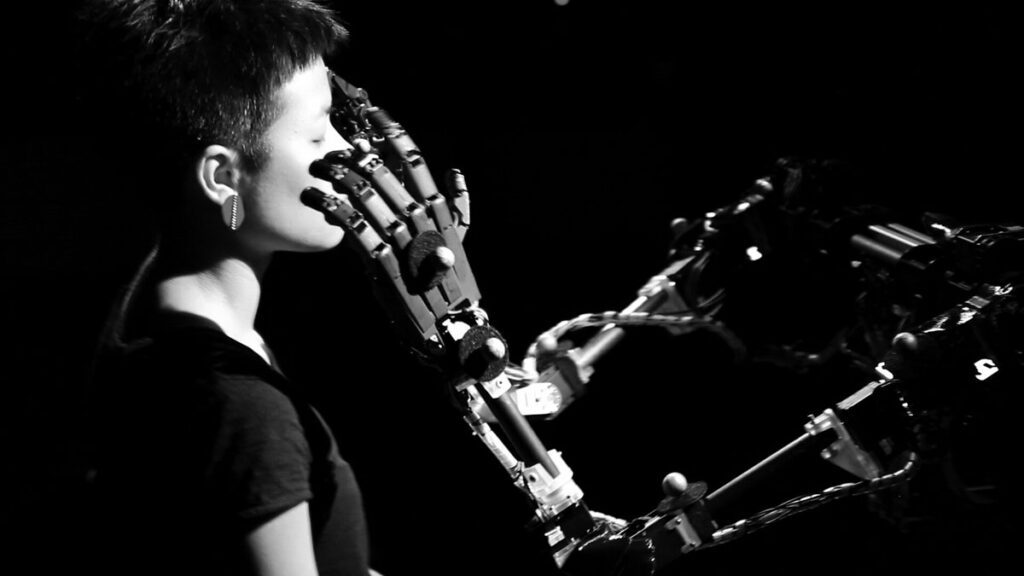
We are working to better understand what is known as the “embodiment” of these devices: indeed, as these robots come to “become one” with us, they alter our behavior and our brains.
The First Generation of Human-Robot Interactions for Industry
This "journey through time" of robots—which have evolved from being dangerous machines to becoming an integral part of human society—has been underway for more than forty years.
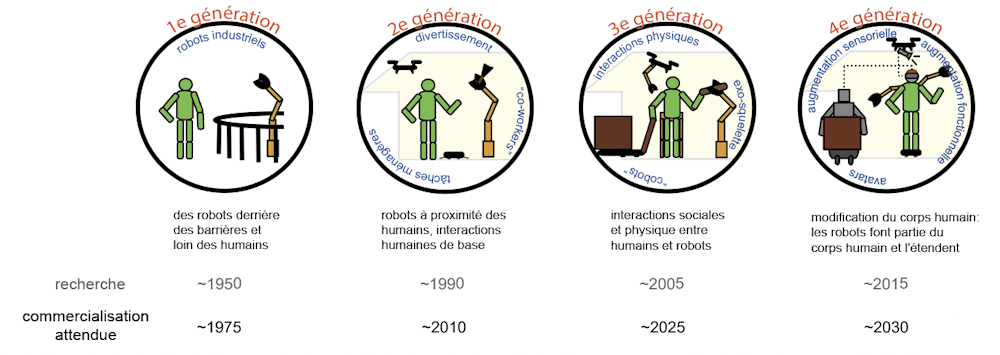
Robots come in a wide variety of forms, ranging in size (from micrometers or even nanometers on one end to human-sized or larger on the other), in the ways they move, and in their functions (such as industrial, space, and defense applications). Here, I am not focusing on the robots themselves, but rather on the interactions between humans and robots, which, in my view, have evolved over four generations.
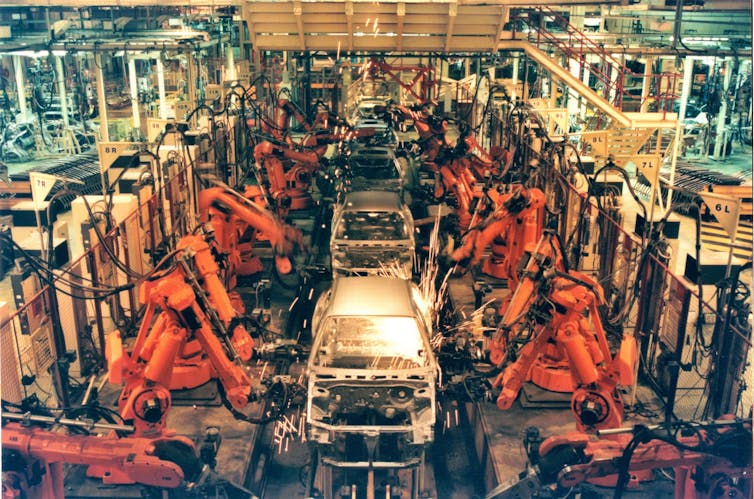
Large-scale interactions between humans and robots began with the advent of industrial robots, the first of which was introduced by General Motors in 1961. These robots gradually became more widespread, and by the early 1980s, industrial robots were in use in the United States, Europe, and Japan.
These industrial robots have made it possible to observe the first generation of human-robot interactions: they generally operate within designated areas to ensure that humans do not approach them, even by mistake.
Industrial robots, which first gained popularity through their use in automotive assembly, are now used for a variety of tasks, such as welding, painting, assembly, disassembly, pick-and-place operations for printed circuit boards, packaging, and labeling.
Working Side by Side
Robotics research during this period focused on bringing robots closer to humans, which gave rise to a second generation of human-robot interactions, first seen by the general public in the early 2000s, when machines such as the Roomba and the Aibo began to enter our homes.
These second-generation robots work alongside humans in our homes and offices for “service applications,” such as cleaning floors, mowing lawns, and cleaning swimming pools—a market worth approximately 13 billion U.S. dollars in 2019. In 2009, there were approximately 1.3 million service robots worldwide; by 2020, that number had risen to approximately 32 million.
However, although these robots operate in a more human-like environment than industrial robots, their interactions are still fairly minimal and basic. Most of their daily tasks are independent and require little interaction. In fact, they often even tryto avoid interacting with humans —which isn’t always easy.
Interacting with People
The relationship between humans and robots is now gradually evolving toward the third generation of interactions. Third-generation robots are capable of interacting cognitively or socially, like so-called “social” robots, but also physically, like exoskeletons.
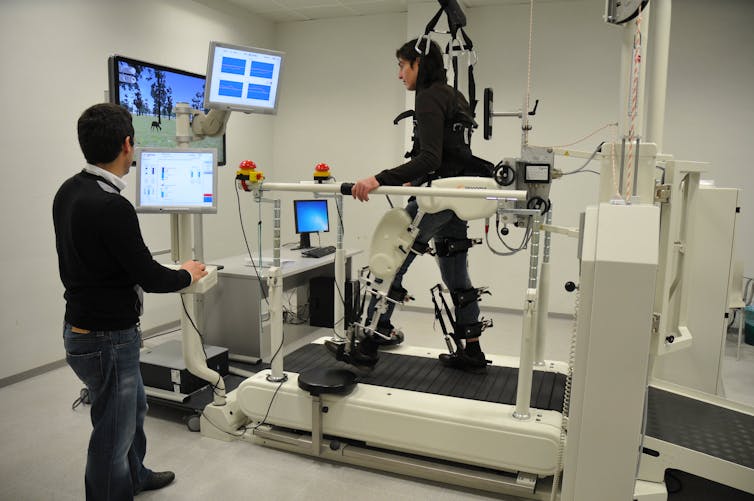
Robots capable of providing physical assistance—which could be used for rehabilitation and elder care, social services, and security—have also been clearly identified as a priority by governments in Europe, the United States, and Japan since the mid-2010s.
One way, in particular, to address the issue of aging populations in these developed countries.
Challenging the Definition of the Human Body
We are now gradually seeing the emergence of a fourth generation of human-robot interactions, in which robots are not only physically close to humans but are actually connected to the human body itself. Robots are becoming extensions of the human body.
This is the case with functional enhancement devices—such as additional robotic limbs—or functional replacement devices such as robot avatars (which allow humans to use a robot’s body to perform specific tasks). Other devices can also provide humans with additional sensory perception.
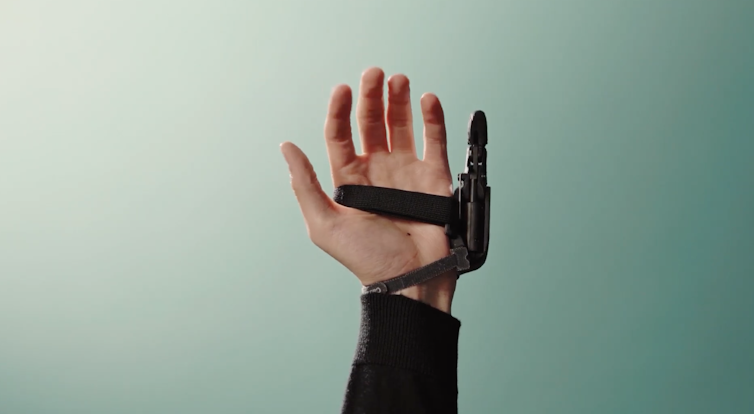
Fourth-generation interactions are fundamentally different from those of other generations due to one crucial factor: prior to this generation, humans and robots were clearly defined in all their interactions by the physical limitations of their respective bodies, but this boundary becomes blurred in fourth-generation interactions, where robots modify and extend the human body in terms of motor and sensory capabilities.
In particular, fourth-generation interactions are expected to interfere with these “body representations.” We know that there are specific representations of our bodies in our brains that define how our brains recognize our bodies. These representations determine our cognition and behavior.
For example, imagine you’re shopping in a crowded grocery store aisle. As you reach for items with your right hand, you’re able—very instinctively and without even realizing it—to avoid bumping your left arm into other shoppers.
This is possible because your brain has a mental representation of the size and shape of your limbs and is aware of and monitors each of them. If you’re holding a basket in your arm (which changes the size and shape of the “arm”), you’ll have a harder time instinctively avoiding collisions, and you’ll have to make a conscious effort to ensure the basket doesn’t bump into anything around you.
Similarly, can our brain adapt to an extra limb—or another fourth-generation robotic addition—and update its body representations? This is what is known as “embodiment” in neuroscience.
If the embodiment of these mechanisms can occur, how quickly does it happen? What are the limits of this embodiment? How does it affect our behavior and the brain itself?
Fourth-generation human-robot interactions challenge not only the user’s brain’s acceptance of the machine, but also the user’s acceptance within society: it remains unclear whether our society will accept, for example, individuals with additional robotic arms. This will certainly depend on cultural factors, which we are also trying to analyze.
In fact, third- and fourth-generation robots are so similar to humans that we need to better understand human behavior and the human brain in order to develop them.
In our work, we therefore combine research in robotics with cognitive, motor, and social neuroscience to develop what we believe to be the science of human-machine interactions.
It is only through a holistic understanding of human beings, the machines that interact with them, and the society in which they live that we will be able to develop future generations of robots. And, in a sense, the society of the future.
Ganesh Gowrishankar, Researcher at the Montpellier Laboratory of Computer Science, Robotics, and Microelectronics, University of Montpellier
This article is republished from The Conversation under a Creative Commons license. Readthe original article.