Tardigrades in the Quantum Realm?
Biology—including “molecular” biology—has traditionally been the exclusive domain of the familiar classical sciences, whereas physics and chemistry have been infiltrated by the ever-shifting and mesmerizing world of quantum physics. Recently, however, remarkable advances in biotechnology have made it possible to explore the quantum aspects of living organisms.
Simon Galas, University of Montpellier and Michel Cassé, French Alternative Energies and Atomic Energy Commission (CEA)
SciePro/Shutterstock
The term “quantum biology” encompasses the application of concepts from the physics of atoms and their components to biology—the science of cells and entire organisms. Its primary areas of focus include enzyme-catalyzed reactions, photosynthesis, ion channels, olfaction, the navigation of migratory birds, and the infiltration of protons into DNA via the tunnel effect.
Does quantum mechanics—random and capricious as it is—point toward what gives life its momentum and charm? Does the intertwining, weaving, and embroidery of the biological and the elementary quantum hold the promise of revealing the fundamental rules of life, in the sense understood by the fundamental sciences? Does life require quantum mechanics? Yes, undoubtedly: we are made of atoms, and our physicochemical machinery is molecular. But on a more subtle level, can we hope to shed light on phenomena that currently defy our understanding? In other words, does quantum mechanics play a fundamental role in biology? Does it have a physiological impact? And if so, what future biomimetic applications does it foreshadow?
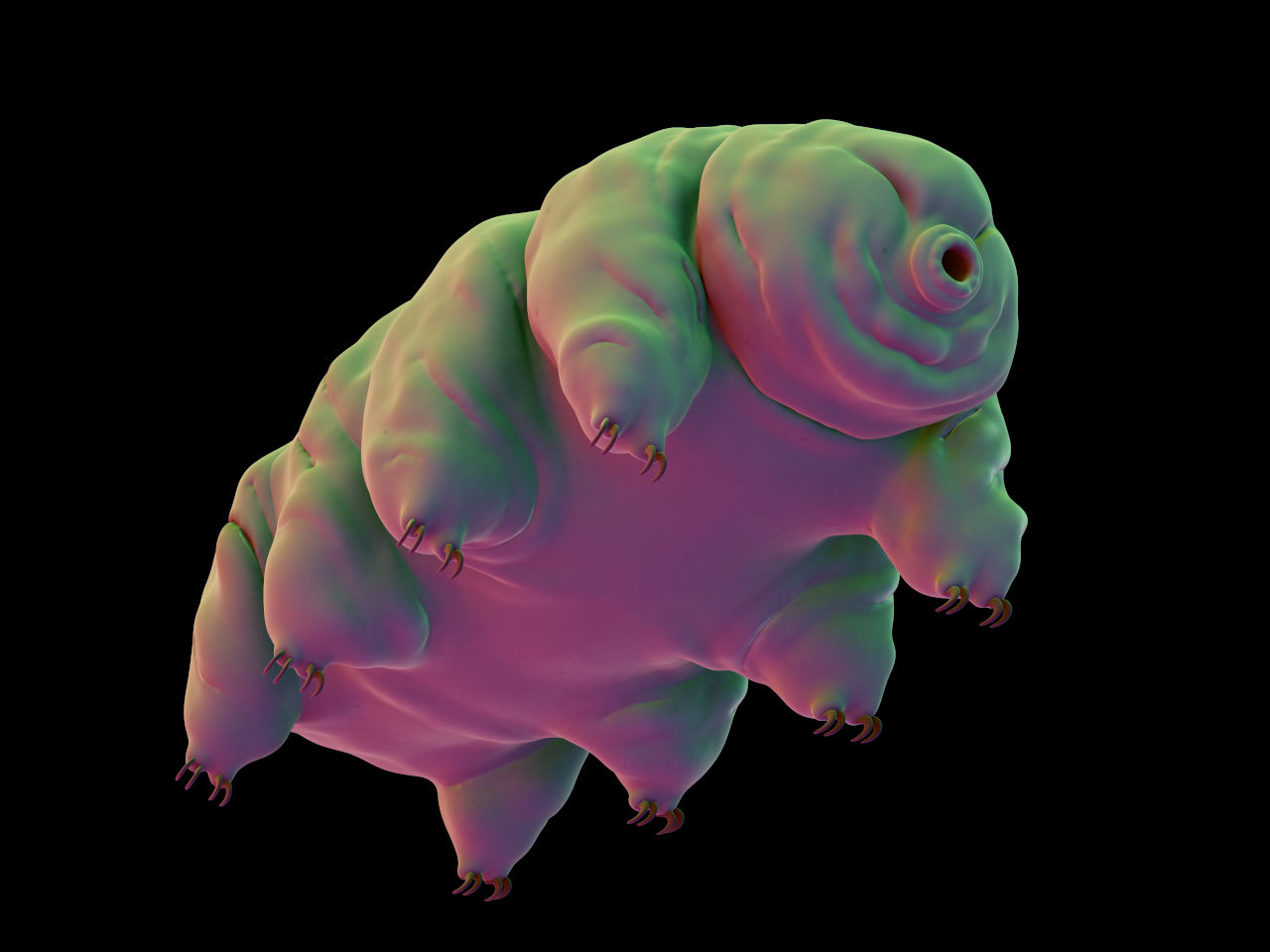
It is within this open technological context that small, four-legged animals with extraordinary resilience—known as tardigrades—have entered the scene, under the pretext that they move slowly. These animals were, in fact, the subject of a recent experiment that made headlines and caused a stir in the quantum and biological communities, while leaving some researchers skeptical.
The Embrace of the Tardigrade and the Qubit
Researchers in Singapore sought to quantum-entangle a cryogenically frozen tardigrade with a qubit (an essential component of superconducting circuits).
Electrons and photons behave in a non-conformist manner: we cannot say exactly where they are, nor in which direction or at what speed they are moving. However, a mathematical tool called a “wave function” allows us to calculate where the electron or photon is likely to be and where it is likely headed. When well-isolated and left to itself, a pure quantum state described by a coherent wave function evolves predictably, according to a mathematical prescription well established by Schrödinger. But when a measurement occurs (in the broad sense of interaction with a macroscopic object), the state changes abruptly. The peaceful evolution is interrupted and replaced by a roll of the dice. Schrödinger’s equation, which is perfectly deterministic, gives way to Born’s rule, which predicts the relative probabilities of various measurement outcomes, introducing an element of indeterminism and uncertainty in the process. This conceptual catastrophe marks the transition between the quantum and classical realms.
Quantum entanglement, on the other hand, refers to a relationship of interdependence between particles that have interacted, no matter how far apart they may be. It is therefore no longer possible to accurately describe each of these particles without including information about the other in the description of the first. (Note: Schrödinger saw entanglement as the hallmark of quantum physics, while Einstein decried it, calling it a “spooky action at a distance.”)
But let's get back to our tardigrades. In their experiment, Reiner Damke and his colleagues at Nanyang Technological University in Singapore integrated the tardigrade into a circuit consisting of two superconducting qubits.

K.S. Lee et al./arXiv
They then gradually lowered the pressure and temperature inside the chamber to create the most perfect laboratory vacuum possible, in order to minimize external influences on the qubits and the tiny animal. Finally, they measured the frequencies at which the tardigrade-qubit system vibrated. The result? The two entities were in a state of quantum superposition: their properties were no longer independent (in other words, information about one was necessary to describe the other, and vice versa).
Then, as the chamber returned to more natural temperature and pressure levels, the tardigrade was warmed and emerged from hibernation to resume its life. In other words, the tiny creature entered the collective, sharing, and impersonal quantum world, then returned to its solitary and well-differentiated state at the end of the experiment, without appearing to have suffered from this strange journey.
Braces, really?
Faced with this result, metaphysical questions flood the mind. What on earth does it mean for a living being to be “entangled”? And what about “marrying” a metal object? This opens the door to all sorts of wild imaginings. To avoid getting carried away, it’s best to put the situation into perspective.
First of all, the temperature and pressure conditions under which the experiment was conducted are extremely extreme. It's unlikely that such conditions occur frequently in nature!
As for the tardigrade, it had been cryogenically frozen, which changes everything! Ice acts as a dielectric and alters the resonance frequency of the qubit on which it is placed. Observing a change in the vibrational frequency was therefore to be expected, whether the ice was a frozen tardigrade or a simple ice cube, and any other material that alters the electric field would have yielded the same result. To consider this as quantum entanglement would be tantamount to saying that a qubit, under normal conditions, is entangled with the silicon chip that serves as its substrate.
In short, we’re still a long way from true quantum entanglement involving living organisms. Detractors claim that the feat should therefore be credited to the tardigrade rather than to the researchers…
Simon Galas, Professor of Genetics and Molecular Biology of Aging, IBMM CNRS UMR 5247 – School of Pharmacy, University of Montpellier and Michel Cassé, Astrophysicist and Writer, French Alternative Energies and Atomic Energy Commission (CEA)
This article is republished from The Conversation under a Creative Commons license. Readthe original article.