Teacher Training: Emmanuel Macron Chooses Mende to Roll Out His Reform
To mark the start of the school year, President Emmanuel Macron, accompanied by Minister of National Education Édouard Geffray, visited students at the Mende campus of the University of Montpellier’s Faculty of Education. The visit focused on the reform of initial teacher training and its implementation at the local level.
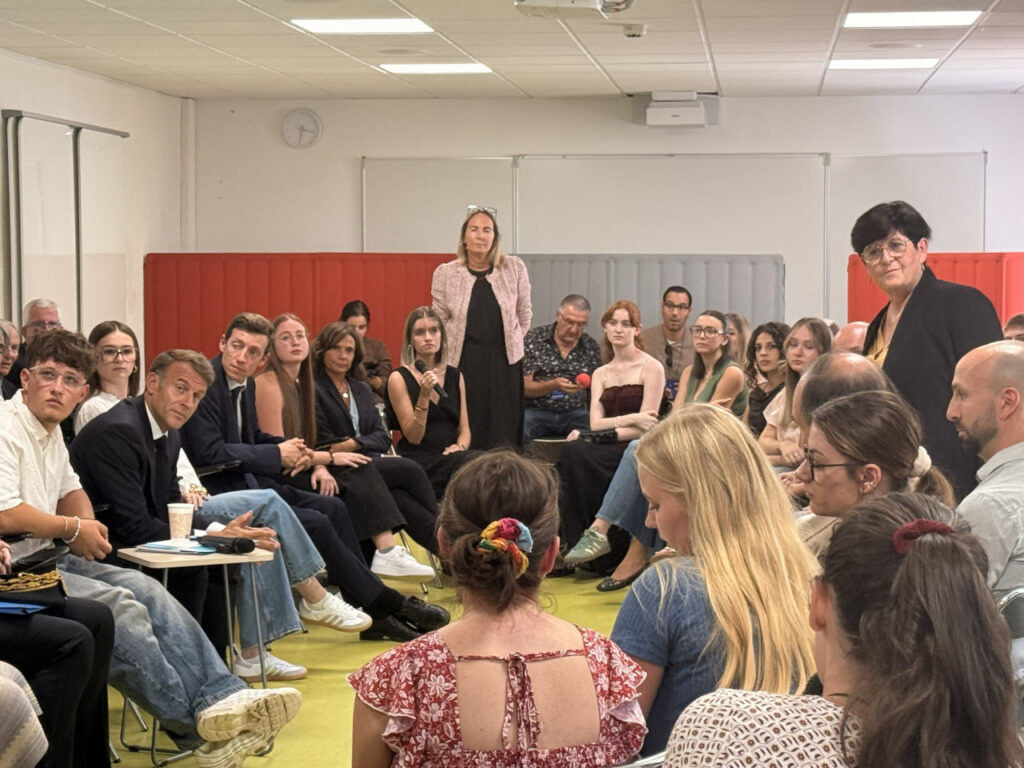
It was at the Mende campus of the Faculty of Education that Emmanuel Macron, in the presence of Philippe Augé, president of the “UM ,” and Agnès Perrin-Doucey, dean of the Faculty of Education, chose to illustrate the regional focus he wishes to give to the reform of initial teacher training. Discussions with students and student teachers focused on their decision to enter the teaching profession, as well as on the key aspects of the reform: opening the competitive examination to students immediately upon completion of their bachelor’s degree, providing compensation during their master’s program, and a gradual transition to professional practice, particularly through internships and practical training periods.
Mende, a local university town
Since the start of this school year, the competitive exam for elementary school teacher recruitment has been open to candidates who have completed a bachelor’s degree (bac+3). Successful candidates then pursue a two-year master’s degree in Teaching and Education (M2E), which combines academic training, professional development, and internships.
At the University of Montpellier, this reform builds on the program developed by the Faculty of Education over the past several years. The Bachelor’s Degree in Elementary School Teaching (LPE) thus replaces the multidisciplinary bachelor’s degree program that has been offered since 2019 at the Faculty’s five campuses. It builds on that program’s multidisciplinary approach while adapting it to the new schedule for the competitive exam, which students can now take upon completion of their bachelor’s degree.
In Mende, students can thus build a comprehensive academic path, from the LPE to the M2E in Elementary School Teaching. The campus also offers the PEFE (Multidisciplinary Education, Training, and Teaching) track within the Master’s in Education and Training Sciences, which, among other things, allows students who did not pass the CRPE to continue their studies and diversify their career paths in the fields of education and training.
This program draws on the unique features of the Mendoza campus: a small student body, close ties with the teaching staff, a library with a collection of approximately 20,000 volumes, workspaces and digital equipment, as well as a student residence integrated into the campus.
A Back-to-School Season in Lozère Focused on Education
By choosing Mende, the President of the Republic highlighted the importance of university campuses outside major metropolitan areas and their role in regional development. This network allows future teachers to receive their training as close as possible to their home regions and helps build a pool of professionals in rural areas—a connection to the local community to which Philippe Augé and Agnès Perrin-Doucey remain particularly committed. Emmanuel Macron also praised the commitment of the students preparing to become teachers.
“ “Teacher training is one of the pillars of our public service mission in higher education. At the University of Montpellier, we have opted for a structured, transparent, and region-specific approach. Through its dedicated unit, the Faculty of Education, theUM is directly involved in implementing the national reform throughout the region.”
says Philippe Augé, president of the University of Montpellier.
This visit followed an earlier trip to Chaptal High School in Mende, where the President of the Republic spoke with students and teachers about extending the ban on cell phone use in high schools. Through these two key events, the start of the 2026 school year will have placed Mende at the center of two major issues facing the education system: the transformation of teacher training and changes in students’ use of digital technology.