Mindfulness-Based Education – A Profile of Stéphane Justeau
Pedagogy—a little-recognized aspect of higher education in France—is the guiding principle of Professor Stéphane Justeau. The director of the Institute of Advanced Pedagogy at the ESSCA business school in Angers spoke at a CSIP MUSE workshop focused on student engagement.
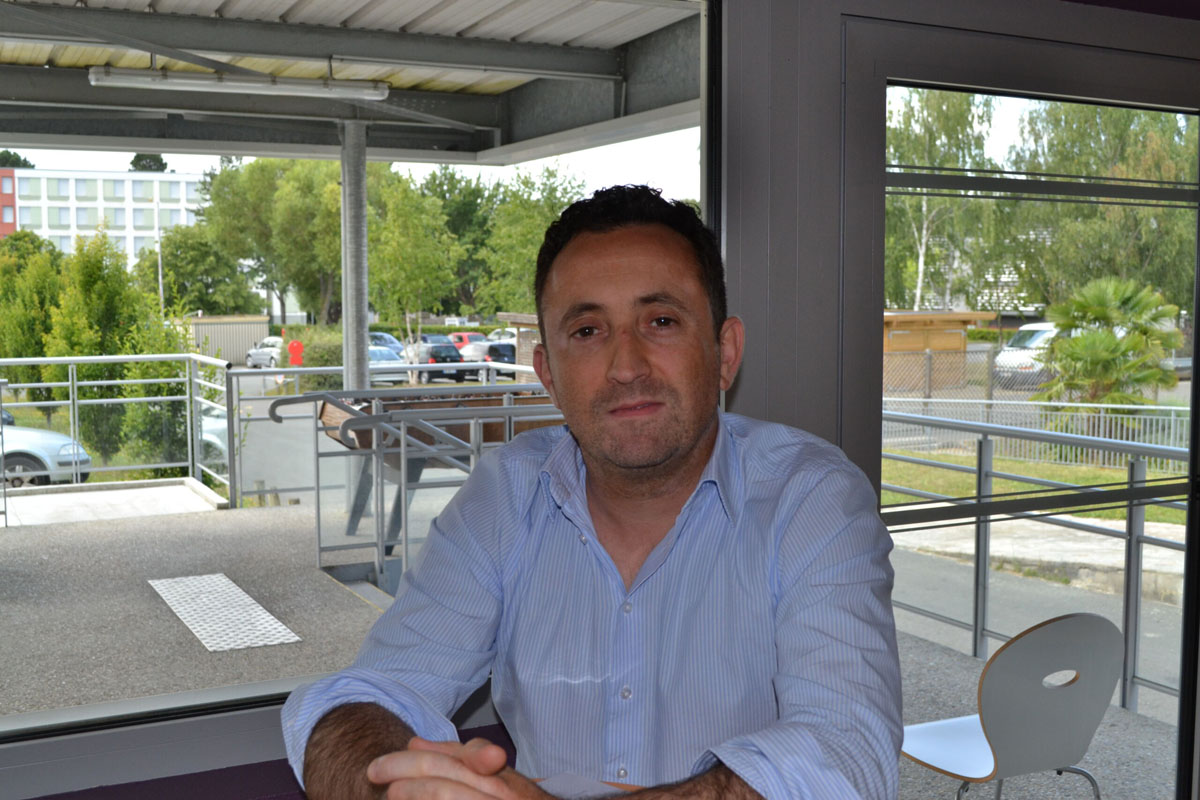
A few minutes of meditation at the beginning and end of each class. This practice isn’t taking place at a California yoga studio, but in a classroom at the École supérieure des sciences commerciales d’Angers (ESSCA). It’s the class taught by Professor Stéphane Justeau, director of the school’s Institute for Advanced Pedagogy. The senior member of the faculty thus came to introduce mindfulness meditation during a workshop on “strengthening students’ attention” organized by MUSE’s Center for Support of Pedagogical Innovations (CSIP) in mid-December 2020.“This unconventional session is part of our strategy to prioritize experimental approaches,” explains Patrizia Tavormina, an educational engineer at the CSIP, “but I admit I was a little worried about how the invitation to meditate with their students would be received by the participating teachers.”
A mandatory certificate
“In addition to the lack of pedagogical training, teaching isn’t valuedamong ‘ Professors,’” laments Stéphane Justeau. Peers—and the institution more broadly—recognize a good publication but not a good course. This state of affairs bothered the economist from very early on—especially since a culture of teaching exists elsewhere, particularly in Anglo-Saxon countries.“In the United Kingdom, a teaching certificate is required to teach in higher education,” explains the ESSCA professor. “This is changing very gradually in France; doctoral schools are beginning to offer teaching courses to their doctoral students.”
He quickly discovered he had a knack for teaching, starting with his part-time work as a graduate student at the university. This was especially true since his research on the impact of migration flows on wages and employment strained his relationships with some colleagues.“Under the pretext that my topic was supposedly reactionary, when in fact I just wanted to provide scientific insights into these issues. It was a difficult accusation to live with,” he says. After earning his Ph.D. in economics in 1998, he landed a position as aProfessor at ESSCA. His affinity for teaching was confirmed: “I’ve always loved explaining and sharing knowledge, but also interacting with young people.”
He was quickly appointed head of the department—where he coordinates courses in economics, law, and mathematics—and is in a prime position to hear his colleagues’ complaints about students who are “not as good as they used to be,” “unable to concentrate,” and so on. These complaints exasperate him and prompt him to open his classroom to them so he can share his teaching methods,“which were already working pretty well,”he says with quiet satisfaction.
Students are asking for more
Little by little, his commitment to teaching earned him an offer from the administration to lead a teaching center within the school. So off he went to train at the Lausanne Teaching Center, a leading institution in Europe. As a champion of teaching at his school, he returned to take on his new responsibilities. His role involved providing training in pedagogy—particularly online—as well as offering individualized pedagogical guidance. Regarding distance learning, he remarked in passing,“It offers fantastic opportunities, especially thanks to its international reach. But it is certainly not the future of education, because it lacks a socio-emotional dimension that is essential to learning.”
This is an aspect he incorporates into his teaching. For him, the ultimate goal of a teacher is to capture students’ attention:“It’s a fundamental pillar. Without it, there’s no learning.” This is a challenge in the age of connected devices and social media, where students face constant and multiple distractions. Since he practices meditation—and since it’s recognized in the scientific literature for improving attention—he’s decided to incorporate it into his classes (seethe article). “Mindfulness meditation is listed in the Vidal, the doctors’ bible,” points out the teacher, who doesn’t want to come across as a crackpot.
“The first step isn’t easy,” he readily admits. At a time when the prevailing ethos is all about efficiency and speed, try convincing students to close their eyes and listen to their breathing. But the practice is well received, and his students keep asking for more. And he takes the experiment further by sharing it in his teacher training workshops, which he organizes around the exchange of best practices.
Laurence Weil, a professor at the Montpellier School of Law and a participant in the MUSE workshop, makes no secret of her disbelief: “This proposal struck me as unbelievable, as if it came from a parallel universe or the22nd century. There’s also a certain lack of tact in intruding on young people’s privacy—it’s very out of step with the times. But at the same time, it pushes me to reflect on my own practice and to open up new horizons that bring a renewed sense of wonder to our profession!”