The Role of Children in the City: What Are the Public Issues?
It is becoming increasingly rare to see children walking around or playing alone in urban public spaces. In response to this social change, some cities are working to rethink their urban design.
Sylvain Wagnon, University of Montpellier
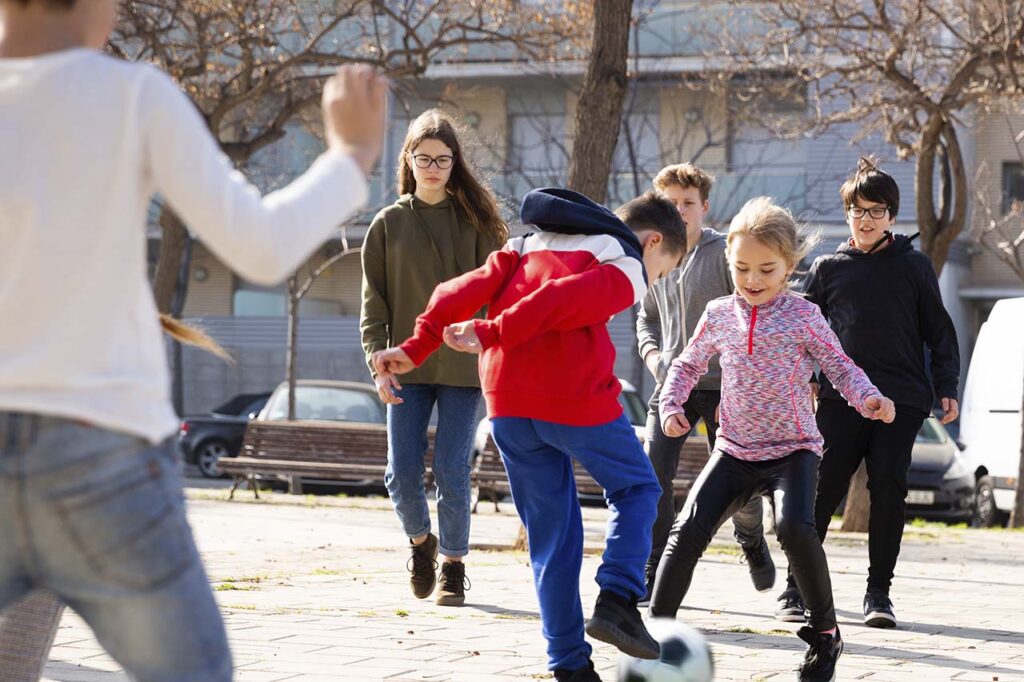
It is becoming increasingly rare to see children walking alone in public spaces because urban planning is poorly suited to their needs. Their absence—or even their exclusion from certain spaces—is now a widely recognized reality. This is evidenced by the front page of the daily newspaper *Libération* on February 19, 2024, which featured the headline “Me, a Kid, and a Nuisance, ” as well as an article in the daily newspaper *Le Monde* highlighting the proliferation of “no kids” zones .
The idea of a city designed “at a child’s eye level” thus represents a radically different perspective. This ambition, shared by a growing number of cities, seeks to address various urban challenges, particularly those related to mobility and community life. How can we characterize this innovative approach that could shape the city of tomorrow?
The Challenges of the City from a Child's Perspective
Designing a child-friendly city means taking children’s needs, perspectives, and experiences into account in the design, planning, and management of urban spaces.
As Clément Rivière, a sociologist and scientific director of the “Ville à Hauteur d’Enfant” research lab in Lille—a city that has been a pioneer in this field—explains in the journal *Mouvements*:
“This approach encourages us to consider how children can reclaim these spaces by questioning the role of the automobile, promoting independent mobility and free play, and ensuring that children have a genuine say in shaping the city.”
Such an approach, which is comprehensive by nature, presents a number of challenges. First of all, accessibility requires, for example, “child-friendly” signage appropriate for children’s ages and heights, as well as a well-balanced spatial distribution of schools, daycare centers, and libraries, to prevent social isolation, of which children are the primary victims.
Second, children need safe and appropriate modes of transportation to get around the city. Wide sidewalks, designated areas around schools, protected bike lanes, and accessible public transportation are essential.
School streets in Lille (2020).
Furthermore, a child-friendly city must be inclusive so that all children can play outdoors. Green spaces offer opportunities to explore nature and relax, and these opportunities should be accessible to everyone.
Finally, involving children in decision-making regarding their urban environment gives them a sense of belonging and strengthens their civic engagement. Since 1979 in France, children’s councils have been established in a large number of local governments as a means of fostering a greater role for children in urban decisions and changes.
A Political Ambition
The effort to rethink the city from a child’s perspective is not, however, a new one. Some local governments have made this policy a catalyst for social and urban transformation, such as the Recife metropolitan area in Brazil with its Urban95 program. Closer to home, the city of Bale in Switzerland has implemented “Les Yeux à 1m20,” a comprehensive urban renewal project designed with and for children.
Since 2002, UNICEF France has developed a network of “child-friendly” local governments to ensure that children’s rights are upheld in urban areas. More than 246 cities and 16 intermunicipal associations are part of this network:
“Becoming a child-friendly community is a political commitment at the local level and involves all elected officials, local government employees, partner educational organizations, residents, and, of course, children and youth. Over the course of a term of office, child-friendly communities commit to five areas: well-being, non-discrimination and equality, education, participation, and raising awareness of children’s rights.”
Cities such as Nantes and Rennes intend to place children’s needs at the center of their public policies. For Lille, Lomme, and Hellemmes—pioneering municipalities in this area—the creation of a “child-friendly city” laboratory makes it possible to foster a sense of agency in a child-friendly city and to engage all residents in this new approach.
These Child-Friendly Cities (TV 78, 2019)
For its part, Montpellier draws on the initiative of Italian sociologist Francesco Tonucci, whose hometown of Fano, Italy, has adopted a whole series of concrete measures enabling children to fully experience the urban environment. Thus, in 2023, the municipality in the Hérault department became the first French city to join the international “City of Children” network, which brings together more than 200 cities and works in 16 countries to promote urban (r)evolution through the “City of Children” initiative.
An educational, inclusive, and environmentally friendly approach
The end of the car’s dominance and the creation of pedestrian zones where children can play safely are part of this urban evolution. Pontevedra, Spain, has made this shift toward pedestrianization and the integration of different modes of transportation the cornerstone of its “child-friendly city” initiative.
A child-friendly city is created not only through family but also through interactions among residents. For example, by establishing, as in Fano, designated businesses marked with a logo where children know they can get help if needed—such as asking for directions or using the restroom—which helps foster their personal independence.
Installing playground equipment, benches, and green spaces helps create fun and attractive environments, as the city of Barcelona does with its green islands. The areas surrounding schools—such as courtyards or specially designed spaces—are the primary means of introducing various stakeholders, both children and adults, to a different urban culture.
The growing number of “school streets,” where vehicle traffic is prohibited during the times when children arrive at and leave school, are examples of safe, health-promoting, practical, and educational spaces where children and parents can gather.
[More than 85,000 readers rely on The Conversation’s newsletters to better understand the world’s major issues. Subscribe today]
Thinking about and implementing ways to integrate children into the city can be a driving force for sustainable urban development. We must be careful not to create a city for just a few, but rather a public space for everyone—cities that take into account both the uniqueness of each child and the desire to create a truly inclusive city.
Sylvain Wagnon, Full Professor of Education, School of Education, University of Montpellier
This article is republished from The Conversation under a Creative Commons license. Readthe original article.