Plastic pollution: the great overlooked factor in carbon footprint calculations
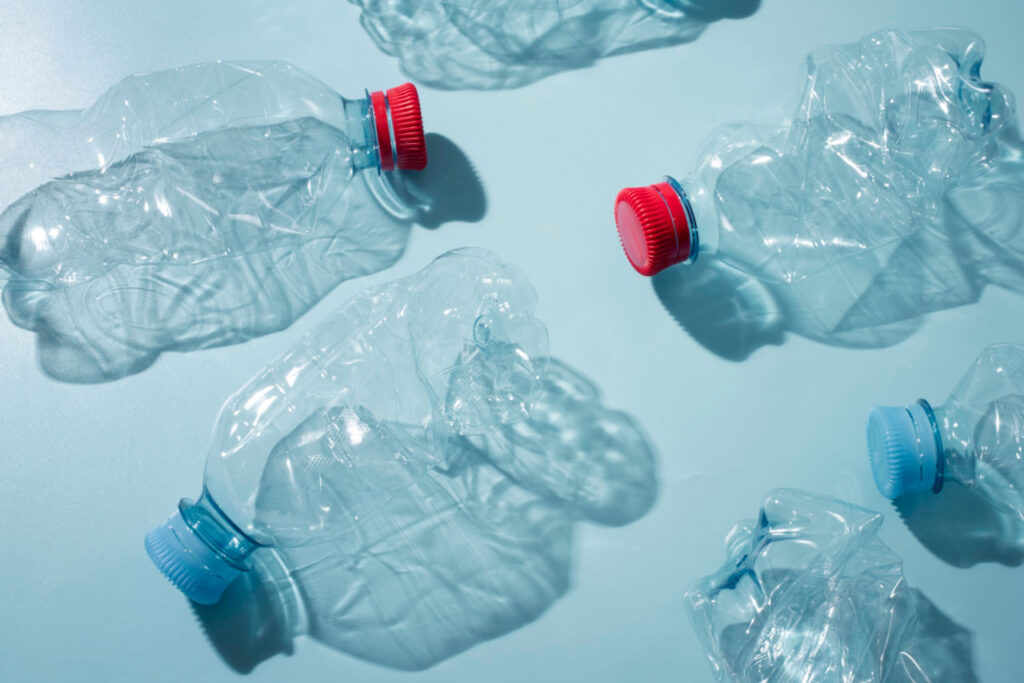
A recycled plastic water bottle, which has a low carbon footprint, is considered an environmentally sound choice compared to its glass counterpart. However, that same plastic bottle is among the items that release the most plastic particles into the environment. And more than three-quarters of this pollution will occur after we stop using these items—decades or even centuries from now.
Valérie Guillard, University of Montpellier and Nathalie Gontard, INRAE
THE ESSENTIALS
- A “climate-friendly” T-shirt can release millions of microplastics: this is the blind spot in carbon footprint calculations.
- We propose a systematic method for calculating the particulate plastic footprint to quantify and address this form of pollution, which is overlooked by the carbon footprint.
- Incorporating this indicator into policy decisions helps ensure that efforts to reduce greenhouse gas emissions do not inadvertently exacerbate the plastic pollution crisis.
This paradox reveals a blind spot in our environmental decision-making. Today, plastic pollution is almost always assessed through the lens of carbon footprints and life cycle assessments (LCAs).
However, these tools—used in the absence of sufficient data and methods—cannot account for what makes plastic so uniquely dangerous: its slow and inevitable breakdown into persistent micro- and nanoparticles that interact particularly strongly with living organisms. These fragments invade the air, soil, and oceans and travel all the way into our organs. It is now found in human blood, the placenta, and even the brain.
To address this gap, our joint team from the University of Montpellier and INRAE has developed a new indicator: the particulate plastic footprint (PPF).
The EPP estimates, for each object, the total mass of particles it will release over the course of its lifetime. This research, published in Science Advances and Science of the Total Environment, challenges several long-held assumptions.
The Particulate Plastic Footprint: An Indicator for Measuring the Invisible
Given the lack of certainty regarding the safety of plastic particles and in light of a body of converging evidence regarding their hazardous nature, the method for calculating the EPP is based on a robust precautionary principle: without permanent destruction at the molecular level (through incineration or biodegradation, for example), all plastic inevitably breaks down into particles that spread into our environment and living organisms.
The EPP accounts for these emissions at each of the four major stages in the life cycle of a plastic object:
- its production,
- its use,
- the disposal of its waste,
- and its fate over the very long term, when it is left behind on a wall, in a landfill, or in a field.
Above all, this accounting system distinguishes between two time frames:
- "immediate" emissions that occur during the object's operational life, which ranges from a few years to about ten years;
- and "delayed" emissions, which appear decades—and sometimes centuries—later.
When applied to everyday objects, the method overturns conclusions that were once taken for granted.
For example, our polyester T-shirt emits slightly less CO₂ than a cotton T-shirt (7.9 versus 8.1 kg of CO₂ equivalent): on the surface, it therefore appears to be the “right” choice for the climate. But it also generates 184 grams of plastic particles, which is nearly 57% of its mass.

Another example: Our reusable plastic crate saves 280 g of CO₂ compared to its single-use wooden counterpart. But this comes at the cost of 21 g of additional plastic particulate pollution, which the carbon footprint calculation alone does not account for.
The warning about this fundamental flaw in life-cycle assessments was first raised in 2022, in Nature Sustainability and elaborated upon in 2025. By treating buried or in-use plastic as inert, life-cycle assessments and their “guiding indicator”—the carbon footprint—overlook the dangers of plastic pollution.
The EPP is now transforming this warning into an operational measurement tool and proposes to correct the unjustified comparative advantage currently granted to plastics in LCA analyses.
Landfills: Toxic reservoirs bequeathed to our grandchildren
One of the most striking findings of our research concerns the timing of these plastic particle emissions. Contrary to popular belief, the majority of these particles are not released during an object’s active lifespan, but continue to be released long afterward—and for a very long time after it is sent to a landfill.
The figures are staggering. For a PET bottle, 83.8% of particulate emissions are deferred. For a polyester garment, that figure rises to 87.6%. For paint—all of which ends up as microparticles if not incinerated—deferred emissions approach 75%.
Landfills are therefore not simply places for inert waste storage: they continuously contribute to the flow of plastic particles that contaminate our environment without being included in any official environmental assessment.
Since 1950, 10.5 billion metric tons of plastic have thus accumulated without being incinerated. The documented emissions of particulate matter from the “leachate” seeping from landfills are already significant and will only increase in the decades and centuries to come. Burying plastic means passing on a toxicity debt to future generations—with interest.
When Recycling Isn't Enough: The Trap of "De-cycling"
That leaves the reassuring argument—the cornerstone of circular plastics—recycling. But here again, the EPP invites us to reexamine its effectiveness. First, by reminding us that plastic pollution cannot be reduced to a matter of plastic waste management, since it begins with the production of the object itself.
Next, by distinguishing between recycling (closed-loop) and decycling (open-loop).
Closed-loop recycling reuses spent plastic to make the same items again: for example, a bottle becomes a bottle once more. But this cycle is only possible a limited number of times—three to four cycles, and primarily for PET—with a one-third loss in mass with each cycle. In Europe, it applies to only about 12% of bottles, or less than 0.5% of all the plastic we use.
Everything else—that is, the vast majority of what is called “recycling”—is actually “downcycling”: bottles become textiles, textiles become insulation, and tires become artificial turf.
However, this transformation into a lower-quality material does not stop the plastic from breaking down; on the contrary, our calculations show that it actually accelerates the process. A garment made from a downcycled PET bottle thus releases 50% more microfibers during use.
In other words, de-cycling does not reduce the overall plastic footprint; it merely shifts it over time by accelerating immediate emissions.

A tire provides a vivid illustration of this.
In Europe, 55% of collected used tires are processed into rubber granules used to manufacture artificial turf, a practice often touted as “circular.” However, this process causes the short-term particulate footprint (during the production and use phases of the products) to jump from 12.2% of its initial mass (emitted during use) to 24.3%.
On the sports fields where our children play, these recycled granules—exposed to the sun and friction—break down even faster than virgin plastic.
Assess Effectively to Better Shape a Sustainable Future
The EPP does not claim to replace the carbon footprint, but rather to complement it by shedding light on its main blind spot. It should not be viewed as a substitute for impact assessment, but as a necessary bridge between current knowledge and future assessment frameworks. It does not quantify the toxicity of the emitted particles, but it finally provides a visible, transparent, and immediately usable record of what our current tools overlook: the lasting and pervasive footprint of our objects in the form of micro- and nanoplastics.
This perspective paves the way, starting now, for a more balanced approach to “low-carbon” and “low-plastic” strategies, so that we can continue to reduce our greenhouse gas emissions without increasing the accumulation of plastic particles.
This line of reasoning should be applied without delay to sectors involved in the digital, energy, and agroecological transitions—and which are heavy consumers of plastics—such as the agri-food sector, the world’s largest consumer of plastic.
This would make it possible to move beyond approaches focused on “everything being recyclable” and give the necessary priority to upstream measures—that is, reducing the use of non-essential plastics—as well as downstream measures, such as cleaning up existing landfills. Without EPP, this prioritization remains impossible.
Because a disturbing truth is becoming clear: we cannot reduce what we cannot measure.
As long as plastic particles remain under the radar and are not quantified, our policymakers will continue to miss the mark.
Margaux Escudier, who holds a master’s degree in environmental policy from Sciences Po Paris and serves as a project assistant for the Policy and Outreach Plastic Particle Footprint initiative at INRAE, contributed to the writing of this text.
Valérie Guillard, Professor of Process Engineering Applied to the Life Sciences, Member of the Institut Universitaire de France, University of Montpellier and Nathalie Gontard, Research Director, Professor, Food and Packaging Sciences, INRAE
This article is republished from The Conversation under a Creative Commons license. Readthe original article.