Science Makes Its Way into the World of Soccer
Soccer is a high-intensity sport: generally, soccer players cover 8 to 12 km during a match lasting about 90 minutes, with their heart rate maintained at 80–90% of their maximum.
Stéphane Perrey, University of Montpellier

Joshua Hoehne on Unsplash, CC BY-SA
In addition to the specific endurance required to meet the physiological demands of the game, soccer players face another challenge: they must sprint more often and faster within specific spatial and temporal constraints in order to perform at their best!
In this context, the Association of Professional Soccer Strength and Conditioning Coaches—represented by its President, Sébastien Lopez-Guia, a professional strength and conditioning coach certified by the FFF and recognized for bringing together the majority of soccer specialists in the French professional and amateur leagues—has partnered with the University of Montpellier (Laurent Mortel and Stéphane Perrey) to create a unique program: the University Diploma in Soccer Performance Optimization. Through this partnership, various approaches to athletes’ physical conditioning in soccer are being developed within professional clubs. This program addresses a growing demand for a highly specialized degree that provides targeted scientific expertise combined with practical on-field skills, as currently applied in all top-level clubs. With the help of human movement sciences, it is now possible to identify motor signatures in soccer.
Force in Motion: A “Useful” Force for Soccer Players
The ability to generate both force quickly and high muscle power is considered one of the most important characteristics of physical performance, particularly in activities that involve repeated jumps, changes in direction, and/or changes in speed.
This is true of soccer, which involves numerous movement sequences that require the ability to perform “explosive” actions such as accelerating, decelerating, sprinting, and jumping, depending on the player’s position on the field.
Statistics show that players cover an average sprint distance (≥ 24 km·h⁻¹) of 250 meters per game, with some players reaching maximum speeds of around 32 km·h⁻¹. Soccer players are also required to perform approximately 60 sprint sequences per game while executing multiple changes of direction and jumping actions. What these types of movements have in common is the need to generate large amounts of force within relatively short time frames.
How can you get stronger to move better?
Strength training is often equated with—or even reduced to—increasing muscle mass. While this is partly true, the fact remains that strength encompasses other aspects, such as “explosive” strength, strength endurance, speed strength, and so on, each of which corresponds to different muscular qualities that can be specifically trained in soccer.
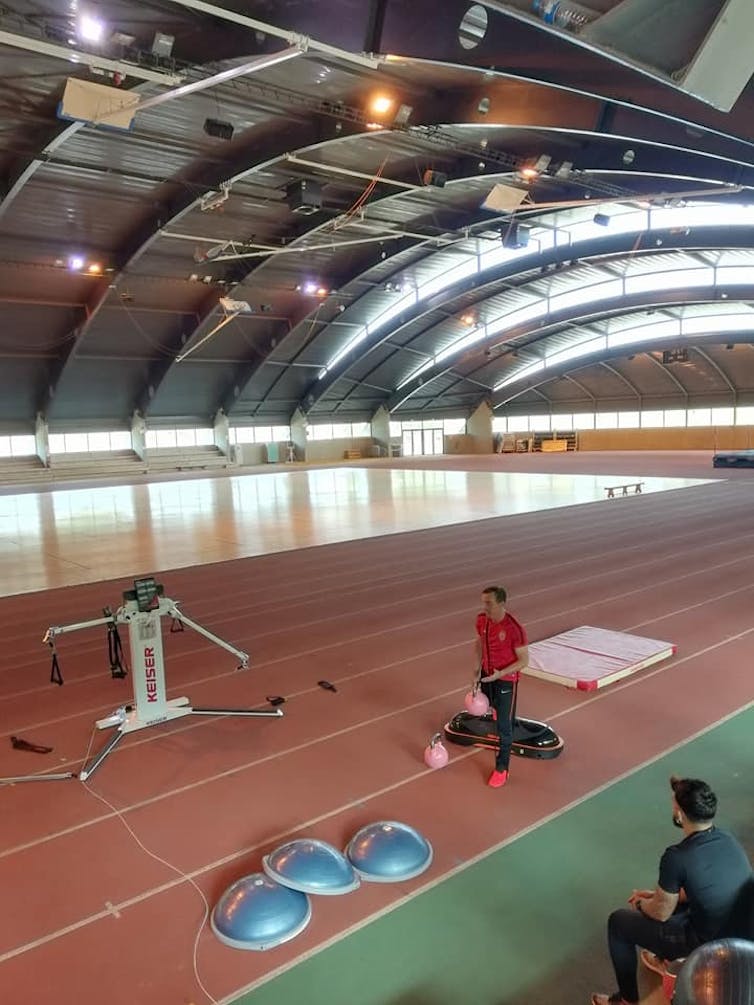
Stephane Perrey, Author provided
One area of modern physical conditioning that is experiencing a resurgence is what is known as functional training. This approach aims to incorporate the demands and constraints of sports into the training environment in order to improve training effectiveness. In other words, functional training designed to develop “explosive” strength and power should be viewed as a form of training in which the exercises and movements are integrated, multidirectional, and appropriately varied.
In practice, functional training involves a range of movements based on kinetic chain exercises (involving a group of muscles), ballistic movements such as throwing weighted balls, and dynamic balance activities that engage proprioception and core stability.
It is important to remember that the principle is to engage the entire muscle chain by targeting the major physiological and neuromuscular systems. Unlike more traditional strength training methods—known as “analytical” training—which focus on one or more muscles by isolating them, functional training takes into account the entire muscle chain and the joints. The upper and lower limbs work together rather than in isolation.
Gone are the days of barbell lifts; instead, we focus on full-body exercises using explosive movements—ranging from simple to complex—based on each individual’s creativity. Functional training can take the form of workshops (such as circuit training), bodyweight exercises (exercises without equipment), or exercises using various accessories (resistance bands, unstable surfaces, weights, straps, etc.) and specialized machines.
Movements that are well-controlled
The goal of functional training is to replicate game situations as closely as possible during training sessions. However, cognitive demands are often overlooked in the context of strength training taken in isolation. Successful performance requires physiological and cognitive abilities that are interdependent or interconnected. Achieving neuromuscular adaptations specific to a soccer player’s movement patterns requires control over two types of effort: physical effort and mental effort. Once again, functional training can address this issue.
An important aspect of the principle of training specificity is the intention underlying muscular action and the nature of the effort. A key training stimulus is the nature of the motor command and the resulting motor unit activation patterns associated with high-speed movements.
These central motor commands activate the muscles in a manner consistent with the athlete’s intention and, furthermore, promote specific physiological adaptations. The nature of the mental effort directly influences the quality and quantity of movement and, consequently, all physiological adaptations and , ultimately, the final performance.
This could lead to more effective patterns of muscle coordination and contraction because we don’t just train the muscles—we intentionally train the movement itself! For example, the intention should be to spring forward during a jump, and jumping becomes a means to achieve that goal, but it is not the goal itself. Applied to the context of training, we learn to better perceive the effectiveness of a movement when we discover solutions on our own through the free exploration of our existing repertoire of movements: this is the added value offered by functional training, whether or not it is assisted by external resistance.
 The functional training method described here is designed to enhance the specificity of the physiological adaptations underlying the types of movements to be performed, not to improve perceptual and cognitive abilities. Functional training is not exclusive. Other methods of strength development are necessary to achieve other goals related to muscular adaptations, such as increasing muscle size, which are integral components of functional performance. The various markers of a soccer player’s movement (cognitive, physiological, neuromuscular, sensorimotor) would thus constitute a behavioral map that contributes to the accuracy of diagnostic predictors of performance. However, it may be more than just a small step to conclude that a player’s game intelligence is reflected in their movement patterns.
Stéphane Perrey, University Professor, Associate Director of the EuroMov Laboratory, University of Montpellier
The original version of this article was published on The Conversation.