[LUM#21] Let It Grow
What if we stopped replanting trees in cleared forests and instead let them regenerate naturally? Researchers have shown that natural forest regeneration is an effective method of reforestation. This practice could play a key role in cocoa farming, allowing production and restoration to go hand in hand.
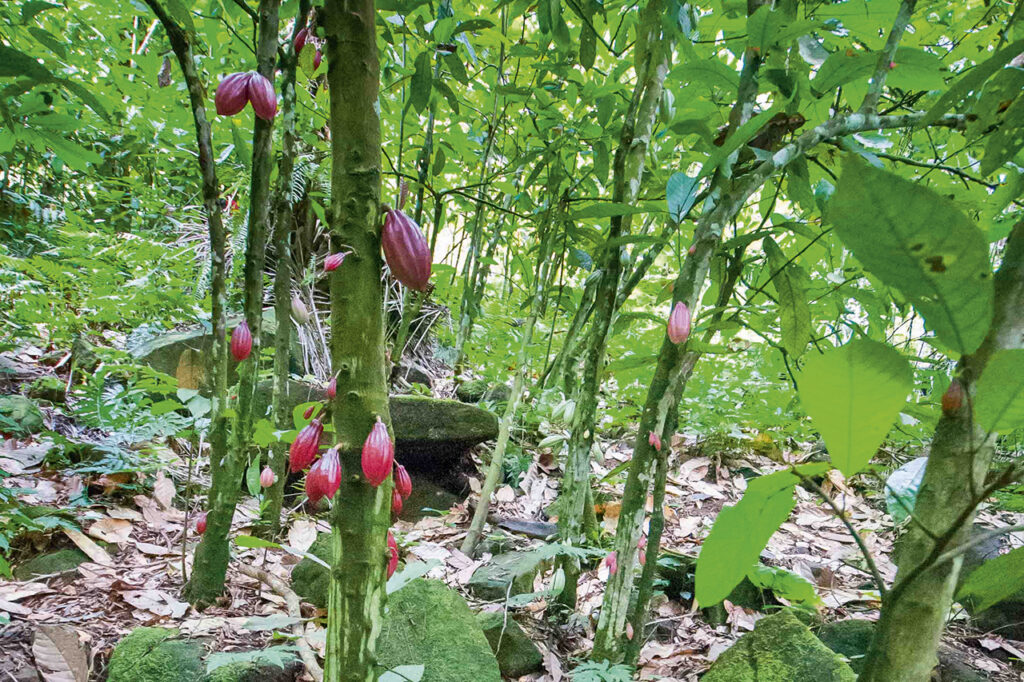
While cocoa cultivation is the main cause of deforestation in West Africa, it also presents an opportunity to restore forest cover in producing countries through agroforestry. “This practice involves combining an agricultural crop with forest trees. Cocoa trees are native to the shaded understory of South American forests, and large trees can provide them with that shade, ” explains Bruno Hérault, a researcher at CIRAD in the Forests and Societies unit.
But how can trees be reintroduced into these deforested cocoa plantations? “The most common practice today is to replant young trees grown in nurseries. In Côte d’Ivoire, more than 10 million trees have been distributed to cocoa farmers over the past 10 years, ” explains the tropical forest specialist.
Planting Shock
Trees don’t always thrive in their new environments. After being pampered in the nursery, the transplant process is a source of stress that can sometimes prove fatal to them. “This planting shock can also be explained by the fact that trees grown in nurseries do not develop their roots as much as they would in a natural environment,” explains Bruno Hérault. As a result, once replanted, most of them die or languish. It’s therefore a mixed success for reforestation programs that are, moreover, very costly.
Yet there is an alternative: letting the trees regenerate naturally. Bruno Hérault and his colleagues have monitored more than 12,000 trees in the cocoa plantations of Côte d’Ivoire and have found that allowing the young trees present in the fields to grow proves to be more effective. “The forests were cut down just a few decades ago; there are still many remnant trees—spared from logging— scattered throughout the landscape, and thus great potential for natural regeneration via the soil’s seed bank,” explains Bruno Hérault. These naturally occurring trees are, in fact, much more resilient than those from nurseries and have a better chance of developing properly.
Intimate relationship
While this practice has proven to be more effective and less expensive than tree-reintroduction programs, it still requires support for cocoa farmers, particularly in identifying young forest seedlings that grow spontaneously on their plots. “We need to train them to help them recognize and select the trees that are most worth preserving, ” the specialist explains.
An alternative that, for the researcher, offers opportunities far beyond economic and ecological benefits . “This gives farmers the chance to envision the future of their land for themselves, allowing them to take greater ownership of it. It’s also a way for them to develop a closer relationship with their land, transforming humanity’s relationship with nature.”
A first-rate solution that is struggling to gain traction among stakeholders in the cocoa industry. “In terms of public perception, it’s always more appealing to replant trees than to let them grow on their own,” laments the researcher, who advocates for these practices to be used in tandem. Natural tree regeneration could, in fact, contribute to efforts to restore forest cover, which currently covers 9% of the territory in Côte d’Ivoire, a country aiming for 20% by 2030.
Check out theUM podcasts, now available on your favorite platform (Spotify, Deezer, Apple Podcasts, Amazon Music, etc.).