The French Far Right’s Attraction to Putin’s Russia
The ties between Russia and the French far right have changed significantly over time. After the 1917 Revolution, a number of Russian exiles joined the French radical right, primarily out of anti-Soviet sentiment. During the Cold War, while the European far right—in France as elsewhere—remained largely hostile to communism, some of its members viewed the USSR as an alternative to the despised globalism promoted by Washington. Today, Vladimir Putin’s regime, which presents itself as the defender of “traditional values,” holds broad appeal for the right wing of the French political spectrum; but within this movement, the war in Ukraine has created a deep divide.
Nicolas Lebourg, University of Montpellier and Olivier Schmitt, University of Southern Denmark
Nicolas Lebourg, an expert on the far right and a research associate at CEPEL (CNRS-University of Montpellier), and Olivier Schmitt, professor of international relations at the Center for War Studies at the University of Southern Denmark, examine this long and complex history in *Paris Moscou, un siècle d’extrême droite* (Paris-Moscow: A Century of the Far Right), which has just been published by Éditions du Seuil. Here we present an excerpt from the book that focuses specifically on the impact of the Russia-Ukraine conflict on the French far right.
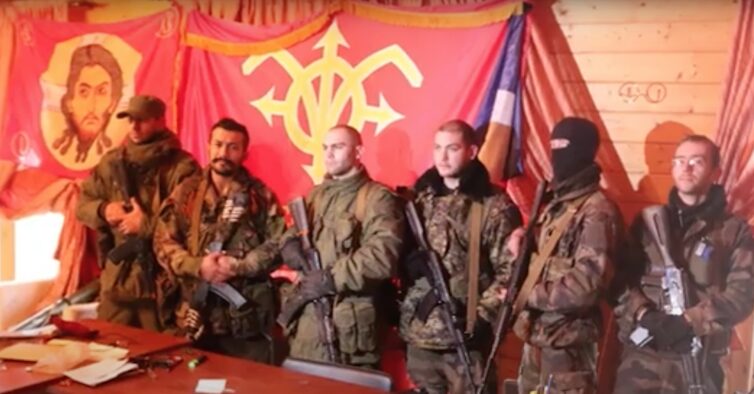
After the invasion of Ukraine in 2014, a group of pro-Russian French volunteers was formed under the name “Unité continentale.” The group managed to gain some media attention; the arrest of some of its members even allowed the Russian news agency Sputnik to portray Ukrainian detention centers as Nazi concentration camps. This contribution by French nationalists is more a matter of psychological warfare and public relations than of military operations per se.
The strength of Russian propaganda lies in its ability to tap into a variety of ideological resonances. The core of the anti-American, anti-liberal, and authoritarian message accommodates a range of ideological options, from the far left to the far right, even though the networks are largely structured around the right-wing end of the spectrum. In fact, an appeal was also made to white nationalists in France and elsewhere. This time, the strategy involved utilizing the Russian Imperial Movement, founded in 2002 as a continuation of the hardline stance of the White Russians (those exiled after the 1917 revolution), adding racist and Islamophobic elements to it, while maintaining ties to the Russian Ministry of Defense and its paramilitary offshoot, the Imperial Legion, founded in 2008.
As supporters of Great Russian and Orthodox nationalism, the legionnaires took part in the fighting in the Donbass region, where several are reported to have been killed in 2014 and 2015. In January 2016, the Legion announced that it was abandoning armed combat in Ukraine but would maintain its goal of “liberating” Kyiv to give birth to “New Russia.”
The term “New Russia” is used to describe a more westerly border for Russia; it dates back tothe 18thcentury, was revived by Transnistrian separatists in the 2000s, and was taken up by Ukrainian separatists and the Russian neo-Eurasianist theorist Alexander Dugin in 2014 (who advocates for an authoritarian regime spanning Eurasia and its diverse peoples and religions). By playing on nostalgia for the tsarist era, the aim is to assert the historical artificiality of the Ukrainian state.
In truth, the Legion is being redeployed to Syria and Libya, alongside the Wagner Group, and is returning to Ukraine to take part in the 2022 offensive. Nationalist and religious messianism go hand in hand here: the Legion espouses a millenarian and eschatological view of politics. According to this view, we are living in the last days, globalism is the work of the Antichrist, Islamism is demonic, and the COVID-19 pandemic is the work of globalists aimed at strengthening the kingdom of the Antichrist.
This conception of the world and of time implies that nationalists cannot remain confined behind their borders: the Legion asserts that it does not intend to establish cells solely in Russia, but throughout the Russian diaspora, a stance that brings it closer to subversive organizations of the interwar period such as the Brotherhood of Russian Truth or the All-Russian Fascist Organization.
At the same time, beginning in 2015, the Russian Imperial Movement has been expanding its international networks by founding a global national-conservative movement in partnership with the Russian far-right party Rodina (“Fatherland”), a supporter of Vladimir Putin and the political home of his Deputy Prime Minister, Dmitry Rogozin. https://www.youtube.com/embed/m9tAKY8q7zs?wmode=transparent&start=0
The organization does not want to limit itself to defending the white race or Christians, and invitations to join the movement have been sent to 58 groups around the world, including those in Thailand, Japan, Syria, and Mongolia—in the United States, the group has established ties with white supremacist Jared Taylor, who is close to French theorist Guillaume Faye.
As for France, it had extended invitations to Action française, Renouveau français (a now-defunct neo-fascist splinter group that included a young Frenchman convicted in Ukraine in 2018 for trafficking in weapons and explosives, along with two other French radicals convicted in 2023 for similar trafficking), to Unité continentale and Yvan Benedetti’s Nationalists (which emerged following the dissolution of the Œuvre française in 2013)—only the latter chose to maintain a relationship with the movement.
[There arealready more than 120,000 subscribers to The Conversation’snewsletters. What about you? Subscribe today to gain a better understanding of the world’s major issues.]
The “national-conservative” manifesto asserts that there is a global Jewish conspiracy to destroy nations and traditional values, and its leader has taken up the fight against the “Jewish oligarchs” in Kyiv. Nevertheless, this is still a stopgap measure: this radical movement was launched in late 2015, whereas earlier that year Rodina had attempted to bring together populist parties such as France’s National Front in an “international forum of conservatives”—but the National Front, playing it safe, had declined…
The noose is unlikely to loosen: In the spring of 2020, the United States designated the Russian Imperial Movement and the Imperial Legion as “international terrorist” organizations, accusing them, among other things, of training Swedish neo-Nazi terrorists. https://www.youtube.com/embed/_fEp7PZmzus?wmode=transparent&start=0
The fact remains, however, that the Azov Regiment had a magnetic effect on radicals, especially since 2015 saw the emergence of a new movement—accelerationism—which can be defined as a totalitarian subculture ranging from a nebulous neo-Nazi sect to millenarian terrorism (it is responsible for numerous attacks, including those in Christchurch, El Paso, Buffalo…).
The trend emerged through an English-language transnational forum founded by a Russian admirer of the Italian theorist Julius Evola and Guillaume Faye, whose American neo-Nazi members went on to create the organization AtomWaffen Division. The latter popularized a fascination with Azov, and several of its members were still being deported from Ukraine as recently as 2020.
It can also be found among the accelerationists of the French group WaffenKraft, two of whose members dreamed of joining Azov, while others wanted to go there to meet the militiamen as part of a neo-Nazi music festival and buy weapons from them. According to them, Ukraine is a place of “defensive” combat but also, and above all, a “land of origin” where it would be possible to live autonomously during the collapse caused by the imminent general outbreak of racial war—they were arrested before carrying out their terrorist act; This case is the first far-right case tried in a criminal court of first instance, with sentences ranging from one to eighteen years in prison at the first-instance trial; the appeal trial began on September 16.

The most extremist faction of white nationalism has thus ended up turning the arguments of neo-Eurasianism against Russia: if Russia represents the convergence of diverse traditions and ethnic groups, then the white cause is Ukrainian.
Thus, while between 2014 and 2019, right-wing extremists from 55 different countries volunteered to fight in the Russian-Ukrainian conflict, their allegiances have shifted dramatically. According to French intelligence, in 2022, the approximately 50 French radicals present were now overwhelmingly on the Ukrainian side. For them, the battle of 1942 is being replayed—when the invasion of the USSR was portrayed as a struggle between Europe and Genghis Khan. When a French fighter died in the spring of 2022, his comrades in the Misanthropic Division paid tribute to him by highlighting his fight against “Bolshevism” and the “Asian hordes.”
This presence allowed Moscow to denounce France’s so-called support for the “Ukrainian Nazi regime” in January 2024, claiming that the French government was thus sending its mercenaries, according to an official statement relayed by pro-Russian French organizations such as SOS Donbass… Aside from armed involvement, it is also worth noting that while members of WaffenKraft were unable to attend the Ukrainian neo-Nazi festival, the same could not be said for militants from the GUD and the Zouaves (which were dissolved by the government in 2022).
Nicolas Lebourg, Researcher at CEPEL (CNRS-University of Montpellier), University of Montpellier and Olivier Schmitt, Professor of Political Science, Center for War Studies, University of Southern Denmark
This article is republished from The Conversation under a Creative Commons license. Readthe original article.