Are French consumers responsible?
Can French consumers be considered “responsible”? Thefirst edition of the MARÉSON-Responsable Barometer on Responsible Consumption, launched by the MARÉSON Chair (Responsible Marketing and Well-Being), offers some insights into this question. Its goal is to understand the behavior of French consumers and to provide guidance to facilitate the transition to solutions that are desirable, valuable, and highly regarded.

Marie-Christine Lichtlé, University of Montpellier; Anne Mione, University of Montpellier; Béatrice Siadou-Martin, University of Montpellier and Jean-Marc Ferrandi, IAE Nantes
The results of the study, which surveyed 1,000 people representative of the national population aged 18 and older in June 2022, reveal paradoxical behaviors and shed light on the “attitude-behavior gap” highlighted in numerous studies.
There is, in fact, a contrast between sincere awareness and the firm adoption of new behaviors. More interestingly, the results also highlight a critical attitude toward brands they consider irresponsible, though this does not translate into any additional favor toward socially responsible brands. Ultimately, consumer attitudes reveal a variety of distinct profiles.
The Quest for “Deconsumption”: Is It a Reality?
With the COVID-19 crisis and climate change protests, many people have become aware of the need to consume more sustainably in order to preserve the planet’s resources. However, according to the survey results, few consumers are translating their concerns into significant changes in their consumption habits.
The French are committed to environmental causes and express this in their own way by focusing their efforts on reducing waste, recycling, and buying local, seasonal products. Thus, in their view, the concepts of the environment and sustainable consumption are intertwined. In fact, for 62.4% of respondents, sustainable consumption encompasses environmental considerations. The French therefore demonstrate a genuine desire for greater sustainability. However, while they seem willing to commit, they are not willing to give up consumption altogether.
As a result, only 35.2% of those surveyed said they were consuming less.
[Nearly 80,000 readers rely on The Conversation’s newsletter to better understand the world’s major issues. Subscribe today]
In contrast, 64.8% of them have not changed their consumption habits. Only 16% of those surveyed believe that sustainable consumption leads to reduced consumption. Thus, 84% of respondents do not consider reduced consumption to be a factor in sustainable consumption.
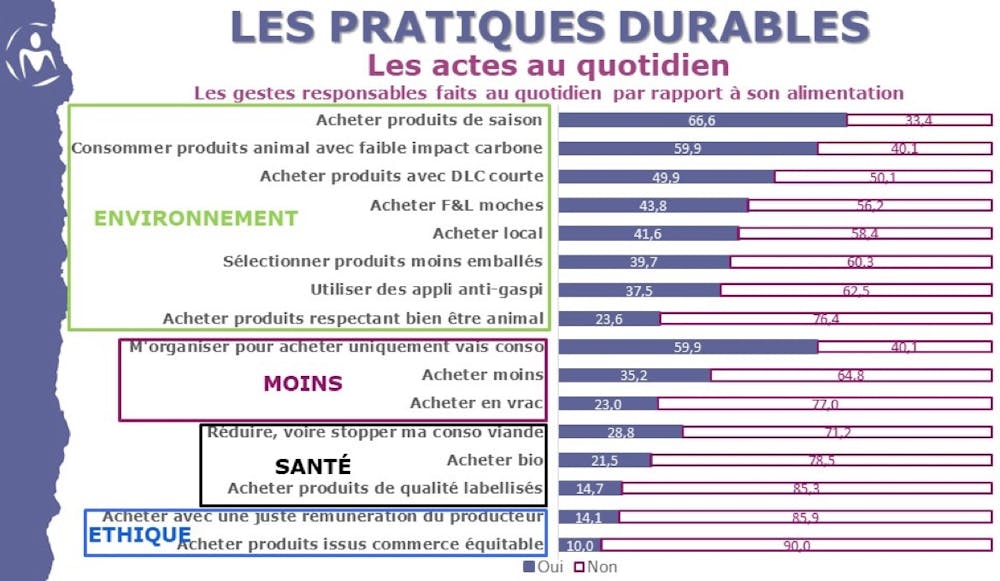
Free choice remains the key concern for French consumers: they are not willing to make sacrifices, nor do they seek to reduce their consumption or give up their favorite brands.
Their sense of responsibility is not universal: only a minority of people consider health and ethical criteria to be important. Yet nearly 89 percent believe that their behavior is environmentally friendly.
Paradoxical behavior toward brands
At first glance, sustainable offerings are booming. Consumers are increasingly saying they want brands to act responsibly. Yet a frustrating paradox remains at the heart of the green business: only a small number of consumers who express positive attitudes toward environmentally friendly products and services are willing to open their wallets.
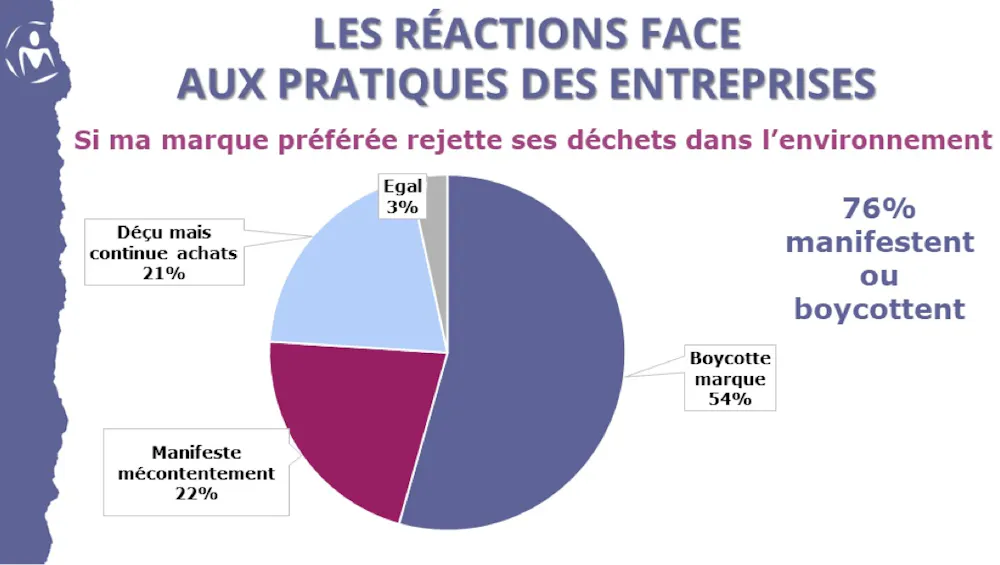
Consumers remain ambivalent, acting more as critics than as drivers of change: they criticize and punish companies that do not make an effort to reduce their environmental impact (nearly 76% of respondents express their dissatisfaction by protesting or boycotting a brand if it discharges waste into the environment), but they do not truly encourage companies’ positive efforts through their purchasing decisions.
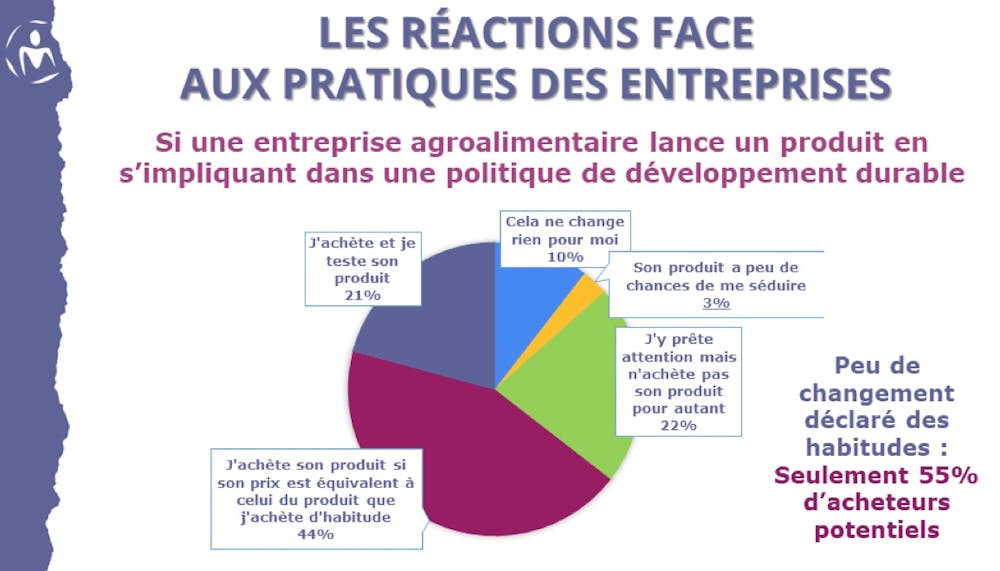
For an agri-food company to be perceived as committed to sustainable food production, it is important to consumers that the company practice responsible raw material management (reducing packaging, resource consumption, and raw material waste—all through continuous improvement), that it provide evidence of the positive nature of its processes (using local raw materials, animal welfare, support for sustainable agriculture, organic certification), and that it operates ethically (fair pricing, support for farmers, transparency).
However, even though 65% of French people said they wanted to buy a product made by a company committed to sustainable development, only 21% actually do so.
Different Consumer Profiles
The observatory’s findings also made it possible to segment consumers into five profiles based on their behaviors, daily concerns, and consumption patterns: the “responsible” consumer, the “locavore who consumes less,” the “non-fair-trade” consumer, the “somewhat locavore,” and the “non-responsible” consumer.
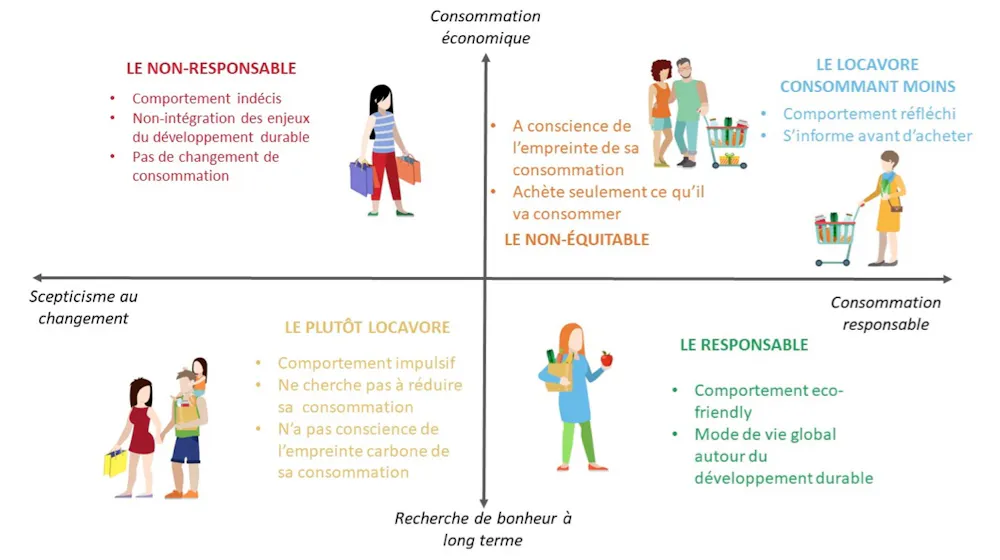
The MARÉSON-Responsable observatory identifies two profiles in the western part of the map: the “non-environmentally conscious ” (15.5% of respondents) and the “somewhat locavore” (20.2%). The “non-environmentally conscious ” respondent reports being undecided when making purchases. They do not wish to incorporate sustainability concerns into their decisions, as they perceive them as a constraint on their consumption. As a result, their consumption habits do not change, and they make no special effort in this regard.
The “somewhat locavore,” on the other hand, is an impulsive shopper; he often buys on a whim to satisfy a momentary desire. His happiness is short-lived. He doesn’t seek to reduce his consumption and buys products he won’t always use. Furthermore, they are unaware of the carbon footprint of their consumption. Aside from these two groups, everyone consumes responsibly in their own way.
In the eastern part of the graph, three profiles round out the study: the “unfair,” the “locavore who consumes less,” and the “responsible.” They account for 26.6%, 25.8%, and 11.9% of respondents, respectively.
The “not quite eco-conscious” consumer is a somewhat unique type. They are involved in responsible consumption but do not fully embrace all of its principles. Unlike the “mostly locavore,” they are aware of the carbon footprint of their consumption and buy only products they are certain they will consume.
The “locavore who consumes less,” on the other hand, adopts a thoughtful and responsible approach to shopping. He or she does research before buying and already knows which products to purchase.
Finally, the “responsible” consumer is the most developed profile in terms of responsible consumption. This consumer engages in “eco-friendly” purchasing behavior and organizes their overall lifestyle around sustainable development.
And you—which consumer profile do you fit into?
Erratic Learning Phase
Ultimately, consumers today are in a learning phase that is more haphazard than structured, due to a lack of concrete examples. Carbon footprints mean very little to them. They need information, evidence, guidance on priorities, concrete examples, and a sense of involvement to commit to genuine behavioral change.
The question of responsibility—whether it lies with providers, stakeholders, or consumers—has been raised. This study therefore prompts us to consider the educational methods and explanations needed for each of these stakeholders to help shift behaviors toward a system of sustainable consumption.
Mathilde Hoareau, a student at the University of Montpellier, made a significant contribution to the writing of this article.
Marie-Christine Lichtlé, University Professor, University of Montpellier; Anne Mione, Professor of Strategic Marketing, Quality Management, and Strategy, University of Montpellier; Béatrice Siadou-Martin, University Professor of Management Sciences, University of Montpellier and Jean-Marc Ferrandi, Professor of Marketing and Innovation at Oniris, IAE Nantes
This article is republished from The Conversation under a Creative Commons license. Readthe original article.