[LUM#4] The Museum Gets Into Perfume
Using a fragrance to bridge the gap between a painting and museum visitors—that’s the challenge taken on by students in the Faculty of Science. Or, when art meets science, much to the delight of the public.
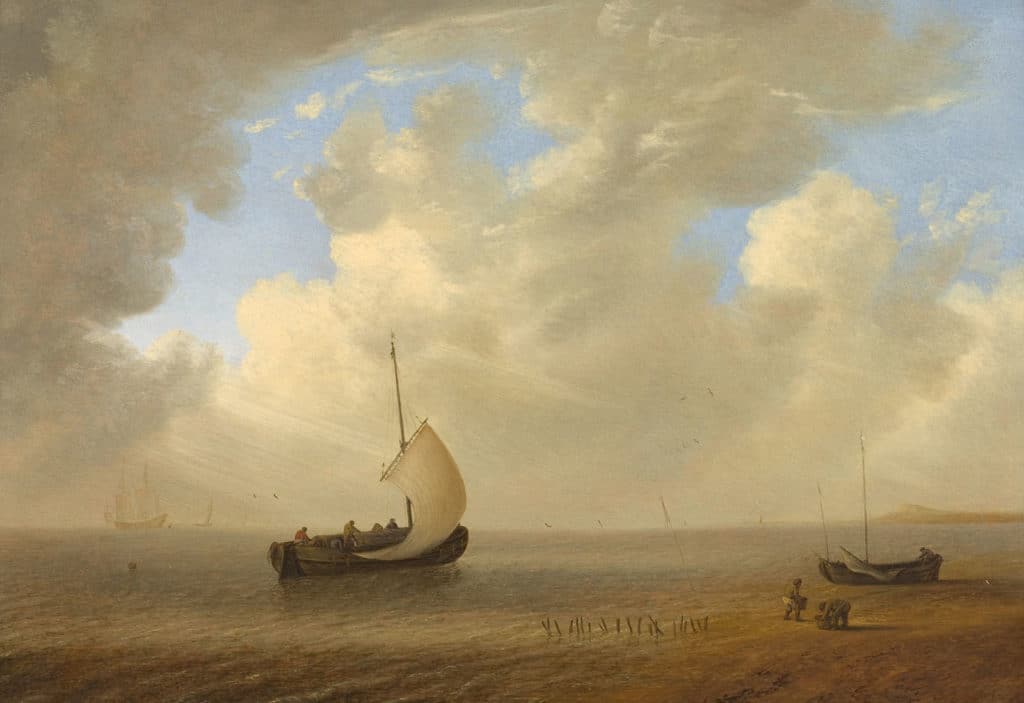
It is a seascape like thousands of others, just one of many illustrations of a theme dear to the Golden Age of Dutch painting. At first glance, there is nothing particularly original about this work, which depicts fishermen returning on a calm morning to an anonymous coastline. Upon closer inspection, however, the scene is not without charm, with its enchanting light, its skillfully orchestrated interplay of light and shadow, and its golden-brown sand plunging into translucent waters… And then there is that ever-present sky—it’s hard to say whether it heralds the onset of a storm or a return to calm after a night of rough weather.
This scene, taken from a painting on wood by Wilhem Van Diest (1600–1678), was—along with other works from the Fabre Museum— at the heart of a project led by studentsin the Master’s program in Cosmetics, Flavors, and Fragrance Engineering. Their challenge: to capture the atmosphere of a painting through a fragrance of their own creation. For Julia Prats, who worked with three of her classmates on “Marine par temps calme,” the main challenge was to avoid the pitfall of a too-literal interpretation: “We didn’t want to create something that would be too maritime, too salty…” she explains.
A cozy atmosphere, a sunny vibe, and warm sand…
“Above all, we sought to capture the soft, cottony atmosphere of the sky—the contrast between the transparency of the water and the heavy, humid atmosphere of the painting—as well as its very ethereal quality, which inspired a sunny tone in our composition.” There is undeniably poetry in this way of probing the soul of the artwork, in this way of evoking“the scent of warm sand” that Julia Prats speaks of. The student acknowledges, in fact, that the creative process was“less methodical than creative.” But chemistry is never far away. It was through a skillful blend of synthetic materials that these apprentice perfumers succeeded in giving the work its olfactory identity.“Once the desired note is achieved, it must be adapted and dissolved in a solvent, with a specific constraint stemming from the need to diffuse the fragrance throughout the space…” continues Julia Prats.
Unveiled during the Fabre Museum’s student night, their fragrance also allowed a specific audience—the visually impaired—to enter the world of painting. It was a resounding success.“We asked them to describe what they felt based on the scent, and thanks to their senses and a highly developed imagination, some were able to describe the painting in precise detail…” explains the student, who has since moved to Grasse, the capital of perfumery, to pursue what is perhaps the most delicate of scientific professions.
Check out theUM podcasts, now available on your favorite platform (Spotify, Deezer, Apple Podcasts, Amazon Music, etc.).