Silence in the Classroom: A Quiet Classroom, a Studious Classroom?
Do students need to be quiet in order to learn effectively? While silence has long been associated solely with the exercise of authority, it now involves other issues as well.
Sylvain Wagnon, University of Montpellier; Fabien Groeninger, University of Montpellier and Sonia Vermeulen Steyaert, Free University of Brussels (ULB)
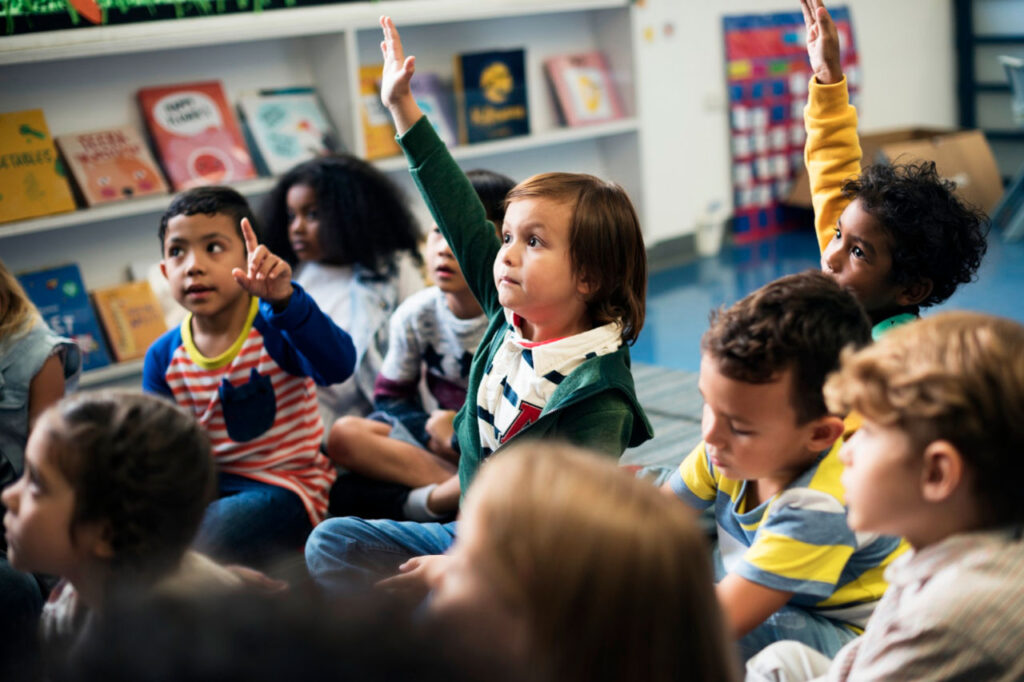
In the collective imagination, a “studious” classroom is often depicted as students sitting in rows, absorbed in their work, in complete silence—or, once their work is finished, with their arms crossed.
Does a quiet classroom necessarily mean one where students are focused on their lessons? This question, far from being trivial, goes to the heart of educational challenges related to student expression, interaction, and active participation. While silence has a history, it is also relevant today in the context of learning.
Silence and Authority
In an educational system historically based on passive listening and repetitive memorization, silence is a central element of classroom discipline. As part of the control over bodies and behavior described by Michel Foucault, it has become a symbol of respect for the teacher’s authority and of the students’ concentration.
Teachers, particularly those in elementary school, often use silence as a classroom management tool. It helps reduce distractions and signals to students that they need to focus on the task at hand. Achieving this silence can sometimes be a real struggle because it is so difficult to maintain.
It is also an aspect of the teacher's authority, as Magali Boizumaultwrites:
“Silence is, first and foremost, a means to an end, requiring the use of professional techniques that involve the teacher’s physical presence in order to achieve it and successfully convey instructions to the entire class. Then, it becomes an end in itself, serving to maintain a calm working environment.”
Silence can also have counterproductive effects. A classroom that is too quiet may mask a lack of engagement or a lack of understanding on the part of the students. Imposed silence may mean that students are afraid to ask questions or interact. Therefore, it is essential for teachers to be able to interpret this silence: does it indicate concentration, or does it hide discomfort or passivity?
Silence and Student Participation
Speech and dialogue play an essential role in learning, particularly by allowing students to express their ideas, articulate what they do not understand, and refine their reasoning through interaction with their peers. Silence, in this context, could be interpreted not as a sign of attention but as a barrier to student participation and engagement.
This is not a new issue. Beginning in 1881, the libertarian socialist Paul Robin theorized and implemented a holistic education that was at once intellectual, physical, and emotional—one in which joyful expression stood in contrast to silence, which was synonymous with passivity. But this issue divided the reformist educators of the “nouvelle éducation” movement in the early20thcentury. In 1932, Élise Freinet contrasted the silence of Montessori classrooms with the liveliness of Freinet pedagogy:
“We watched them with a sort of amazement as they silently and deftly manipulated surfaces and cubes, and all those static objects—which sometimes led to feats of square-root or cube-root virtuosity—placed us in an atmosphere reminiscent of trained monkeys… We thought of our little shaggy, scruffy students, so spontaneous in their gestures and bursts of energy, and the memory of our bustling classrooms came flooding back, perhaps preventing us from understanding the truth hidden in the games of these little Montessori magicians.”
Thus, while silence is often seen as the opposite of active participation, this contrast warrants further qualification. Some studies highlight its performative function and suggest that silence encourages students’ self-regulation by prompting them to turn inward and process information independently.
This quiet space then becomes a time when each student can progress at their own pace, based on their needs and their ability to absorb knowledge, thereby fostering a better educational relationship.
In a classroom, the balance between silence and expression is essential for it to become a truly effective teaching tool. A teacher who emphasizes silence alone can stifle students’ creativity and curiosity. On the contrary, an environment in which speaking is encouraged—without descending into chaos—can stimulate participation and engagement among all students, creating a classroom atmosphere where silence and speech coexist in a complementary way, each playing a role in the learning process.
This process of learning when to speak and when to be silent can be fostered, in particular, through theater activities, in which silences play an important role. Furthermore, silence, like verbal expression, is also a matter of power dynamics between boys and girls in the learning process —something teachers need to be aware of.
Silence: A Challenge in Schools
Silence is beneficial to health and can play a key role in the development of social-emotional skills, even as ambient noise becomes a real source of disruption for students. In a society where noise is the norm, moments of silence take on a different meaning in the classroom: a time that can be controlled. The sound environment is a major challenge for schools, particularly in terms of understanding the role of silence in the overall educational process.
While the idea of “visual” or “auditory” learners may seem like a neuromyth, teachers can allow moments of silence for individual reflection, while also encouraging interactive discussions for those who learn through speaking. In this sense, the management of silence should not be uniform in the classroom but should instead be tailored to the students’ needs and the educational objectives to be achieved.
[There are already more than 120,000 subscribers to The Conversation’s newsletters. What about you? Subscribe today to gain a better understanding of the world’s major issues.]
Managing silence and classroom noise levels does not depend solely on teaching methods. It is also influenced by the acoustic qualities of the space. A poor acoustic environment can hinder effective noise management by introducing disruptive noise from inside or outside the classroom, thereby affecting the learning atmosphere and student interactions. By improving acoustic conditions, teachers can better control noise and thus achieve their instructional goals.
Beyond the classroom, new forms of schooling—particularly outdoor education—approach silence in a different way and rethink its role and function in the educational process, using it as a means of listening to the surrounding nature, focusing, and observing. These are all ways to learn about the role and importance of silence today, both in education and in human relationships as a whole.
Sylvain Wagnon, Full Professor of Education, School of Education, University of Montpellier; Fabien Groeninger, Associate Professor, Faculty of Education, LIRDEF (Interdisciplinary Research Laboratory in Didactics, Education, and Training), University of Montpellier and Sonia Vermeulen Steyaert, Ph.D. candidate in Work Psychology and Educational Sciences, Free University of Brussels (ULB)
This article is republished from The Conversation under a Creative Commons license. Readthe original article.