The "Combat Hero" Syndrome: Watch Out for the Comeback!
COVID-19 arrived in France at a time when the hospital system was in a severely deteriorated state, with extremely difficult working conditions and a growing sense that their efforts were not being recognized by the public—and even less so by government authorities.
Florence Nande, University of Montpellier and Marie-Laure Weber, University of Montpellier

All of this is contributing to a growing sense of unease among healthcare workers. And yet, in the face of this unprecedented health crisis, hospital staff are standing together and stepping up on the front lines, day after day, in service to the entire nation.
We are rediscovering these women and men who are fighting at their own risk for the sake of others: yesterday’s forgotten figures are becoming today’s heroes. They are the subject of numerous tributes, not only from ordinary French citizens but also from the highest levels of government. The President of the Republic’s resolute speech on March 16 (“We are at war”), announcing the start of a nationwide lockdown, transformed healthcare workers into heroic frontline fighters. At the height of the health crisis, every evening at 8 p.m., the French people applauded them from their windows as a sign of gratitude for these unsung heroes who command such admiration. And every day, the media also relayed messages of support from the entire population.
Loss of psychological resources
However, taking on the role of a hero can be dangerous for these healthcare workers, both in the short and long term. They face extremely stressful situations on a daily basis and are already vulnerable due to past struggles. Their anger over the lack of resources has not been heard by public authorities, as evidenced by the protests by hospital staff in late 2019.
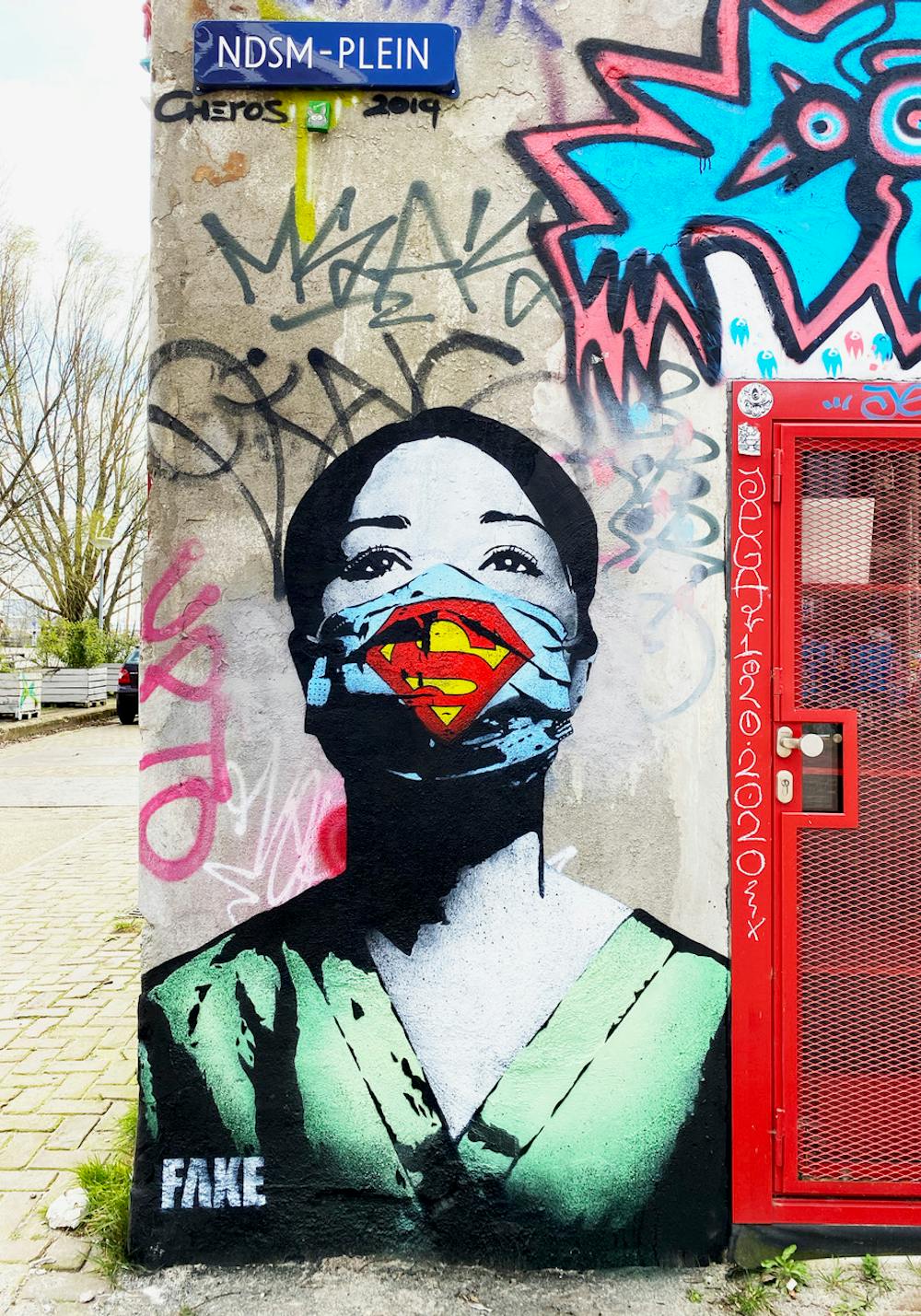
Street Art News
In mythology, the warrior hero is a superhuman, a demigod who is distinguished by his exploits, his extraordinary courage, his great self-sacrifice, and his willingness to make sacrifices; he goes into battle and endures suffering in silence without asking for any help.
Although healthcare workers demonstrate self-sacrifice and courage, their daily lives are also marked by: fear for themselves and their families; stress caused by shortages of protective equipment; the brutality of this disease, which is leading to an exponential surge in patients and day-to-day reorganizations; the fear of having to make decisions that go against their values, incivility and violence from some members of the public, and the fatigue that builds up in a daily routine that has become extremely anxiety-inducing. All of this contributes to the depletion of their psychological resources.
This “heroic fighter” approach may seem rewarding and encouraging in the short term, but without strong support systems and additional resources, it may not compensate for the loss of personal resources caused by these extreme circumstances, with both short- and long-term consequences for the mental health of healthcare workers.
Hobfoll’s (1989) Theory of Resource Conservation (COR) provides us with an informed perspective on this situation. It suggests that individuals continually strive to obtain, maintain, protect, and nurture the resources they value (such as health, family, etc.). Stress arises when these resources are threatened or actually lost, or when circumstances prevent individuals from acquiring new resources despite significant personal effort.
The availability of and access to these resources enable individuals to achieve or maintain their goals. Situations that undermine access to these resources generate stress and can have long-term consequences for individuals’ psychological health. It is therefore important to establish conditions that allow healthcare professionals to protect and replenish their reservoir of resources—conditions that Hobfoll refers to as “resource caravan passageways.”
When people live in enriching and stable environments, they have fertile ground for developing richer networks of resources and for maintaining their “resource caravans” (in other words, their reservoir of resources); whereas in harmful circumstances, people may struggle or fail to develop or maintain them.
Recognition alone is not enough
Based on this theory, there is therefore a high risk that these healthcare workers—who are facing an unprecedented situation in which their core resources (health, family, sense of purpose) are constantly under threat—will develop a sense of chronic stress that could have consequences for their health. In this context, the resource of “recognition” alone does not serve as a means of coping with stress. It will help them cope in the short term, but it will not be enough unless accompanied by other material, financial, and human resources that could compensate for the loss of resources experienced by our healthcare workers.
This is all the more significant because, as a result of chronic stress, people tend to see their pool of resources become increasingly depleted and will be more vulnerable when coping with future losses. Hobfoll emphasizes the primacy of loss: individuals overemphasize the loss of resources and underemphasize gains. In other words, every individual exhibits loss sensitivity, meaning that emotional responses are more pronounced during negative experiences than during positive ones. It is therefore important to establish sustainable conditions to maintain a level of available resources, lest increased workplace distress emerge once the spotlight on these professions fades.
The massive investment plan for hospitals and the revitalization of careers—announced at the height of the crisis on March 25 by the President of the Republic—must therefore establish sustainable conditions that provide for, enrich, and protect the resources of healthcare workers. This could be a first step toward addressing the now-viral plea made by neurologist François Salachas last February: “You can count on me; the opposite remains to be proven…”
Florence Nande, Temporary Teaching and Research Assistant ( Research , or ATER) – MRM Laboratory and Nîmes University of Applied Sciences (IUT), University of Montpellier and Marie-Laure Weber, Ph.D. candidate in Management Sciences, MRM Laboratory, University of Montpellier
This article is republished from The Conversation under a Creative Commons license. Readthe original article.