The School of Change: Filming Alternative Teaching Methods
The lockdown and the challenges of returning to school under health protocols remind us—if any further reminder were needed—of the importance of the interactions and human connections that develop between teachers and children.
Sylvain Wagnon, University of Montpellier
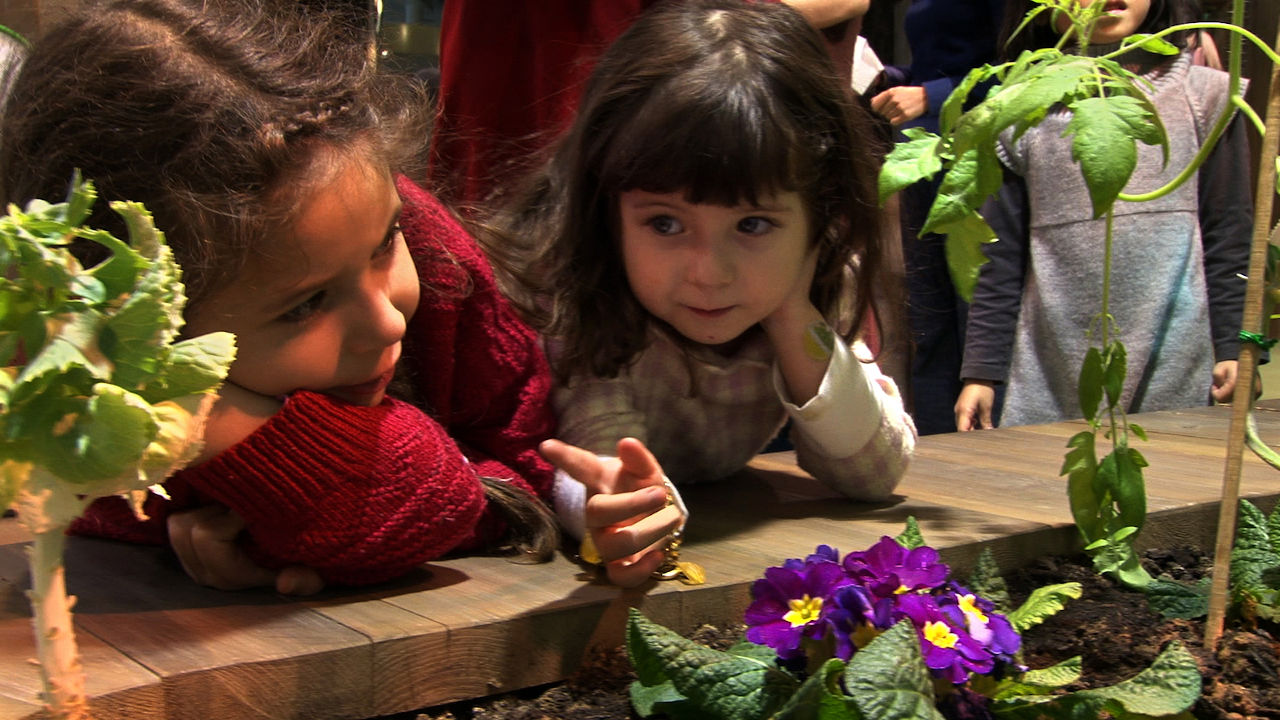
As there is much discussion about the “world after,” calls for a renewal of teaching methods and school environments are on the rise—one notable example is the op-ed published in *Le Monde* calling for classes to be held outdoors.
However, this need for new horizons did not suddenly emerge with the lockdown. It is a goal of alternative educational approaches that emerged as early as the beginning ofthe 20th century and continue to enjoy widespread success, as evidenced by the popularity of the Montessori method.
How can we move beyond the realm of utopia and view this bubbling cauldron of ideas as real possibilities for the future? What if film could help us chart concrete paths to explore? Here is a selection of documentaries that can help us see school from a different perspective.
The School of Change
In 2018, a documentary by Anne Schiffmann and Chergui Kharroubi, *The School of Change* , focused on two new secondary schools in Brussels that have opted for active teaching methods—that is, methods that move beyond the traditional lecture format, where students are merely listeners, to empower them to take an active role in their own learning. This choice is reflected in the words of a teacher featured in the film:
“What we want to do now is an activity where we’ll talk as a group. We’re not going to turn to the board where I’ll supposedly be imparting knowledge to you. We’re going to look at one another because knowledge resides within each of us.”
The filmmakers spent a year immersed in these schools, observing the students’ daily lives and bringing these teaching methods to life. One of the film’s strengths is that it does not limit itself to a purely didactic understanding of these teaching methods, which in reality form a vast array of approaches—including Freinet, Montessori, Decroly, and Steiner—each with its own distinct characteristics.
Here, the filmmakers observe the transformations taking place within an educational community, the hesitations and doubts of the teaching staff, but above all their commitment and enthusiasm. Far from being a rigid institution, the school thus comes across as an adventure.
Playing hooky
Although they remain a small minority even today, all alternative educational approaches have been committed to raising awareness of their methods. As early as the beginning ofthe 20th century, they recognized the importance of film. But it was initially through fictional films that the general public was first introduced to these educational approaches.
In 1949, *L’école buissonnière*, directed by Jean-Paul Le Chanois, is a fictional account of the early career of educator Célestin Freinet, portrayed on screen by Bernard Blier. The screenplay was supervised by Elise Freinet herself, who was eager to spread Freinet’s innovative educational ideas.
More recently—in 2016—and in a much more “Hollywood-style” film, *Captain Fantastic*, starring Viggo Mortensen, shed light on homeschooling.
A Different Perspective on School
Recently rediscovered, Vittorio de Seta’s 1973 Italian film *The Diary of a Schoolteacher* was a pioneer in its skillful portrayal of children playing, working, and creating, while offering a glimpse into the caring educational relationship between the teacher and his class—a relationship that alternative educational approaches seek to foster.
Filming teaching in action is complex. How can we show children playing, thinking, or marveling? Yet there is a successful genre of educational documentaries. Nicolas Philibert’s film, *Etre et avoir*, released in 2002, chronicles the journey of a single-grade rural classroom in Auvergne.
Over the past decade or so, we have witnessed a resurgence of this genre. Every alternative educational approach recognizes the importance of highlighting the characteristics of its experiments. The perspective chosen is generally that of the proponents of the educational approach in question, rather than that of critical analysis.
Regarding Montessori and Freinet teaching methods, or homeschooling, examples include *Etre et devenir* by Clara Bellar (2014) and *L’école en vie* by Mathilde Syre (2016), *The Teacher Is the Child* by Alexandre Mourot, or *Une idée folle*, by Judith Grumbach, 2017, *To Be Rather Than to Have* by Agnès Fouilleux, 2018.
Creativity and Independence
These films all aim to convey the enthusiasm, dedication, and passion for teaching through alternative teaching methods.
Returning to *L’école du changement*—whose title is a manifesto in itself—the filmmakers have succeeded in showing that rethinking school requires a multitude of small actions, a caring and trusting approach from adults, and a joy in teaching that sparks children’s boundless curiosity.
The film crew’s immersion allows them to capture scenes of school life that highlight important concepts such as independence and creativity by following children and adults as they grow together at their own pace.
The challenge with all these films is to show the invisible aspect of the mental process of learning. By observing children and adolescents as they reflect, think, and work in groups or on projects, a picture emerges of this alternative school envisioned by alternative educational approaches.
Contrary to some common misconceptions, these films highlight the importance of adults, the teacher-student relationship, parents, and respect for rules established together, as well as a high standard and rigor in work that are not at odds with enjoyment and well-being.
An Educational and Political Project
Of course, these films portray these educational experiences in a sympathetic light. The danger would be to fall into an idealized view and blind activism. Criticisms do exist and must be taken into account by alternative educational approaches.
Some studies highlight the difficulties and inequalities that active learning methods can create for certain students. This raises the question of social diversity and the risk of social “cliques” in such schools. These films obviously do not answer all of these questions, and understanding the intentions and goals of an education system beyond mere rhetoric is a challenge.
See also:
Alternative teaching methods: a vast array with diverse political aims
Nevertheless, observing the joy of learning and teaching highlights the gap between an approach to education based on the omnipotence of disciplinary knowledge and one that seeks meaning. This should not prevent alternative educational approaches from clarifying their social and political mission in order to determine whether they will contribute to at the first sign to envision a new kind of education.
Sylvain Wagnon, Full Professor of Education, School of Education, University of Montpellier
This article is republished from The Conversation under a Creative Commons license. Readthe original article.