Mites Step Out of the Shadows: A First-of-Its-Kind Exhibition Reveals the Fascinating World of These Sentinels of Life
From July 22 to October 30, 2026, the Jardin des Plantes in Montpellier will host a special exhibition dedicated to mites. Through spectacular photographs and stories accessible to all, the INRAE Occitanie-Montpellier Center, the University of Montpellier, and their partners invite the public to discover these microscopic animals, which play a major role in soil health, agriculture, ecosystems… and even our daily lives.
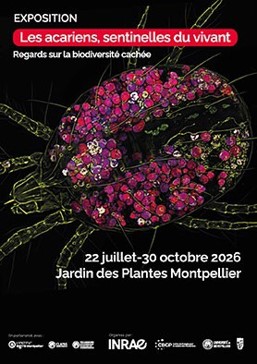
They live in the soil, on plants, in the oceans, on animals… and even on our skin. Yet most of us are unaware of them. Tiny cousins of spiders, mites are among the most abundant and diverse animals on the planet. Scientists have already described nearly 55,000 species, but this number is thought to represent only a small fraction of their actual diversity. Produced by the INRAE Occitanie-Montpellier Center / UMR CBGP (Center for Biology and Population Management), in partnership with the University of Montpellier / the School of Medicine and the Agro Montpellier Institute, the exhibition “Mites: Sentinels of Life—A Look at Hidden Biodiversity” offers a journey into the heart of an invisible world.
“The photographs are from a contest that inspired researchers from 18 countries participating in the 17th International Congress of Acarology, which is being held for the first time in France, in Montpellier, from July 20 to 24, 2026,” explains Denise Navia, an acarologist at the Center for Biology and Population Management, a joint research unit of INRAE, CIRAD, IRD, IAM, and the University of Montpellier. Through 23 richly illustrated panels, visitors discover how mites contribute to the functioning of ecosystems, soil fertility, and natural pest control, as well as to human and animal health.
Debunking Common Misconceptions
The exhibition also debunks a few common misconceptions. While some species cause disease or damage crops, many are, in fact, valuable allies. Some protect crops by consuming pests, while others recycle organic matter or serve as indicators of environmental health. Mites are now at the heart of research on agroecology, biodiversity, biocontrol, and the “One Health” approach, which links the health of humans, animals, and ecosystems. One of the exhibition’s highlights is the exceptional quality of its images. Taken by researchers from around the world, the macro and electron microscope photographs reveal a world of unexpected beauty. Vibrant colors, microscopic structures, and details invisible to the naked eye transform these little-known animals into true works of natural art.
The exhibition also pays tribute to Antoine Louis Dugès, a physician from Montpellier and one of the pioneers of the scientific study of mites in the 19th century, and shows how advances in imaging and genetics are now enabling us to better understand these organisms, which are essential to the functioning of living organisms.
Designed for audiences of all ages, this bilingual (French-English) exhibition invites visitors to take a fresh look at biodiversity that is often invisible but essential.
Practical Information:
- Date: July 22, 2026, through October 30
- Location: Jardin des Plantes in Montpellier
- Registration: Free admission