The physical challenges that aerobatic flying poses for pilots
Our species is adapted to a world governed by constant gravity—specifically, an ever-present force of acceleration resulting from Earth’s gravitational pull (the unit of Earth’s gravitational acceleration, denoted by g, is 9.81m/s²). There are, however, circumstances in which our bodies are subjected to forces stronger than Earth’s standard gravity… This, too, is a matter of acceleration.
Stéphane Perrey, University of Montpellier
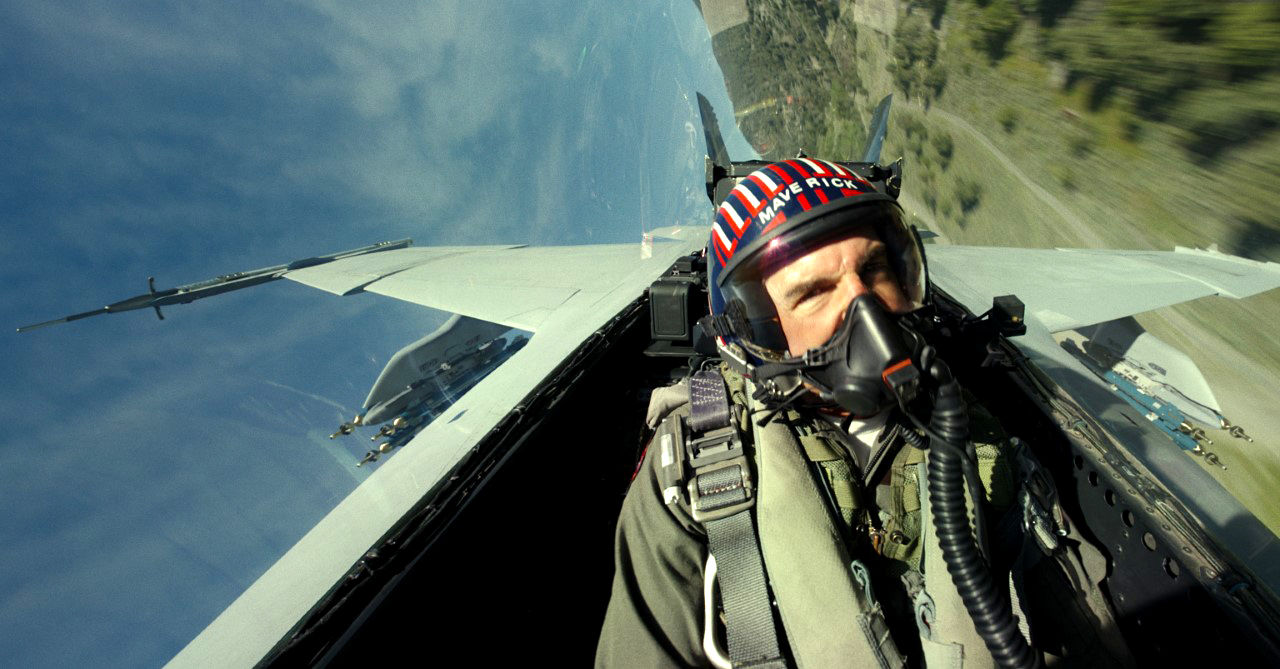
In the aerospace and automotive industries, experts refer to G (for gravitational) or load factor as a unit of acceleration. And its effects can be devastating.
As children learning to walk, we quickly discover that a misstep will eventually result in a painful impact with the ground—precisely because of gravity. When we board an airplane—without going so far as to crash this time—everything we’ve learned about gravity and everything we’re used to changes abruptly. You only have to watch Pete “Maverick” Mitchell’s final aerial maneuvers in the latest Top Gun to be convinced.
Flight essentially involves overcoming gravity to rise into the air, and speed is essential to this process. Any aviation maneuver can therefore expose our bodies to significant accelerations, with notable effects on the cardiovascular system, the brain, and the joints. Some aircraft are capable of reaching 12G, with climb rates exceeding 15 G/s!
How many Gs do we experience on a daily basis?
Such figures are, of course, extremes. When standing still on the ground, the perceived acceleration is 1G. Everything is fine. At 2G—for example, while taking a 60-degree banked turn—you already feel a moderate sense of compression against your seat and have difficulty moving. A person weighing 80 kg on Earth (assuming this is equivalent to 1G) will feel as if they weigh 160 kg if they experience 2G. At 8–9 G or higher, it becomes impossible to move your limbs, with the exception of your extremities.
In fact, there are three main types of G-forces present along three axes in space. We can experience lateral G-forces (Gy) during a turn, resulting from centrifugal acceleration that pushes us outward. For horizontal acceleration or deceleration, we refer to Gx. Finally, Gz occurs during an airplane’s descent or following a sudden climb. We are particularly sensitive to these accelerations experienced along the vertical axis (Gz)—that is, from head to toe—since this is where we feel the force of Earth’s gravity, which is necessary to maintain our balance.
To further complicate matters, for all three axes, both positive and negative G-forces are possible… Whether a car is turning a corner or an airplane is flying vertically, a force opposing the motion—the force of inertia—adds to the actual weight due to gravity to give the “apparent” weight of the airplane in flight. When the apparent weight during motion is greater than the actual weight, the load factor is greater than +1G. Conversely, if the aircraft is flying upside down, for example, the load factor is expressed as a negative value, -G.
To calculate the G-forces they are subjected to, airline pilots—who are particularly vulnerable—are equipped with three-axis accelerometers, which allow them to know in real time what forces they are experiencing.
How Our Bodies Cope with Gravity Under Normal Circumstances
During flight, pilots are indeed subjected to a wide variety of physiological effects resulting from the combination of acceleration and gravity. These effects are inherent in the inertial forces generated by acceleration and affect all the body’s organs, particularly the cardiovascular system: the heart (the pump), the blood vessels (the circulatory system), and the blood (the fluid).
Blood circulation, however, ensures the transport of oxygen, which is essential for the proper functioning of the organs. The brain is particularly demanding in this regard, both in terms of consumption (it uses a lot of oxygen) and the consistency of its supply. It doesn’t like sudden fluctuations, excesses, or shortages!
On Earth, there is a complex mechanism for controlling and adapting the entire system that ensures a steady, well-oxygenated blood flow at a constant rate to the brain, whether at rest or during intense exertion: this is cerebral autoregulation. Any variation in blood pressure is therefore inconsequential. However, this delicate balance does have its limits… Accelerating while turning, braking, or—even more so—performing aerobatics will significantly disrupt it.
The ability to maintain cerebral blood flow—resilient in the face of repeated exposure to increased stressors—is therefore a critical issue for pilots operating outside normal everyday conditions.
When Our Physiological Adaptations Are No Longer Enough
The risks were identified—albeit poorly explained—more than a century ago. In 1918, the first acceleration-induced disorder was experienced during the Schneider Cup air race, when a sharp turn had to be made. Initially described as “air sickness,” it is now known as “G-induced loss of consciousness, ” or G-LOC, and results in confusion and impaired judgment due to a temporary interruption of blood flow to the brain. This condition occurs at G-forces of +4.5–6G in a trained pilot.
Since the heart is located in the thorax, in an upright position (standing or sitting), the blood supply to the brain—which is situated above it—requires the blood to fight against its own weight (hydrostatic pressure) to flow from the heart to the brain. In the presence of +Gz, the inertial force along the head-to-feet axis adds to the hydrostatic force and exacerbates the situation by opposing the flow of blood from the heart to the head.
When exposure to levels above +3Gz is sustained for more than ten seconds, our self-regulatory mechanisms are overwhelmed, resulting in an immediate decline in vision and mental performance. This can result in visual disturbances such as a “gray haze” (at 3–4.5 G, caused by reduced blood flow to the retina and impaired peripheral vision) and a “black haze” (at 4.5–6 G, caused by a complete cessation of blood flow).
Negative accelerations (-Gz) trigger adaptive mechanisms that are the opposite of those caused by +Gz, accompanied by a more unpleasant sensation and greater perceived fatigue.
But the main problem lies in the rapid alternation between -G and +G at high values (the “push-pull” effect, or nose-down/nose-up motion), as in aerobatics, which is particularly difficult to tolerate. This stems from the disruption of our adaptive mechanisms and our increased susceptibility to blackouts and/or loss of consciousness, which can occur as early as +2Gz.
Identify the limits…
If the cardiovascular system’s response cannot keep pace with the onset of G-forces, the pilot’s performance will deteriorate to the point of causing a loss of consciousness. To avoid this dangerous outcome, studies have helped us better understand the limits of our adaptive capabilities and develop techniques to overcome them.
The creation of +Gz-time tolerance curves made it possible to compare asymptomatic and symptomatic individuals. The upper limit of these curves, marked by loss of consciousness (LOC-G), is a key factor in our physiological response to accelerations.
It has been found that if the increase in acceleration is gradual, visual symptoms precede cerebral symptoms. However, for accelerations exceeding +7Gz that are reached rapidly, loss of consciousness is not preceded by any warning signs. In fact, if the rate of acceleration increase is low enough, cardiovascular reflexes can, at least partially, compensate for changes in circulation. The tolerance threshold is thus increased.
In general, it has also been observed that individuals' sensitivity to these effects varies and can be modified with practice. Several factors can influence tolerance to acceleration.
If the heat isn't too intense, a well-rested, hydrated, and physically fit pilot will be able to tolerate +5Gz. This is because the volume of blood circulating in the body is greater and more readily available: it is therefore easier for the cardiovascular system to keep the brain supplied with oxygenated blood.
… To Outperform Them: Training for Expert Pilots
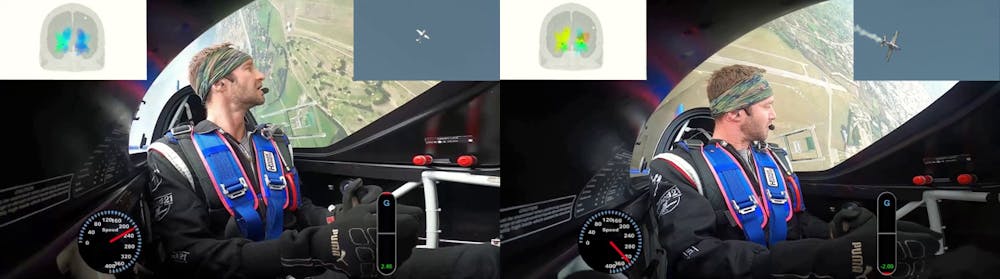
Experienced pilots also use musculoskeletal and respiratory techniques: tucking their heads into their shoulders and leaning forward to reduce the height of the hydrostatic column; contracting their abdominal and lower limb muscles to slow blood flow; and creating intrathoracic positive pressure by exhaling or keeping the glottis closed while tightly contracting the diaphragm and neck muscles.
Stephane Perrey, Author provided
A regular physical training program that includes a mix of endurance and strength exercises also increases a pilot’s tolerance to G-forces. Important factors to consider are core strength and aerobic capacity. Any aerobic endurance activity (even while holding one’s breath or at high altitude) is beneficial for the cardiovascular system.
Core-strengthening exercises (planks, push-ups, pull-ups, sit-ups) and, above all, those that strengthen the neck muscles are essential: high G-forces make the head weigh more than normal, and with a helmet, that’s a lot of weight to bear. Pilots of the fastest and most agile aircraft must constantly monitor their external reference points and adjust their head position during maneuvers.
Aerobatics can cause or exacerbate spinal pain. Strength training to cope with repeated, intense accelerations is essential for these pilots, who are considered elite athletes competing—and doing so—in extreme environments.
In addition, several tools can improve an individual’s tolerance to acceleration. Developed very early on during the world wars, anti-G pants—by applying counterpressure to the lower body in response to acceleration—help ensure adequate venous return. However, these devices only address +Gz forces and are unsuitable for use in aerobatic aircraft due to their weight.
Other innovative devices are being developed at research centers and companies in the sector. One example is the work being conducted by EuroMov Digital-Health in Motion and Semaxone, which are developing algorithms and sensors to measure cerebral oxygenation in real time in order to anticipate changes in drivers’ tolerance to acceleration.
The author would like to thank Mr. Jacky Montmain, University Professor (IMT Mines Alès, EuroMov Digital Health in Motion), for reviewing this manuscript; Mr. Gérard Dray, University Professor (IMT Mines Alès, EuroMov Digital Health in Motion), for reviewing this manuscript; and Mr. Guilhem Belda, engineer (CEO of Semaxone), for providing data and reviewing this manuscript.
Stéphane Perrey, PR, Unit Director Research , EuroMov Digital Health in Motion, University of Montpellier
This article is republished from The Conversation under a Creative Commons license. Readthe original article.