[LUM#9] Wastewater: A Resource for the Future
To address water shortages and preserve this increasingly scarce resource, researchers atthe European Membrane Institute are proposing an innovative wastewater treatment process. Their goal: to ensure that water leaving wastewater treatment plants meets quality standards and can be reused.
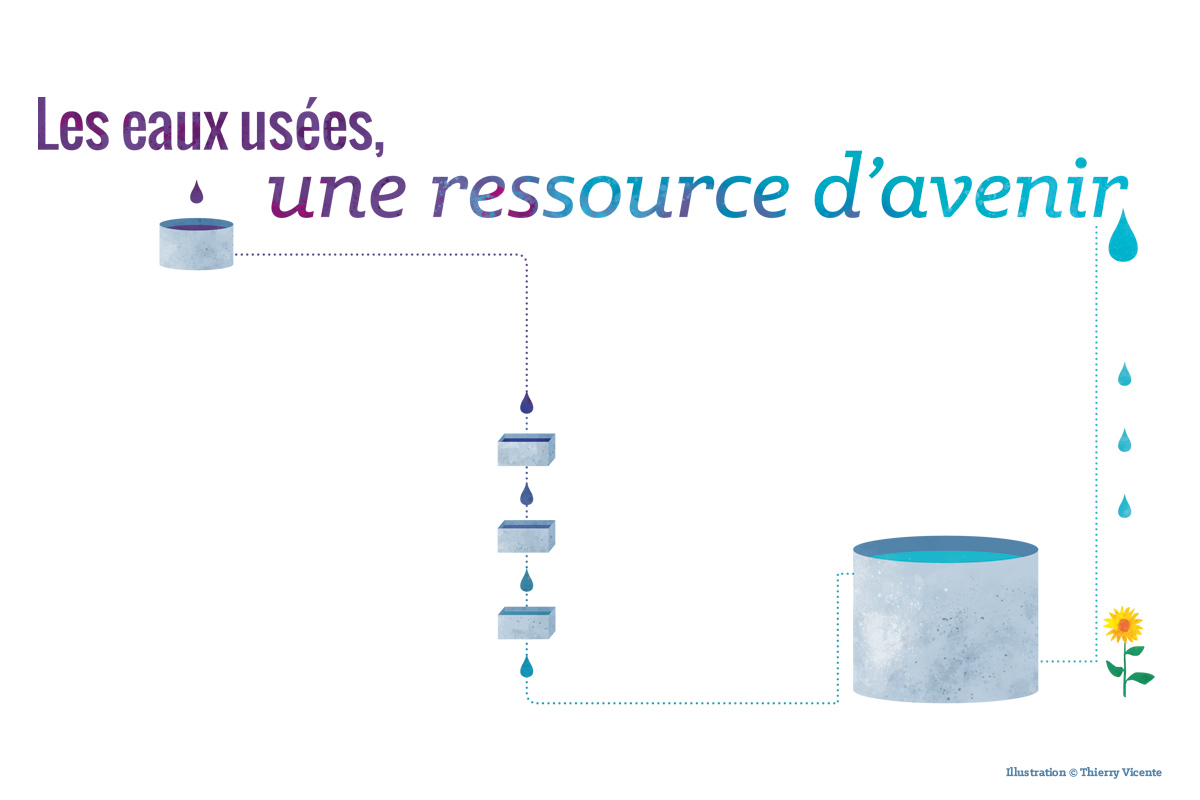
Pesticides, insecticides, pharmaceutical residues, and endocrine disruptors—all of these substances produced by human activities end up in the environment, and water bodies are no exception. This is an especially problematic issue because these micropollutants are harmful even in very small doses.
To preserve “blue gold” at a time when water scarcity is becoming a growing concern, researchers are developing new processes designed to effectively remove these substances from wastewater as it leaves treatment plants. This is a significant challenge that addresses a dual environmental goal: limiting the impact of micropollutants on the environment and enabling the reuse of wastewater that has been treated to remove these contaminants. A path forward for optimizing the management of water resources.
Persistent pollution
“Today, about 80% of micropollutants are removed by the biological treatment processes used in wastewater treatment plants, thanks to activated sludge that naturally breaks them down,” explains Julie Mendret, a researcher atthe European Membrane Institute (IEM). The problem is that some molecules are not biodegradable and persist in the water even after this treatment. “There remains 20% of refractory pollution that is discharged into the natural environment. In France, unlike other countries such as Switzerland, there are no standards for micropollutants at the wastewater treatment plant outlet, ” the researcher points out.
Yet the environmental consequences are well known: these micropollutants, which re-enter the water cycle, accumulate in the sediment and affect the entire ecosystem. “Studies show that fish living near wastewater treatment plant outfalls are contaminated by these molecules. These toxic compounds have become a major concern, and wastewater treatment plants of the future will need to modernize in order to limit their emissions, ” explains Julie Mendret. The researcher has decided to take on this challenge by proposing an innovative and intensive wastewater treatment process.
Innovative and intensive
Today, there are two types of processes used to treat these micropollutants: membrane processes and advanced oxidation processes.
The first relies on the use of membranes that trap very small molecules while allowing water to pass through. This filtration method is effective but has its limitations: “While the pollutants are certainly isolated from the water, they are not destroyed, and they must then be removed, ” explains Julie Mendret.
Another solution: advanced chemical oxidation processes. “Ozonation is particularly effective against micropollutants,” the researcher points out. “They are oxidized by ozone, which breaks them down into increasingly smaller molecules until, in the case of complete mineralization, only CO2 and H2O molecules remain. ” The pollutant is ultimately eliminated, leaving only harmless water and carbon dioxide molecules. It’s an effective but imperfect method: on the one hand, ozonation is not very cost-effective for pollutants that are highly diluted in water, and on the other hand, it can lead to the formation of toxic byproducts.
A 2-in-1 process
Faced with these limitations, researchers at theIEM came up with the idea of combining these water treatment processes to leverage their respective advantages.
An ambitious project called Saware. “It’s a 2-in-1 process: we combine highly advanced filtration—nanofiltration—with an advanced ozone-based oxidation process. The molecules are retained by the membrane and simultaneously oxidized through ozonation, ” explains Julie Mendret.
This hybrid process offers several advantages: ozone acts more effectively on pollutants that have been concentrated by filtration, and any toxic byproducts generated by ozonation are retained by the membrane and are therefore not released into the environment.
To develop this device, Julie Mendret and André Ayral of theIEM chose ceramic nanofiltration membranes, a material resistant to ozone. “This is the first time this type of catalytic membrane has been used to treat municipal wastewater, ” the specialist notes.
This innovation could ensure that high-quality water, suitable for reuse, is discharged from wastewater treatment plants (see sidebar). “Unfortunately, we’re held back by very strict French legislation that limits the reuse of wastewater,” laments Julie Mendret. This is a call for regulatory change to help preserve this invaluable resource.
Reuse: A Powerful Tool for Conserving Water Resources
In the face of a global water shortage, wastewater reuse is a path forward. Once treated, this water can be used for a variety of purposes: irrigating green spaces or crops, fighting fires, washing streets, or even replenishing groundwater aquifers. Some countries, such as Singapore, even go so far as to produce drinking water by treating wastewater.
In France, “reuse” remains underdeveloped. The reasons: a lack of public awareness and very strict regulations. Industry professionals are therefore advocating for a relaxation of the law that strictly regulates the reuse of wastewater, primarily for health reasons. The European Commission recently took up this issue and, in 2018, issued a proposed regulation specifically for agricultural irrigation, with the goal of facilitating the reuse of treated wastewater.
Check out theUM podcasts, now available on your favorite platform (Spotify, Deezer, Apple Podcasts, Amazon Music, etc.).