Flowers are letting pollinating insects down
As the decline in insect populations shows no signs of slowing, new questions are arising about how plants—which depend on pollinators—are adapting. How are they managing to reproduce under these conditions? In a recent study we conducted, we compared field pansies (Viola arvensis) currently growing in the Paris region to older plants of the same species, “revived” from seeds collected 20 to 30 years ago. We found that today’s flowers are 10% smaller and produce 20% less nectar than their ancestors—important traits for attracting pollinators, who consequently visit them less often. These changes show that the bonds between violets and their pollinators are breaking down.
Samson Acoca-Pidolle, University of Montpellier
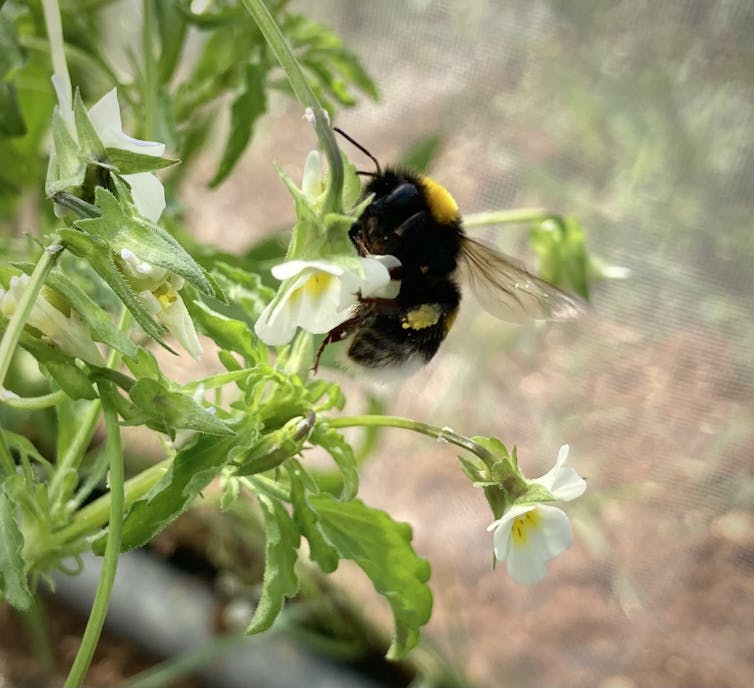
To highlight how today’s flowers have evolved compared to their ancestors, we used a method called “resurrection ecology.” This practice involves comparing individuals of the same species that were collected several years apart.

In this study, published in the scientific journal *New Phytologist*, the ancient plants were “revived” from seeds collected in the 1990s and 2000s and preserved by the National Botanical Conservatories of Bailleul and the Paris Basin. These ancient plants were compared to plants collected in 2021. Comparing the historic pansies with their descendants currently growing in the same fields in the Paris Basin provides insight into the species’ evolution over the past 20 to 30 years.
Is the decline of pollinators to blame?
This is how we were able to study the changes in four populations of field pansies—a field weed, that is, a wild plant found in agricultural crops—in the Paris Basin. Field weeds play an important role in pollination services by attracting pollinating insects and providing them with a diverse food source. A decline in the attractiveness of field plants could reduce the attraction of pollinators, which are essential for good yields in 75 percent of agricultural crops.
The reduced attractiveness of flowers to pollinators is likely their response to the decline in insect populations over the past few decades, as reported by several studies across Europe. More than 75% of the biomass of flying insects—which includes pollinators—has disappeared from German protected areas over the past 30 years. Field pansies, like most flowering plants, are the result of coevolution with their pollinators over millions of years, leading to a mutually beneficial relationship. The plant produces nectar for the insects, and in return, the insects transport pollen between flowers, ensuring the plant’s reproduction.
With the decline of pollinators—and thus the transfer of pollen between flowers—plant reproduction is becoming more difficult. The results of this study reveal that pansies are therefore evolving to reproduce without pollinators. They are increasingly resorting to self-fertilization—reproducing with themselves—which is possible for hermaphroditic plants, which account for about 90% of flowering plants.
A similar trend has already been observed in experiments where, within just a few generations and in the absence of pollinators, plants reproduce more through self-pollination and produce flowers with less nectar that are less attractive than their insect-pollinated counterparts. Our study, however, is the first to show that the decline in pollinators may already be driving a shift toward self-fertilization in nature.
Consequences for the Entire Ecosystem
Self-fertilization is a reproductive strategy that may be effective in the short term but would limit the species’ ability to adapt to future environmental changes by reducing genetic diversity, thereby increasing the risk of extinction.
These findings are also bad news for pollinators and the rest of the food chain. Our study has indeed revealed a vicious cycle: a reduction in nectar production by plants means less food for insects, which in turn can contribute to threatening pollinator populations. We show that the decline of pollinators has not only demographic consequences but also evolutionary ones, which are all the more difficult to reverse.
Samson Acoca-Pidolle, Ph.D. candidate in evolutionary ecology, University of Montpellier
This article is republished from The Conversation under a Creative Commons license. Readthe original article.