UM 's researchers win gold in Boston
For the second consecutive year, a team of students from theUM has won a medal atIGEM, the major international synthetic biology competition organized by MIT.
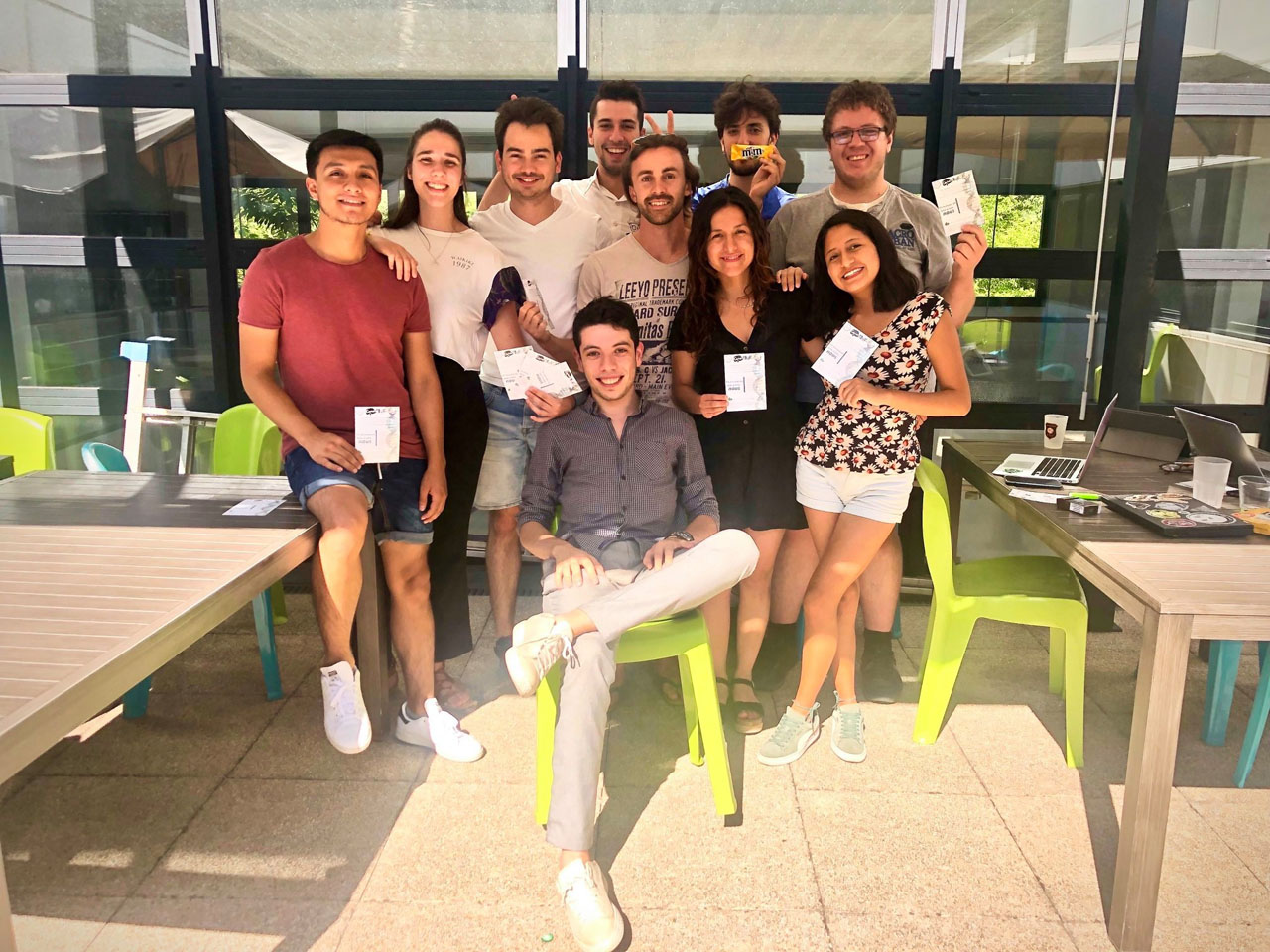
Part of the IGEM team from Montpellier that will travel to Boston to present its work on November 5
The 14 students, who were in Boston on November 5, worked on a new molecular medical tool: a protein scissors that could have numerous therapeutic applications. Project name: Karma!
Derived from Sanskrit, the term “karma” could be translated as “action.” It’s a word that aptly sums up the energy of this new team from Montpellier, which participated in the prestigious“International Genetically Engineered Machine Competition”(IGEM). In Boston, the team presented its project against 340 selected teams from 40 countries, including teams from Stanford and Oxford.
Elsa Frisot is a Ph.D. student at the Center for Structural Biochemistry (CBS); she participated in the competition last year with the Vagineering project and wanted to repeat the experience, this time as a mentor. “We selected the candidates based on their applications in January. Many biologists apply, but all students are welcome to participate; we need computer scientists, communications specialists, lawyers, graphic designers…”
Targeting Proteins
Once the team was formed, the fourteen young researchers had to develop a research project. Inspired by the CRISPR-Cas9 tool—a genetic scissors capable of targeting and cutting a specific DNA sequence—they came up with the idea of designing a molecular tool that functions like protein scissors.
“In many diseases, such as cancer or Alzheimer’s, research has identified the role that certain proteins play in the development of the disease,” explains Thomas Bessede, a first-year BIOTIN (Master’s in Biology and Health) student. “Current drugs use chemical molecules to break them down.” The problem is that these molecules do not always target only the proteins in question and therefore cause side effects.
Molecules capable of breaking down proteins also exist in our bodies; these are called proteases. Some of them are highly specific and can effectively target a particular type of protein. “Unfortunately, ” explains Elsa Frisot, “we don’t have a specific protease for every type of protein; there are certainly nonspecific proteases, but they, too, carry the risk of causing side effects.”
A Researcher

Karma: a protein scissors that combines a protease with the “seeking head” of an antibody called VHH
The students then came up with the idea of combining these nonspecific proteases with antibodies, whose strength lies in being specifically designed to target a protein. “Today, in the lab, we’re able to design antibodies for just about anything. Each antibody has the ability to bind to a specific target thanks to a small part called the VHH,” explains Thomas Bessede. A VHH functions as a sort of “homing head,” which the IGEM team fused with the protease to guide it to the desired target.
To test this concept in the lab and prove that their “scissors” were indeed capable of cutting a protein at the desired location, the biologists had only three months—a real challenge! They used GFP, a protein capable of emitting green fluorescent light, to which they added a small tag that blocked this fluorescence. “Our VHH was designed to target a specific motif on the tag. The goal was to guide our protease to that tag so it could break it down and allow the GFP to glow again. That’s exactly what happened, so we’ve proven the concept,” Thomas says happily.
Proof of Concept
The experiment was then confirmed using the same VHH, but this time replacing GFP with another protein. “Since our VHH was designed to specifically target GFP, it shouldn’t have had any effect. Once again, we confirmed our proof of concept,” the biologist concluded.
Although the Montpellier team didn’t expect to win the Grand Prize given the competition from major Anglo-Saxon universities, they were nevertheless aiming for a gold medal. And that’s exactly what they achieved! “It’s a great project, and we met all the criteria!” These criteria go beyond the scientific aspect of the project. The MIT competition also seeks to highlight other aspects of research, such as fundraising from private and public partners, building a website, and science communication.
A “caravatour”
“All summer long, we promoted science to the general public as we traveled throughout the region in a caravan ,” explains Elsa Frisot. The team also addressed the environmental aspect by creating, in partnership with students from Nantes, an educational art piece using all the waste generated by their experiments. “In just three weeks, we generated 20 kg of plastic. Science creates a lot of pollution, and we also wanted to raise awareness about this lesser-known aspect of research,” emphasizes Thomas Bessede.
The KARMA project, which has received recognition and awards, is now sitting in the CBS refrigerators, in the hope that a motivated researcher will continue the experiment to fully realize its potential. You can read more about this adventure on theIGEM 2019 website.