[LUM#10] The Miraculous Properties of Urine
When scientists and eco-friendly entrepreneurs team up to reinterpret the miracle of water turned into wine, the result is a very special vintage called “I’ll Pee on Your Vines.” Or, how the nutrients in our urine can be repurposed as fertilizer for grapevines. The Gospel of the Valurine Project according to Marc Héran, a researcher atthe European Membrane Institute (IEM).
The French consume drinking water—a lot of it—20 percent of which is used solely for flushing toilets. This water must then be transported to our wastewater treatment plants, treated, and returned to our natural environments. It’s a rather unsustainable cycle with staggering financial, energy, and environmental costs.
“We’re just now beginning to apply to water the same line of thinking we applied to waste twenty years ago, when we established recycling systems,” says Marc Héran, a researcher at theIEM. “When it comes to wastewater, however, the question is similar: Can’t we recover the nutrients it contains for irrigation, for example?”
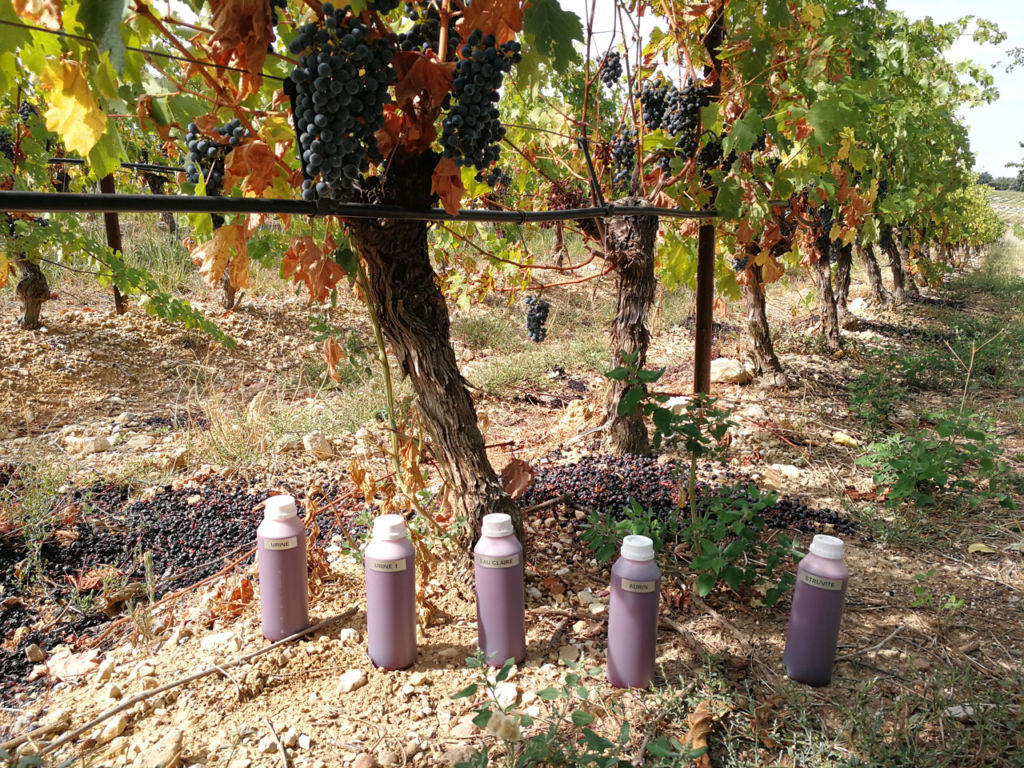
This water treatment specialist has been conducting this experiment since last year in collaboration with the Montpellier-based company Ecosec and the La Jasse vineyard in Combaillaux. For two years, two vineyard plots will be irrigated with fertilizers made from urine collected in dry toilets installed in the village in the Hérault department and specially designed by Ecosec to separate urine from feces. The project is called Valurine.
From Urine to Fertilizer
“There’s no doubt that the ecological transition is underway and will come to pass. This growing awareness of our consumption patterns and their dependence on fossil fuels and raw materials is a major issue in the news today,” the researcher emphasizes.
“Our urine contains most of the nutrients used as plant fertilizers: nitrogen, phosphorus, potassium…” explains Marc Héran. Phosphorus, which is essential for plants, is “a fertilizer that enables high agricultural yields. We extract it from phosphate mines, and we’re drawing on it more and more.” It is a limited resource, the depletion of which could lead to a global agricultural crisis in the coming decades.
“Nitrogen, on the other hand, is an unlimited resource,” explains the researcher, “because it’s present in the atmosphere. However, its cycle is extremely energy-intensive. ” Wastewater treatment plants are required to treat nitrogen before discharging it into the natural environment to limit eutrophication (see box below). Once converted into gas, the nitrogen returns to the atmosphere before being recaptured and converted back into liquid nitrogen to be used as fertilizer.
Strict controls
The question remains: how can this urine be put to good use? Urine can indeed contain micropollutants and pathogens, so sanitization and monitoring are carried out throughout the processing. “We have not observed any accumulation of pathogens in the plants, and as for micropollutants, we are below the detection limits,” says Marc Héran.
Another goal of the project is to optimize the management of urine volume, which is costly to store and transport. To reduce these costs, the Valurine project is testing several processes. These include the production of struvite—a powdered urine extract—and the concentration of urine through nitrification and distillation. “Struvite is extracted through a simple precipitation process, which recovers more than 90% of the phosphate and a small amount of nitrogen in powder form by adding magnesium to the urine, which produces a precipitate.”
Concentrating urine requires a bit more expertise because it must first be nitrified, as Marc Héran explains: “This involves stabilizing the nitrogen present in the urine in the form of ammonium by converting it into nitrate. ” The urine is then distilled “to preserve all the nutrients in just 5–10% of the original volume.”
The End of the Sewer System
Once concentrated in solution or in powder form—or simply used as is—urine is ready for drip irrigation in open fields. A small miracle that made possible the production of the very first bottles of wine made using this fertilization process. A fittingly named vintage: “I’ll Go Pee on Your Vines”— or the story of an eternal cycle where nothing is lost, nothing is created, and everything is put to good use. “Urine can change the face of agriculture as well as that of our planet; the 21st century will mark the end of the sewer system,” concludes the researcher.
Eutrophication: The Suffocation of Ecosystems
Urban growth means that today, wastewater treatment plants discharge colossal volumes of water that “still contain far too many nutrients for rivers to naturally purify themselves, as was still the case 50 years ago,” explains Marc Héran. “Algae grow rampantly, blocking out the light; they die and ferment, causing ecosystems to suffocate.” This phenomenon, known as eutrophication, has led authorities to impose standards on wastewater treatment plants regarding the discharge of nitrogen and phosphorus.
Check out theUM podcasts, now available on your favorite platform (Spotify, Deezer, Apple Podcasts, Amazon Music, etc.).