[LUM#1] In Search of Alexandre Grothendieck
Who remembers Alexandre Grothendieck? The man once considered the greatest mathematician of the20th century passed away recently. As he emerges from obscurity, this pioneer of new worlds leaves behind uncharted territory: a body of handwritten work that remains to be discovered.
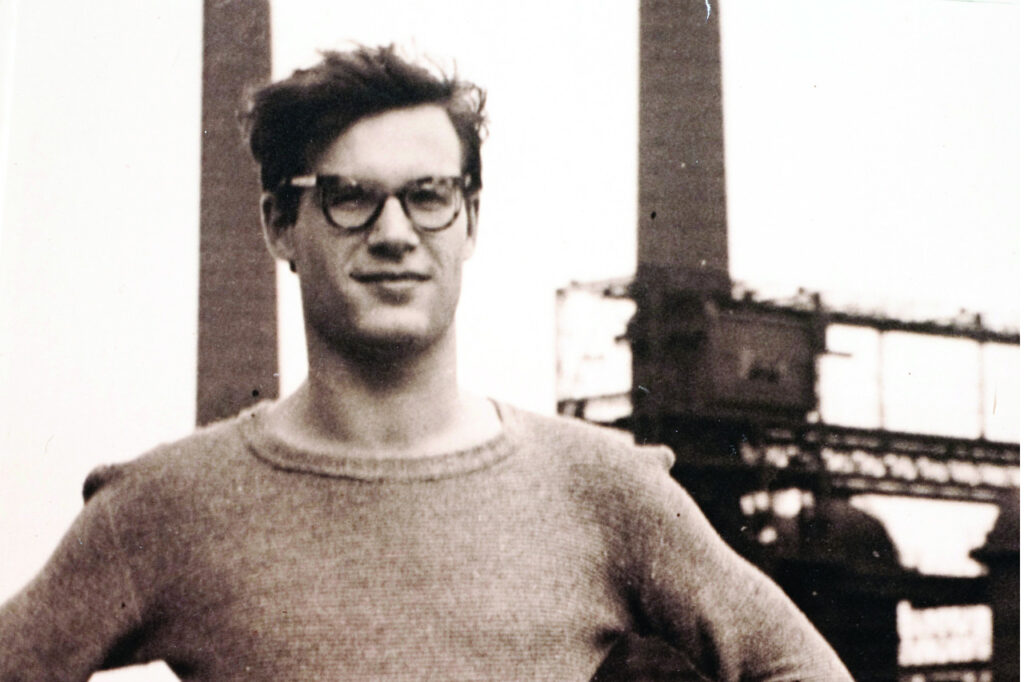
He changed the landscape of mathematics. Alexandre Grothendieck passed away on November 13, 2014, at the age of 86. He had long since distanced himself from the wider community. Having taken refuge in Lasserre, a small village in the Pyrenees, the “enfant terrible” of mathematics had been living there as a hermit since 1991. His last public act took place three years earlier, when he refused the Crafoord Prize —intended to crown his career—and the $270,000 that came with it.“Fertility is measured by one’s offspring, not by honors,”explained the man who had been showered with them, having notably received the prestigious Fields Medal.
Extraordinary Genius
Jean Malgoire was his student. Now a lecturer at the University of Montpellier, he recalls the“absolute uncompromising nature” that characterized both the man and the researcher.“He had complete faith in his ability to analyze things on his own, without being swayed by other points of view. A self-confidence he applied to all areas…".
From a very early age, Grothendieck explored on his own this magic in which the secret harmony of the world resides—and which we call mathematics. At the University of Montpellier, he didn’t shine in class, but rather behind the scenes: at age 18, without even realizing it, he reconstructed Lebesgue’s well-established theory of integration. Jean Dieudonné was flabbergasted when he met this extraordinary genius in 1949: that’s not how you’re supposed to work!
The man who would become his closest collaborator then entrusted him with 14 problems in functional analysis that neither he nor Laurent Schwartz had been able to solve. What followed has become legendary: in just a few months, the young scholar untangled these 14 Gordian knots, each of which could have been the subject of a respectable dissertation. Grothendieck was 22 years old.
From the Age of Miracles to the Age of Protest
Two decades of unbroken miracles lay before him. At the Institut des Hautes Études Scientifiques, founded around him, this ogre with dazzling visions devoured his work. And he placed a new constellation in the mathematical sky: modern algebraic geometry, a new conceptual framework that was universally adopted.
“When did he think? We didn’t know. He seemed to know everything about a new subject,” remarks mathematician Michel Demazure, his first doctoral student, still in wonder half a century after they met. “With this strange being who seemed fundamentally different in nature, everything seemed to already be there…”
But those 20 years of grace were about to come to an abrupt end. For Grothendieck, in the aftermath of May ’68—with the Vietnam War raging—mathematics mattered less and less. “Should I continue my research?” he asked. He found his answer. In 1970, upon learning that the IHES was receiving grants from the Ministry of Defense, he resigned. The mentor whom we had been following down new paths cut all ties.
Exile Diaries
With his usual conviction, he held this view: the world is headed for ruin. He named the threats:“the ecological imbalance created by contemporary industrial society (…), military conflicts.” He took“the first step on a new journey”—a journey that would lead to his exile in 1991. In the meantime, he would found, along with a group of scientists, one of the very first radical environmental movements: “Survive and Live.”
It was once again in the shadows that he continued his intellectual pursuits. At the University of Montpellier—his new refuge, where a scientific star was teaching but growing increasingly isolated—and even during his exile in the Pyrenees, he filled sheet after sheet of paper. The master’s thoughts flowed freely there.“He never stopped doing math,” asserts Jean Malgoire, to whom Grothendieck entrusted, in 1991, voluminous boxes ofdocuments, still largely unexamined (see sidebar).
Grothendieck had insisted that nothing be published during his lifetime. His notebooks from exile, so long awaited by the scientific community, may now be published. What will we discover there?“Seeds, no doubt, which it will be up to us to bring to fruition,” suggests Jean Malgoire. In the realm of mathematics, Alexandre Grothendieck may not yet be done shedding light on uncharted territory.
Unexplored Continents
The “Malgoire Collection”: In June 2015, the University of Montpellier announced the signing of an agreement with the Languedoc-Roussillon Region to make use of these 20,000 meticulously organized pages. Written between 1970 and 1991 and entrusted to Jean Malgoire in 1991, they include more than 15,000 pages of mathematics as well as the professor’s correspondence. After an inventory and conservation measures, these documents will be digitized in 2016.
Compiled between 1992 and 1999 at Grothendieck’s final residence, the “Lasserre Collection” contains his last papers: 60,000 pages, including approximately 3,500 pages of mathematics, as well as writings of all kinds—literary, philosophical, and autobiographical. In 1997, Grothendieck bequeathed these manuscripts to the National Library, which is now responsible for unveiling this new terra incognita once the estate matters have been settled.
Learn more
- The Grothendieck Circle contains numerous documents, including some of Grothendieck’s unpublished works.
- Read the article “28,000 Pages” by Alexandre Grothendieck.
- Browse the Grothendieck archives.
Check out theUM podcasts, now available on your favorite platform (Spotify, Deezer, Apple Podcasts, Amazon Music, etc.).