[LUM#1] Bird Drone
How can we survey wild bird populations without disturbing them? Researchers at the Center for Functional and Evolutionary Ecology in Montpellier have found the solution…
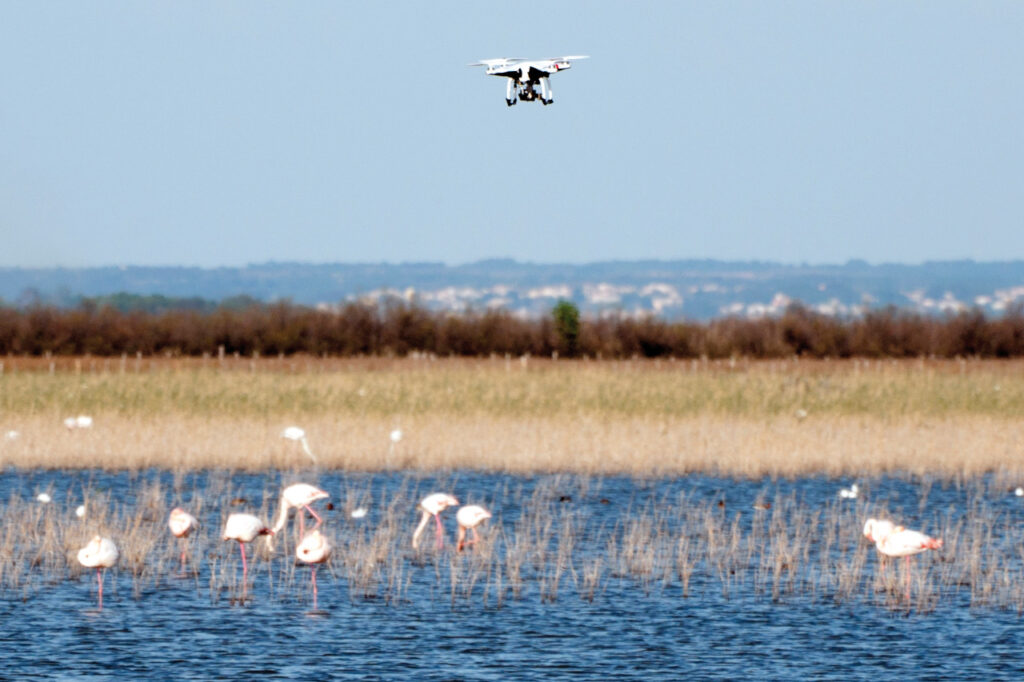
It’s a strange bird hovering over the Camargue ponds: four motorized wings, metallic plumage, and a camera in place of an eye. A drone hums quietly a few meters above the flamingos. Its mission: to count the birds. Ecologists have embraced this small flying machine, which allows them to take aerial photos to facilitate population censuses. More accurate than counts with binoculars and cheaper than using airplanes or helicopters, the drone has it all. “Using drones is fine, but it’s essential to do so without disturbing the animals, ”warns David Grémillet. The researcher at the Center for Functional and Evolutionary Ecology led the very first full-scale study aimed at assessing the impact of these aircraft’s flight on birds.
Respect the well-being of birds
“We wanted to know how far we could go without triggering a reaction from them,” explains Elisabeth Vas. For her master’s internship in Information and Communication Sciences and Technologies for Ecology and the Environment, the young woman chose the startup Cyleone, which specializes in drones. She organized more than 200 flights over the Camargue ponds to study the reactions of black-winged stilts and pink flamingos. “We varied the approach angles, speed, and color of the drone. We also tried gradually getting closer to assess at what distance the birds seemed disturbed by the drone’s presence.”
Results? To their great surprise, the researchers were able to fly their drone within 10 meters of the flamingos without them showing any signs of stress.“No doubt because the drone doesn’t look like one of their predators, ”speculates Elisabeth Vas. “Only when it approached vertically, directly above the group, did they turn their heads, since that’s their blind spot,” explains David Grémillet.
However, the researchers point out the need for further studies to assess the birds’ reactions more accurately.“It’s possible that the birds experienced stress without us realizing it; to verify this, we would need to measure more specific parameters, such as their heart rate and stress hormone levels,” warns Elisabeth Vas, who also recommends expanding the experiment to include other species.
A host of apps on the horizon
Thanks to the approach protocols established in this way, ecologists will be able to take full advantage of the many possibilities offered by drones: counting seabirds that nest in hard-to-reach cliffs, counting eggs in nests, reading rings used to identify individual birds, tracking migrations… all while respecting the animals’ well-being.
Check out theUM podcasts, now available on your favorite platform (Spotify, Deezer, Apple Podcasts, Amazon Music, etc.).