[LUM#10] Cells in Crisis
Energy conservation isn’t just about our lifestyle—it also determines the survival of our cells. François Favier and Vincent Ollendorff have identified the key role played by the REDD1 protein in reducing a cell’s energy expenditure under stress.
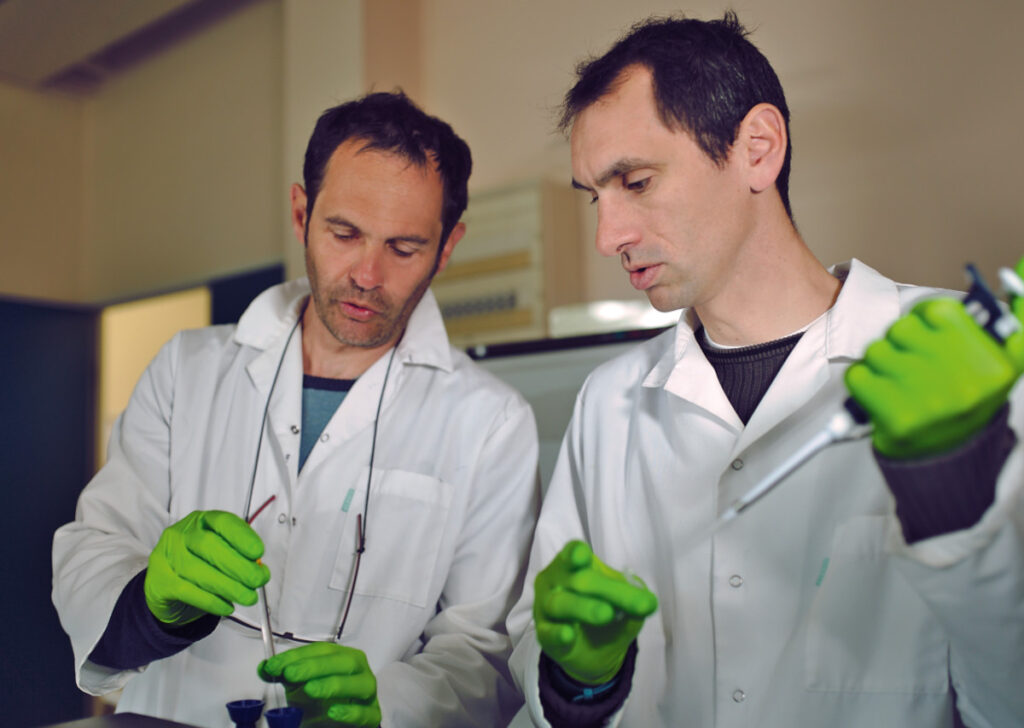
“If we had to sum up the role of REDD1, we could say it’s sort of like the Pierre Rabhi of the cell—it curbs energy expenditure to adapt to conditions of scarcity,”explain François Favier and Vincent Ollendorff, researchers at theMuscle Dynamics and Metabolism Laboratory, with a touch of humor. For nearly six years, they have been studying the response of muscle cells when faced with stressful situations that cause muscle atrophy.
Vital energy
Walking, running, grabbing an object, holding a yoga pose, speaking… All these actions are made possible by muscle cells, which, when they contract, generate mechanical tension. To contract, these cells consume energy—specifically, ATP. “Each cell hasa sort of factory capable of producing the ATP it needs to function. That’s the mitochondrion,” explains François Favier.
Under normal conditions, this energy is used by the cell to synthesize the proteins essential for its functioning. “ Liver cells produce proteins for digestion, eye cells produce proteins for vision, and muscle cells produce proteins for contraction,” explains Vincent Ollendorff. “This protein synthesis takes place in the endoplasmic reticulum, located near the mitochondria.”
A Sense of Priorities
But what happens when a cell is faced with a stressful situation, such as physical exertion, fasting, or a decrease in oxygen supply?“These situations lead to an inability to provide enough energy,” explains François Favier. “To survive , the cell must prioritize its activities and put protein synthesis—which consumes too much energy—on standby.” The cell will then release proteins capable of slowing down energy expenditure.
Research had long identified the AMPK protein as playing this role as an energy regulator—"a sort of cellular firefighter," as Vincent Ollendorff describes it—but the two researchers from Montpellier are the first to demonstrate the early role of REDD1. “REDD1 could be compared to a fire extinguisher, ” the biologist continues. “It acts before AMPK and in a more targeted, more appropriate way.”
How does it work?“REED1 physically moves the energy-producing factory—the mitochondrion—away from the site of protein synthesis in order to redirect energy to where muscles contract and generate muscle tension,” explains François Favier. Once the stress response has subsided, the mitochondrion and the endoplasmic reticulum move closer together to resume the production of new proteins. Proof that, in a situation of energy crisis, adaptation remains the best solution.
Check out theUM podcasts, now available on your favorite platform (Spotify, Deezer, Apple Podcasts, Amazon Music, etc.).