[LUM#10] Are you polychronic or monochronic?
Do you ever feel like you’ll never see the end of it, or that there aren’t enough hours in the day? Do you tend to get distracted—or, on the contrary, to stay focused? What if we just learned to live at our own pace? Andréa Gourmelen, a marketing researcher, breaks down how our relationship with time influences our daily behaviors.
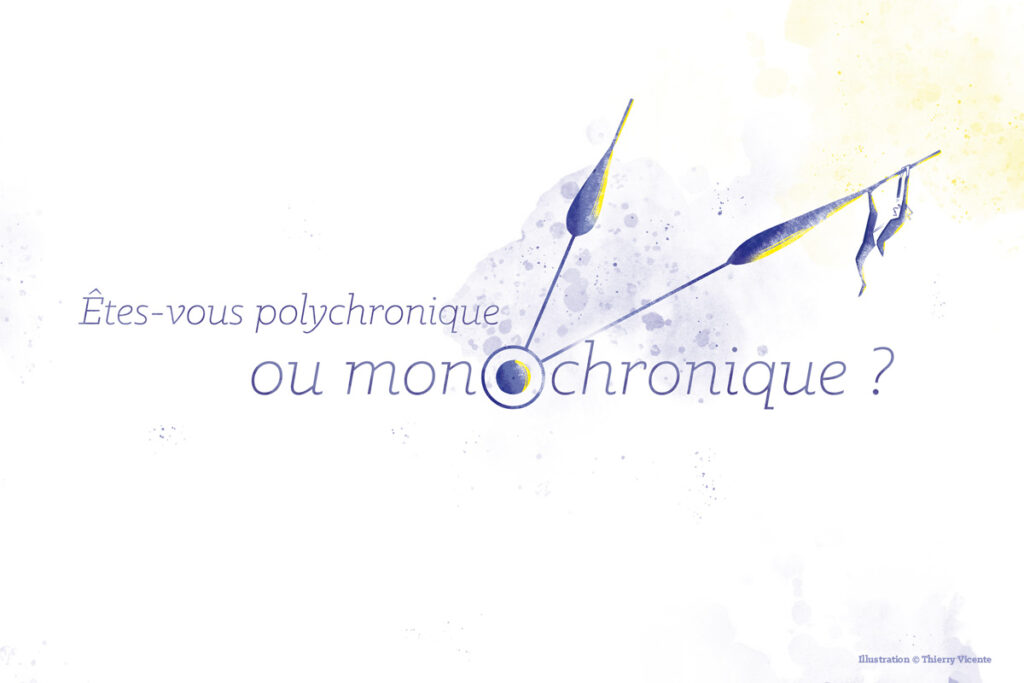
“Today, our relationship with time is a key factor,” explains Andréa Gourmelen, a researcher at the Montpellier Research in Management (MRM) laboratory. “There was a time when we were told to move quickly. Now, with the ‘slow life’ trend, we’re told to slow down, but no one encourages us to follow our own rhythm.” The researcher does not hesitate to compare this individual rhythm “to a personality trait—a subjective relationship that each person has with time.”
A personality trait
Andréa Gourmelen describes two typical personality profiles in particular: the polychronic and the monochronic. “The former will enjoy doing a thousand things at once and will be very efficient that way. The latter will prefer to finish one thing before starting the next. No one method is better than another; you just have to follow the one that suits you best.”
Except that at a time when magazines, blogs, and various coaches are all offering their own little tips on how to manage our time better, it’s still not that simple to understand and stay true to our true nature. To conduct their studies and create our profiles, marketers therefore use scales. Respondents are presented with statements and asked to rate their agreement on a scale from 1 (strongly agree) to 5 (strongly disagree). “For example: ‘I prefer to work on several projects each day rather than finish one and then move on to the next,’” explains the researcher.
At the end of the test, the total number of points points toward one profile or the other. “It’s perfectly possible to agree with only three or four out of six items,” explains Andréa Gourmelen. “The idea is to define a general personality trait based on one’s degree of polychronicity.”
Time and Fuel Consumption
Our relationship with time—which modern societies tend to frame more readily in terms of task planning or productivity—ultimately shapes much of our behavior and the ways we act, as the researcher explains: “Our relationship with time is as individual as a personality trait, but it is also multifaceted. It influences how we shop, our exercise routines, our eating habits, and even our use of digital apps.”
These are all situations and approaches in which “the time variable” can prove relevant or revealing—and one that has captured the interest of marketing researchers for more than 25 years. “There is a wealth of literature on this subject in our discipline,” explains Andréa Gourmelen. She and her colleague at the University of La Rochelle, Jeanne Lallement, wanted to make this literature more accessible by publishing in the journal * Research , and Applications in Marketing* “a synthesis of the 198 articles examining the influence of this variable on our consumer behavior.” Enough to keep you… entertained.
See also:
"Slow Down… or Find Your Own Pace?", 2018, in The Conversation
The Time That Remains
How does the perception of time left to live influence retirees’ involvement in volunteer work? It was with this original approach that Andréa Gourmelen, then a doctoral student, began to introduce the variable of time into her research—a social marketing study aimed at improving the quality of volunteer work in nonprofit organizations. “It is often mistakenly believed that retirees volunteer because they have a lot of time to spare, when in fact they often feel they lack time in their daily lives.”
Three years and some 700 questionnaires later, she highlights the relationship between volunteering and what she describes as “how older adults perceive the time they have left to live.” This perception of time—and its acceleration—is, once again, experienced in a highly individual and subjective way. “For some, the awareness of death plunges them into regret and nostalgia for all the things they haven’t done, while for others, it spurs them on to do lots of things because they feel they don’t have much time left and want to make the most of it. It’s really very personal,” the researcher concludes.
Check out theUM podcasts, now available on your favorite platform (Spotify, Deezer, Apple Podcasts, Amazon Music, etc.).