[LUM#10] Less Salt for a Longer Life
Less salt for fewer cardiovascular events? That’s what Caroline Desmetz’s research suggests, showing that a low-salt diet reduces the risk of cardiac fibrosis.
In France and throughout the developed world, one in six men over the age of 40 is affected by metabolic syndrome. “It’s a condition that combines ‘high blood pressure with a metabolic disorder such as insulin resistance—which causes type 2 diabetes—or obesity,’” explains Caroline Desmetz, a professor and researcher at the Laboratory of Biocommunication in Cardiometabolic Research at the School of Pharmacy . “It’s the scourge of our societies today.”
An irreversible scar
A metabolic syndrome that triples the risk of a cardiovascular event by promoting, in particular, the development of cardiac fibrosis—in other words, a kind of scar on the heart. “Just like on the skin, this scar is irreversible—you have it for life. Except that your heart is a muscle that needs to be able to contract to function, which the scar will prevent,” the researcher points out . This fibrosis is virtually undetectable before a heart attack.
Prescribing a low-salt diet for metabolic syndrome might, however, help prevent the development of these lesions. At least, that is what initial experiments conducted on rats have shown. Rats with a condition equivalent to metabolic syndrome but fed a low-salt diet did, in fact, develop less fibrosis than the same animals that consumed a normal amount of salt.
Salt-sensitive genes
How does salt—or rather, the lack of it—affect the mechanism of fibrosis? Two possible explanations have emerged. Caroline Desmetz and her team first observed in rodents on a salt-free diet “a decrease in the presence of certain immune cells that cause inflammation, which damages the heart muscle and leads to lesions.”
But the researcher was primarily interested in the effect of a low-sodium diet on the expression of certain genes during a phenomenon—rarely described in the mechanism of fibrosis—called the endothelial-mesenchymal transition, which refers to “the transformation of endothelial cells (in blood vessels) into fibroblasts. These are cells that secrete collagen, which is responsible for fibrosis.”
Research Award from the French Society of Nutrition
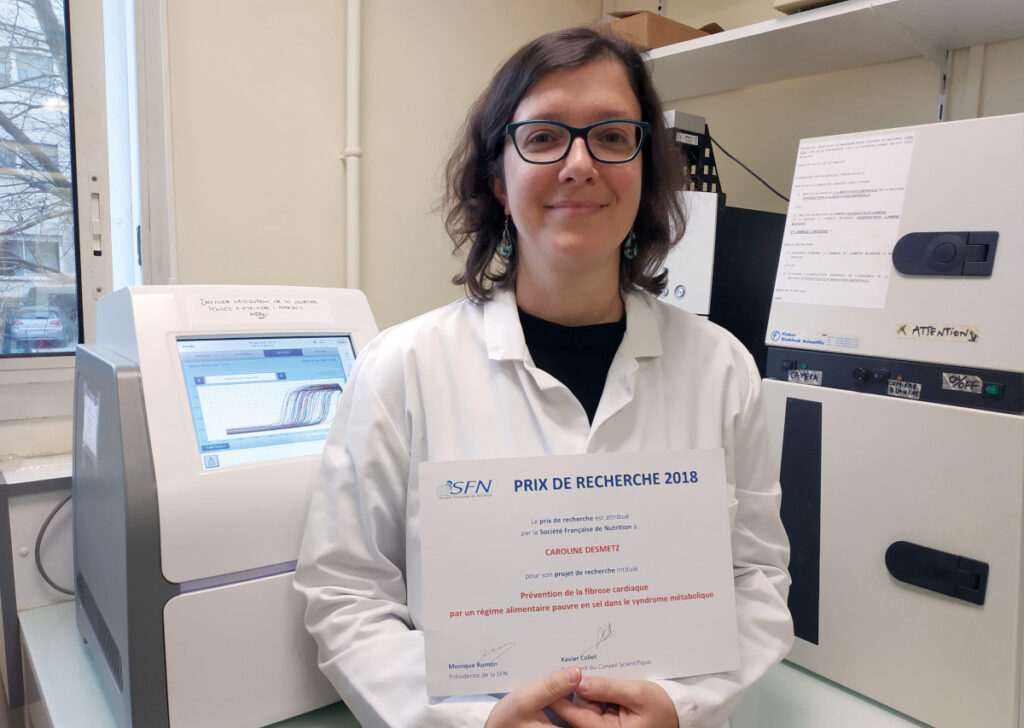
According to Caroline Desmetz, ongoing experiments seem to confirm that this phenomenon is indeed reduced in animals on sodium-restricted diets. It remains to be seen “which genes are more specifically involved and whether we can modulate them.” Last July, Caroline Desmetz was awardeda research grant by the French Society of Nutrition. The grant enabled her “to hire a master’s student and pay for the reagents needed for the experiments,” which, for their part, remain quite costly.
Check out theUM podcasts, now available on your favorite platform (Spotify, Deezer, Apple Podcasts, Amazon Music, etc.).