[LUM#11] Made in Mada
Auriane, Raphaël, Isabelle, and Sabine, undergraduate students in Ecology and Organismal Biology (EBO) at the University of Montpellier, spent the summer doing humanitarian work in Madagascar. It was an opportunity to work with the local community to promote better stewardship of natural resources and to travel off the beaten path.
“When we arrived and the people at the airport found out where we were going, they stared at us in disbelief!”says Auriane, 21. Nineteen hours by bush taxi and seven hours by boat later, the four students arrived in Analalava, a small coastal town in northwestern Madagascar.
Raphaël, Auriane, Sabine, and Isabelle organized this project with Opti’Pousse Haie, an organization founded by young researchers from Réunion and mainland France, with the goal of creating—in close partnership with a local organization—a community-managed marine protected area in Analalava. Traveling throughout the region by pirogue, the four Montpellier residents participated in village meetings to discuss the harmful effects of certain aquaculture practices while proposing solutions for better resource management.“We talked to them about the breeding cycles of fish species and the types of nets to prioritize,” explains Auriane, “and then the residents chose what they wanted to implement—or not—in their village.”
Three Areas of Focus
Once there, the students organized their work around three main areas. The most important focused on raising awareness of sustainable agricultural practices, particularly agroforestry: the combination of trees and crops on the ground.“The idea was to identify the species cultivated by local farmers and foresters in order to create a theoretical database accessible to everyone,” explains Raphaël. Local residents were also able to observe hands-on experiments such as composting, crop rotation, and intercropping legumes.
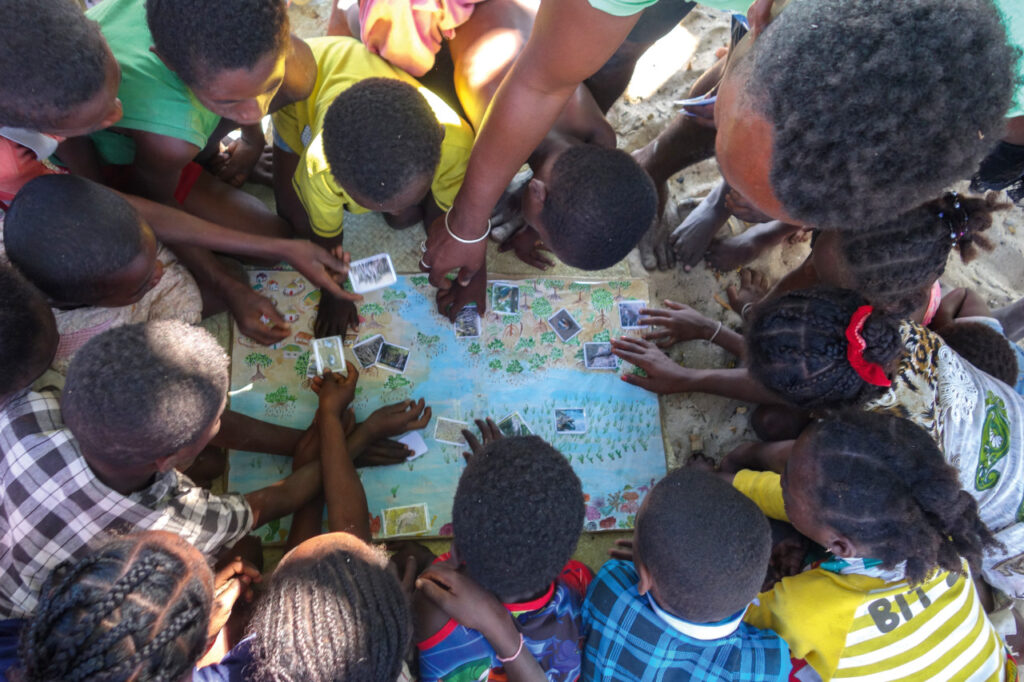
Second component: education. Using an educational kit developed by IRD researchers and with the association’s help, Auriane was able to raise awareness among young children about the region’s rich ecosystems: the reef, the seagrass beds, and the mangroves. This work can be challenging at times due to the country’s socioeconomic difficulties.“We had to adapt the kit because illiteracy is widespread in Madagascar, and class sizes can reach up to 40 children, aged 8 to 16, per class.”
"Full of little touches"
The third and final focus is the restoration of Madagascar’s mangrove forests, “one of the most dynamic ecosystems on the planet because it stores enormous amounts of carbon,” explains Raphaël, but one that is threatened, in particular, by the use of mangrove wood for heating or construction.
Beyond their Auriane mission, Raphaël, Isabelle, and Sabine discovered a different way of traveling and connecting with others:“Everywhere we went, people offered to let us pitch our tent in their yard and gave us food. It was full of little gestures like that!” It was an experience that, in addition to planting trees, sowed the seeds of long-term openness.
For interested students, the Opti’Pousse Haie association is regularly looking for volunteers in the field of international solidarity.
Check out theUM podcasts, now available on your favorite platform (Spotify, Deezer, Apple Podcasts, Amazon Music, etc.).