[LUM#12] Karma's Brain Trust
Imagine a molecular scissors capable of breaking down a protein by cutting it exactly where you want. Karma is the name of this project, carried out by fourteen students from Montpellier and recognized at the prestigious international synthetic biology competition held annually in Boston.
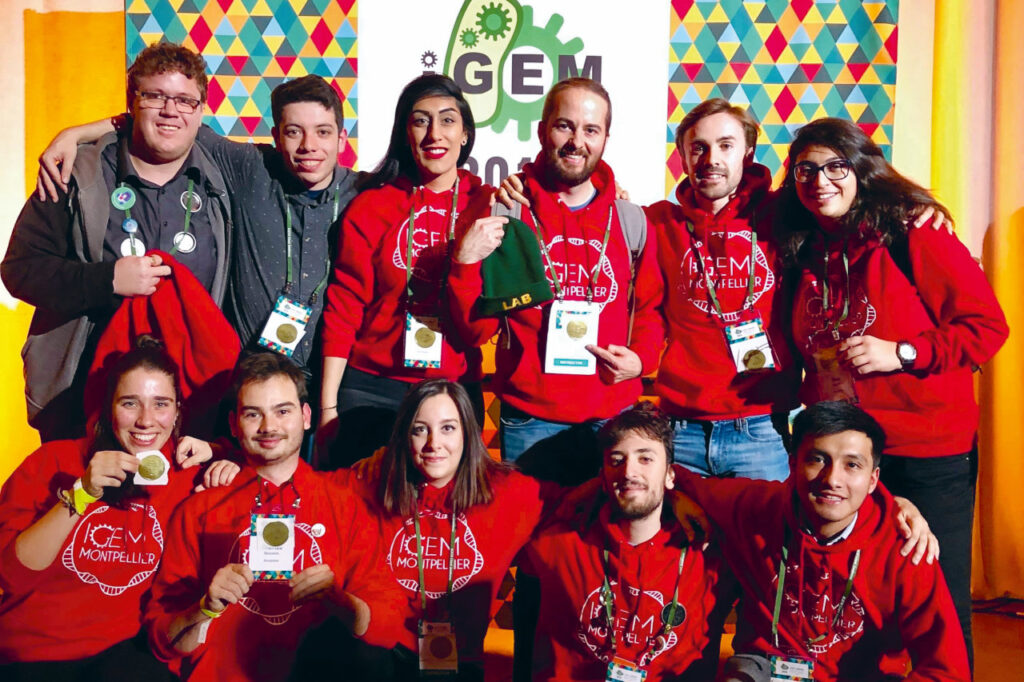
“In many diseases, such as cancer or Alzheimer’s, research has identified the role that certain proteins play in the development of the disease,” explains Thomas Bessede, a first-year BIOTIN (Master’s in Health Biology)student. “Current drugs use chemical molecules to block them.” The problem is that these pharmaceutical molecules do not always target the proteins responsible and therefore cause side effects.
Molecules capable of breaking down proteins occur naturally in our bodies; these are called proteases. Some of them are highly specific and can effectively target a particular type of protein.“Unfortunately,” explains Elsa Frisot, a doctoral student at the CBS and the team’s supervisor, “we don’t have a specific protease for every type of protein, and while there are indeed nonspecific proteases, they too may cause side effects.”
A Researcher
The fourteen students participating in the IGEM (International Genetically Engineered Machine) competition set out to tackle this problem and devised a revolutionary molecular tool: a protein scissors capable of degrading proteins in a highly targeted manner.“We drew inspiration from the CRISPR-Cas9 tool, a genetic scissors that can target and cut a specific DNA sequence,” explains Thomas Bessede.
To develop this tool, the team focused on antibodies, whose strength lies in being specifically designed to target a protein, much like a“seeking head.” “Today, in the lab, we’re able to design antibodies for anything. Each antibody has the ability to bind to a specific target.” From among these antibodies, the IGEM team selected the VHH and fused it with a nonspecific protease to deliver it to the desired target.
A successful experience
To observe the effect of the Karma scissors on a target protein, the young biologists used GFP, a protein that emits green fluorescent light.“For the experiment, we added a small tag to the GFP that blocks this fluorescence. The goal was to direct our VHH-tagged protease to that tag so it could break it down and allow the GFP to glow again, ”Thomas explains. And the experiment was a success!
Recognized and awarded in Boston, the Karma project now lies in the CBS freezers, hoping that a motivated researcher will continue the experiment to fully develop its potential and perhaps discover new therapeutic applications. You can read more about this project on the IGEM 2019 website.
Check out theUM podcasts, now available on your favorite platform (Spotify, Deezer, Apple Podcasts, Amazon Music, etc.).