[LUM#2] Tomorrow, Healing
A targeted, sustainable form of medicine that no longer settles for merely providing relief but allows itself the luxury of repairing. Thanks to advances in stem cell research, regenerative medicine is poised to revolutionize the medical world.
Is osteoarthritis causing you pain? Get the knees you had in your twenties thanks to brand-new cartilage. Is Alzheimer’s looming? Replace your failing neurons with more efficient ones. Is your heart threatening to give out? Replace it! Science fiction? No—these are the promises of regenerative medicine. Its goal:“to repair an injury or a diseased organ by replacing failing cells with healthy ones ,” explains Christian Jorgensen. This targeted medicine offers the prospect of completely curing certain diseases rather than merely treating the symptoms with heavy doses of medication.
The Amazing Potential of Stem Cells
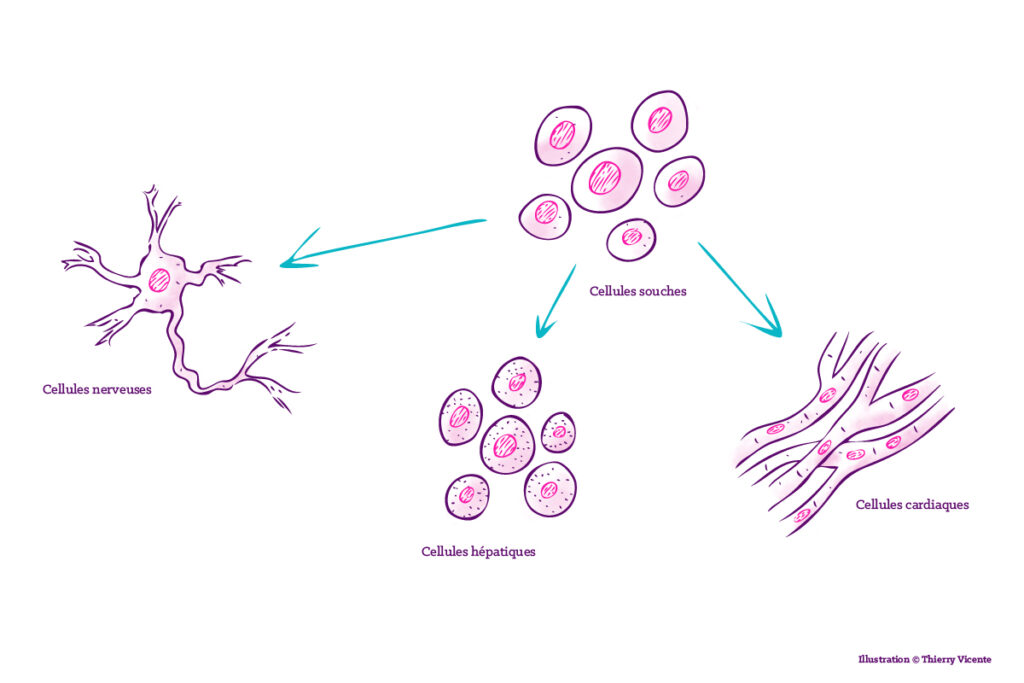
In Montpellier, this medicine of the future is already a reality: researchers atthe Institute for Regenerative Medicine and Biotherapy (IRBM) are at the forefront of this field. Their primary tool? Stem cells. These cells have the unique ability to give rise to different cell types, making it possible to produce cartilage, neurons, heart tissue, liver tissue, skin, and more…
There are two types: multipotent stem cells, which can differentiate into a limited number of cell types, and pluripotent stem cells, which can give rise to all the cells in the body (see sidebar). How?“Thanks to a cocktail of molecules that induces their differentiation into a specific tissue,”explains the director of the IRMB. A “liver” cocktail to produce liver cells, a “heart” cocktail to produce cardiomyocytes—the choice is yours. The advantage of this technique is that cells can be harvested from the patient and re-injected after differentiation, without the risk of the immune system rejecting the graft.
Numerous clinical trials are currently underway to test these new therapies. In Montpellier, researchers are treating patients with knee osteoarthritis as part of the European Adipoa clinical trial led by Christian Jorgensen.“We’re using mesenchymal stem cells, a type of multipotent cell found throughout the body,” explains the researcher. These cells are injected directly into the patients’ knees to promote the regeneration of damaged cartilage. An initial trial involving 18 patients yielded very encouraging results: 80% of them reported improved function and reduced pain within nine months of the injection. “We have now launched a second, larger-scale trial involving 150 patients, and we expect the results by the end of 2018.”
Create Organs
Osteoarthritis, heart attack, heart failure, macular degeneration, Alzheimer’s and Parkinson’s diseases… The list of diseases that can be treated with stem cells continues to grow. But regenerative medicine has even greater ambitions. The goal: creating organs.“We know how to produce heart cells. We also know how to reconstruct the matrix of a human heart using collagen fibers and a 3D printer. By using these cardiac cells to ‘colonize’ this matrix, we can create a human heart—an organoid that could potentially be transplanted into a patient without any risk of rejection,” explains Christian Jorgensen, who believes this dream could become a reality within five years… perhaps in Montpellier.“We have all the necessary infrastructure to be at the forefront of regenerative medicine thanks to a platform that brings together medicine, robotics, chemistry, and imaging. Montpellier is a leader in this field,” says the director of the IRMB. This is part of addressing a major challenge facing our society: living longer, but above all, living in better health.
Researchers are "resetting"
Access to pluripotent stem cells has long been limited, since they occur naturally only in embryos. Now, researchers are able to create them. Their method? They take a small skin sample from a patient and extract cells from it, which they then “reprogram” genetically. “It’s as if we were pressing a ‘reset’ button to reset the cell,” explains Christian Jorgensen. This yields “induced pluripotent stem cells” (iPS cells), which can be transformed into any cell type. This technique earned its inventor, Japanese researcher Shinya Yamanaka, the 2012 Nobel Prize in Medicine.
Check out theUM podcasts, now available on your favorite platform (Spotify, Deezer, Apple Podcasts, Amazon Music, etc.).