[LUM#2] Eco-design: Looking Out for Fish
Ports, piers, seawalls… How can we protect fish from the concrete pours that are constantly reshaping our coastlines? Eco-design now has a role to play.
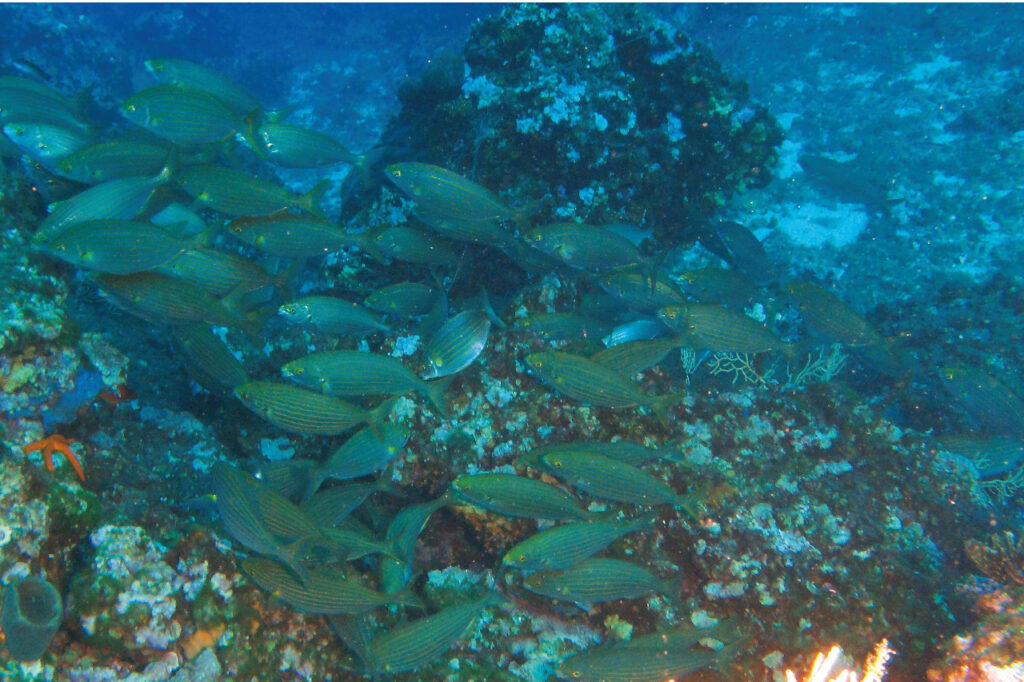
©IRD – Thomas Changeux
He fell into the sea when he was a child.“Diving, fishing, watching fish… I spent my entire childhood with my head in the water.” His role model? Commander Cousteau. So when the time came to choose a path, Matthieu Lapinski’s course was already set: he would become a marine biologist. A path that led him to the Faculty of Sciences in Montpellier and its master’s program in Ecology and Biodiversity Management Engineering.
Artificial shelters and reefs
“While I was in school, I heard that Egis was hiring an engineer specializing in marine biology and ecology. They wanted someone with 3 to 5 years of professional experience,” recalls Matthieu Lapinski. He doesn’t have his degree yet, nor does he have the required experience. But he knows the sea like the back of his hand.“I’m the one you need,” he says. It was his dream job—and it became his career.
His job? Protecting the marine environment.“I do eco-design for maritime and port structures, ” explains Matthieu Lapinski. “My mission is to minimize the impact of human construction on the aquatic environment.” For example, by creating shelters for young fish in the large seaport of Marseille.
Because these boisterous juveniles need protected areas.“In harbors, juvenile fish have nowhere left to take shelter, even though these areas are teeming with predators.” Or by designing artificial reefs—“concrete homes for fish that replicate their natural habitat when it has disappeared,” explains the engineer specializing in marine biology and ecology.
Respect marine ecosystems
A brand-new profession that emerged just a few years ago“thanks to society’s growing environmental awareness in the face of significant degradation of our oceans.”But also because regulations have changed.“Now, we are required to take into account the impact of human activity on the environment.”
Should a protective seawall be built in a coastal area to combat rising sea levels caused by climate change? “In that case, we’ll be involved in the project’s environmental management.” The idea is to make the new seawall an integral part of the marine ecosystem. This is a real challenge that requires balancing technical, economic, and environmental constraints. Is this the end of unregulated coastal development?“Today, the technical solutions exist. It’s up to us to implement them.”
Check out theUM podcasts,UM available on your favorite platform (Spotify, Deezer, Apple Podcasts, Amazon Music, etc.).