[LUM#2] Toward an "uberization" of society?
Digital technology is definitely changing your daily life. But perhaps not in the way you imagined. Welcome to a world whose contours are still unclear: the world of the sharing economy.
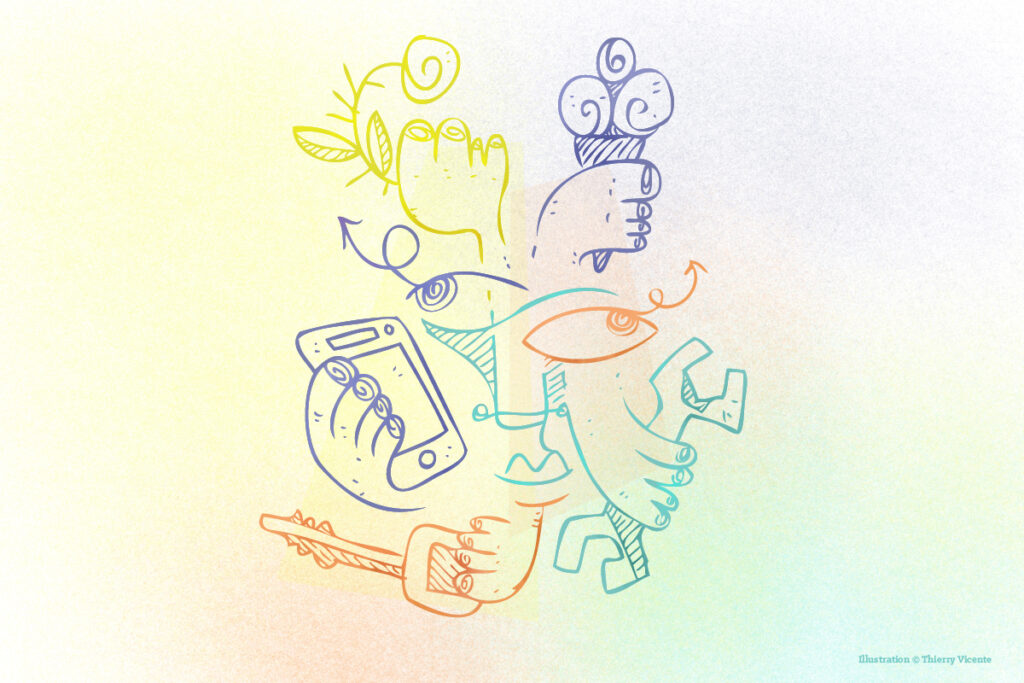
5:00 p.m. In a few minutes, it will be time to leave the office. But your workday is far from over. Around the corner, a notification on your smartphone tells you that two high school students are waiting for you at the next traffic light for a quick ride-share, organized on the fly via a geolocation-based ride-sharing platform. Back home, you glance at your Airbnb account: your daughter’s room—she’s on vacation abroad—has indeed found a guest for tomorrow night. 8:30 p.m. Before collapsing onto your monthly-rental sofa, you double-check the details of your morning route one last time—it’ll take you on your way to work to the homes of three of your neighbors, who’ve been lured by the beef bourguignon simmering quietly in your kitchen.
Free Sharing and Business Acumen
Driven by the explosion of mobile internet, the widespread adoption of digital technology is paving the way for new forms of interpersonal relationships. A fundamentally flexible society is taking shape, composed of hybrid citizens who are simultaneously consumers and producers, employees and independent workers. A symbol of this new reality: Uber. In just a few years, the Silicon Valley startup has become the standard-bearer for these new giants, skillfully combining the ideology of free sharing with a formidable business acumen. After establishing itself by connecting drivers with private individuals, Uber now aims to extend this model to the entire spectrum of services. What does Uber do? It anticipates and maps out needs, turning everyone into a potential customer or employee. More than just a service, it’s a model for society—so much so that some people no longer hesitate to speak of a true “uberization.”
As a professor in the School of Economics and a keen observer of the emergence of this so-called “sharing economy,” Michel Garrabé urges caution regarding a catch-all term that tends to lump together two diametrically opposed models: “We must clearly distinguish , on the one hand, a truly collaborative, non-market economy—like Wikipedia, conceived as a space where people organize themselves to create a common good—and, on the other hand, companies in the traditional market economy, such as Uber or Airbnb, which have shareholders and aim to maximize their profits , ” explains this specialist in social economy.
Nomadic and Horizontal
In the wake of Uber, Airbnb, and the French company BlaBlaCar, there are countless startups riding the wave of a nomadic, horizontal economy that tends to replace the concept of ownership with that of usage. From healthcare to transportation, housing, and banking, no sector seems likely to be spared. This revolution is not without its share of resistance: some cry foul over “unfair competition”—as seen in the taxi drivers’ revolt against Uber—while others warn of the risk of a rise in self-employment against a backdrop of widespread job insecurity… On the side of the sharing economy’s players, there is no shortage of well-intentioned arguments: optimization of resources and reduction of environmental costs, as seen with car-sharing; creation of value in saturated markets such as tourist accommodations in Paris… Above all, the sharing economy would allow everyone to supplement their income in a context marked by mass unemployment and eroding purchasing power.
New Deal
There remains the particularly sensitive issue of the status of workers in an ecosystem that is still poorly defined. For Paul-Henri Antonmattei, the rise of Uber and similar companies is merely a manifestation of a fundamental trend that makes it essential to rethink a legislative framework that is now obsolete: “Labor law was built on a single model—that of the factory. Unity of time, unity of place, unity of action, strong employer power… Yet this model is no longer fit for the21st century.” According to this labor law specialist, a member of the Combrexelle Commission tasked by the government with considering labor law reform, the solution lies in developing new tools such as company-level collective bargaining. “A solution that allows for greater adaptability of the rules to the diversity of companies, as well as to the diversity of employee profiles and career paths , ” he explains . Is the Labor Code ready for the shelf? “The law certainly has a role to play, and we must maintain a common legal framework, but it is now impossible to respond with a single, general, impersonal, and permanent standard.” In search of the much-discussed “flexicurity”—a delicate balance between employee protection and labor market flexibility. “A true economic and social New Deal and a tremendous challenge,” summarizes the law professor.
Toward “flexisolidarity”?
For Michel Garrabé, the dangers of “uberization” are very real, particularly for those who decide to make it their primary source of income: “We see people working 10 hours a day for a wage below the minimum wage,” notes the economist. This view is shared by Paul-Henri Antonmattei: “The Uber system cannot become a model for society because it remains a supplementary system, a make-do economy. We certainly cannot wish for a young person to work this way for 45 years…” Other issues remain unresolved, such as the taxation of companies quick to shift profits earned domestically to countries with favorable tax regimes. “We are still in a pre-institutional phase regarding these issues, but establishing a regulatory mechanism is essential,” confirms Michel Garrabé. The future of the sharing economy, therefore, has yet to be shaped. And it could hold a few surprises. In his book *The New Zero Marginal Cost Society*, published in 2014, American economist Jeremy Rifkin envisions an alternative path: one in which workers band together in cooperatives to develop their own matching platforms, contributing to a truly equitable redistribution of profits. Or, in other words, when technology combined with the market economy makes Karl Marx’s dream a reality.
Check out theUM podcasts, now available on your favorite platform (Spotify, Deezer, Apple Podcasts, Amazon Music, etc.).