[LUM#5] Surgery, Gentle Surgery
As explorers of the human body, surgeons are seeing their practices evolve thanks to “minimally invasive” surgery: techniques that reduce the physical strain of operations and make life easier for patients.
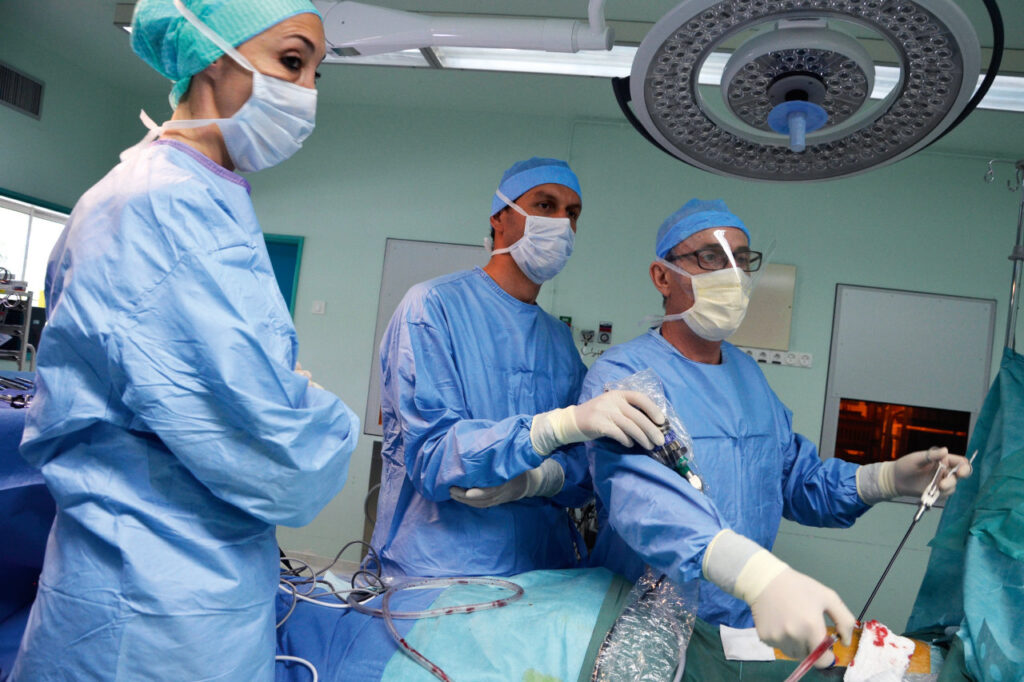
It’s a true “gentle revolution.” A surgical technique that offers procedures that are just as effective but less invasive for the patient. How does it work? Instead of making large incisions with a scalpel to expose the organs to be treated, doctors make tiny incisions through which they insert their instruments. The main advantage of this technique is that it reduces surgical trauma and allows the patient to recover more quickly.
In Montpellier, Professor Charles Marty-Ané is a pioneer in the use of minimally invasive surgery to treat lung cancer patients who require a lobectomy—a procedure that involves removing the lobe of the lung where the tumor is located. To perform this procedure using traditional “open” surgery, doctors perform a thoracotomy: the patient’s chest is widely opened so that the surgeon can access the lung.“This type of procedure causes severe chest pain because it requires cutting through muscles,” explains Charles Marty-Ané. This pain can have serious consequences during the postoperative period.“The patient is in so much pain that it’s difficult to breathe, and, more importantly, they can no longer cough, which prevents the elimination of lung secretions and increases the risk of complications and secondary infections.”
Three small holes
The alternative in minimally invasive surgery? Video-assisted thoracoscopy.“Three incisions, just one centimeter wide, on the side of the chest, through which instruments and a camera are inserted to provide a panoramic view of the chest cavity and guide the surgeon’s movements,” explains Charles Marty-Ané. Once the lung lobe has been resected, it is then removed through one of the incisions, which is slightly enlarged for this purpose. What are the benefits for the patient?“A significant reduction in postoperative pain and pain-related complications,” replies the surgeon. Patients thus experience a shorter recovery time and are discharged from the hospital 2 to 4 days after surgery, compared to 8 to 10 days for a thoracotomy. “They return to their normal lives more quickly, ”the specialist emphasizes.
Thoracoscopic lobectomy is rapidly gaining ground and is on its way to becoming the standard procedure. Although its adoption has been slow since its development in 1995, it now accounts for 30% of lobectomies in France. It still lags far behind countries such as China, South Korea, Japan, and the United States, where 40% of lung lobectomies are performed using this procedure. Yet these countries still lag far behind the Thoracic Surgery Department at Montpellier University Hospital, a true pioneer in the field:“Over the past five years, 74% of lobectomies have been performed thoracoscopically,”explains Charles Marty-Ané (who has performed 600 minimally invasive thoracic surgeries in Montpellier). This year, his department surpassed the 1,000-procedure mark for this type of surgery, giving it unparalleled expertise in France and even in Europe.
Choosing the Best Solution
While minimally invasive surgery represents a true revolution in the treatment of lung cancer, its advantages are less obvious in other fields, particularly in cardiology. “Open” surgeries involving sternotomy—a procedure that involves opening the sternum to access the heart—are generally well tolerated by patients and remain the standard of care in most cases.“To perform minimally invasive surgery, you need a well-trained team and the right equipment, but above all, you must carefully select the patients,” explains Professor Roland Demaria, a cardiac surgeon at Montpellier University Hospital. For now, minimally invasive surgery is primarily reserved for patients in good physical condition who require heart valve repair or replacement.“Ultimately, very few patients are eligible for these techniques,”emphasizes Roland Demaria.
For the surgeon, the future of the field lies instead in modern interventional cardiology, a hybrid discipline born of close collaboration between surgeons and cardiologists. “This collaboration allows us to choose the best solution for each patient by discussing each case with the entire medical staff,” explains Roland Demaria. Interventional cardiology makes it possible, for example, to replace a faulty aortic valve without having to open the patient’s chest.“All it takes is an incision in the groin, through which a new valve is inserted and guided up to the heart via the arterial pathway. The procedure is much less invasive for the patient than traditional surgery,” the surgeon emphasizes.
The use of these techniques often allows patients to go home sooner. And patients who leave the hospital sooner to return to work are also patients who cost less ( Health Economic Analysis of Thoracoscopic Lobectomy Versus Thoracotomy for Lung Cancer: Study Protocol for a Multicenter Randomized Controlled Trial, in BMJ journals, 2017).“At 1,500 euros per day of hospitalization, the savings for the healthcare system are far from negligible,” explains Charles Marty-Ané.
Check out theUM podcasts, now available on your favorite platform (Spotify, Deezer, Apple Podcasts, Amazon Music, etc.).