[LUM#6] A Shared University
For the past eight years, the university has been extending its reach to priority neighborhoods in Montpellier. Sixty students work with children at twelve schools, both in the classroom and during extracurricular activities. The program includes meetings and discussions.
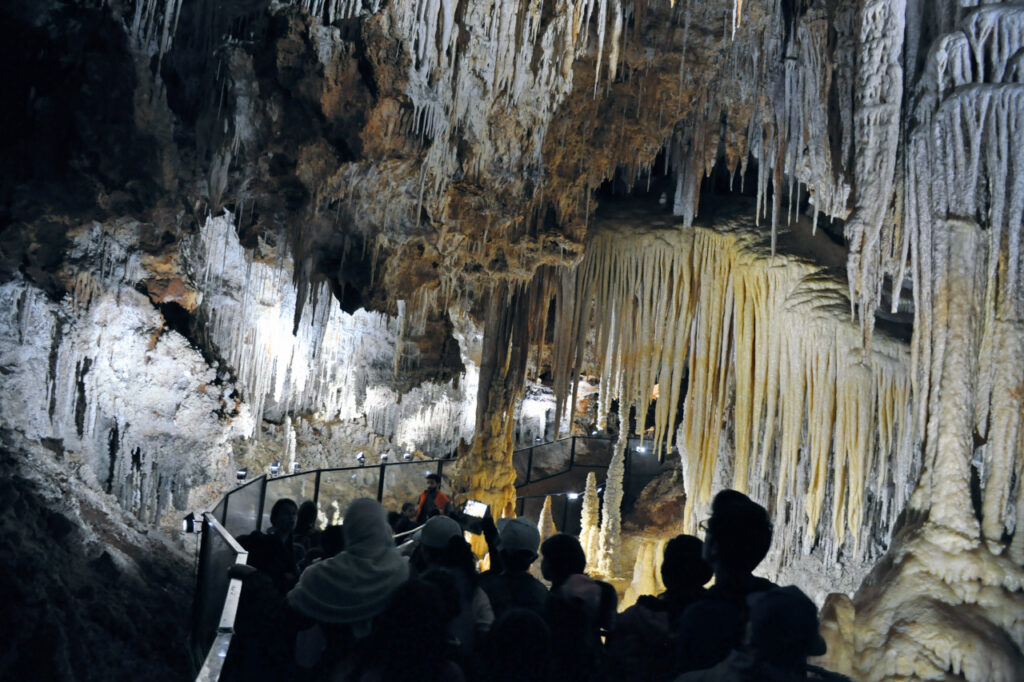
May 2017, Clamouse Cave, in the Montpellier hinterland. With wide-eyed wonder, students from the Petit Bard school and their teachers explore the underground world of rocks and crystals hundreds of thousands of years old. That evening, back in their so-called “priority” neighborhood, they will return home deeply moved by this breathtaking sight.
In the midst of the group, a unique and enriching presence: students from the Faculty of Sciences are accompanying the children. To promote the university and spread scientific culture in local neighborhoods, they are participating in the UniverlaCité project, launched by the University of Montpellier to bring together two worlds that don’t often intersect.
Stalactite and stalagmite
Standing in front of limestone formations, Mehdi, a third-year undergraduate student, engages the children:“What do we call the one that goes down? And the one that goes up?” The answers come flying back, full of enthusiasm:“The one that hangs down is a stalactite, and the one that grows up is a stalagmite!” The students’ visits to the classrooms before the field trip have paid off. A flurry of questions follows:“Why is this stalactite so big? Has it been there for a thousand years?”“Given its size, hundreds of thousands of years,” says one student. Faces light up in the crystal corridor, but also when they see the “eccentrics”—those zigzagging concretions that seem to defy the laws of gravity.
Once back in the daylight, the group sets out to explore the aquatic and terrestrial wildlife along the banks of the Hérault River. It’s a breath of fresh air for the students and children, who are intently observing frogs, shrimp, grasshoppers, beetles, and more… With a butterfly net in hand, a parent accompanying the class becomes a naturalist, delightedly searching for insects in the bushes. Even the teachers expand their knowledge of zoology alongside the students. As biologists, the students draw on their memories of lab work as they identify dragonfly larvae and viper snakes.
Each class is welcomed at the university
Today, UniverlaCité involves sixty science students from twelve schools in the Mosson and Petit Bard neighborhoods of Montpellier. Throughout the year, they meet with approximately 700 children in the classroom and on field trips. At the end of the year, each class is welcomed to the College of Sciences. To carry out their mission, the students are supervised by Thierry Noëll, the project’s founder and UniverlaCité’s official project manager at the University of Montpellier since 2009, with the assistance of his colleague Sylvie Lanau.“We supervise the students, but they don’t receive any specific training: the project develops spontaneously through human interaction.”
“Pursuing a college education comes with a certain responsibility toward society. Students are thoughtful and eager to share. When they go into the neighborhoods, they represent the university. The project brings ambition, openness, and a sense of connection to the children, but also to the students,” explains Thierry Noëll, who believes in the calming effects of having students present in the neighborhoods. Starting next year, UniverlaCité will expand, reaching six to eight additional schools.
Check out theUM podcasts, now available on your favorite platform (Spotify, Deezer, Apple Podcasts, Amazon Music, etc.).