[LUM#7] Major Scales
Preserving our Mother Earth: that is the essential challenge facing agriculture today. To meet this challenge, scientists are focusing on the soil—the cradle of crops. An ecosystem of unimaginable complexity…
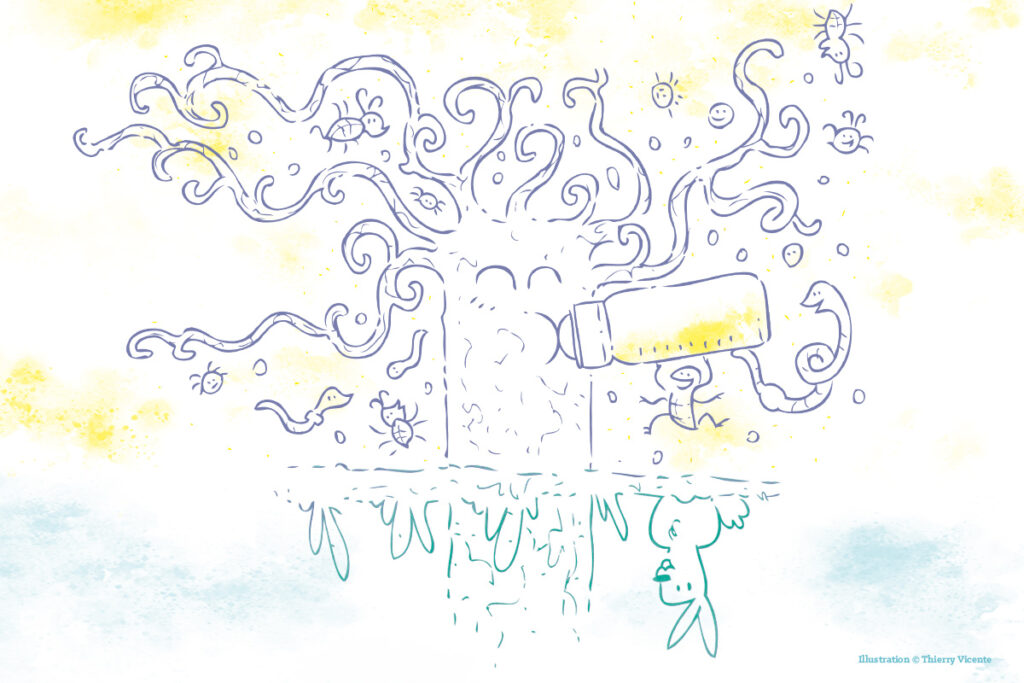
“It’s impossible to understand the soil if we separate it from its context, ”warns Robin Duponnois, a soil microbiologist and chair of the French Scientific Committee on Desertification, right from the start. “Only a comprehensive approach allows us to understand these highly complex phenomena.”
Vital Symbioses
A brief glimpse into the complexity at play: without the vegetation cover that provides the raw material for the underground life cycle—dead leaves and other plant debris—but also without the countless hidden inhabitants of the soil—insects, microscopic fungi, and other symbiotic bacteria, which are the only ones capable of transforming this material (see box)—there is no hope for the plant.
Because the plant doesn’t survive on just sunlight and fresh water. And it is anything but self-sufficient. On its own, it can access only the nutrients closest to its roots. That’s not enough to support its growth… Fortunately, mycorrhizal fungi1 work to colonize those very roots using their “hyphae”—thin filaments capable of exploring a large volume of soil—thereby providing access to infinitely more nutrients (“Mycorrhizal Associations in Soils: Toward Better Control of Plant Production,” in *Soils and Underground Life*, 2017).
Even more surprising, these same fungi act as nurturers: “The soilcontains complex molecules—both organic and inorganic—that cannot be directly absorbed. The fungus ‘digests’ these large molecules, then uses its hyphae to transfer the recycled nutrients to the plant.” In exchange, the fungus receives carbon from the plant, which is much better equipped than the fungus to extract it from the atmosphere. Plants thus form inextricable, interconnected networks with their fungal partners. And they can only thrive thanks to this symbiosis… unless the absence of this symbiosis is compensated for by the artificial application of mineral fertilizers.
From the “Green Revolution” to Agroecology
It’s true that these fertilizers can boost plant growth very easily: basically, you add a soluble mineral to the soil… and the plants grow. This is the long-standing idea behind the“Green Revolution ”: growing varieties selected for their optimal yield potential, with heavy reliance on fertilizers, as well as pesticides, irrigation, and machinery, while prioritizing large-scale monoculture.
What impact would this have on the soil and the environment? Back then, no one asked that question. It was the 1960s, right after the great famines. The goal was crystal clear: to produce, in large quantities. A revolution that was “green” in name only; costly in terms of water, chemicals, and oil, this industrial agriculture had serious drawbacks, foremost among them a decline in biodiversity, a major pillar of food security.
Imitating Nature
Times have changed: Scientists are now calling for a form of agriculture capable of both feeding people and respecting the environment. The first principle of this “agroecology” is: “Intervene as little as possible! And apply natural biological processes—the ones at work in a forest.” For example, reintroducing plant cover by replanting trees; promoting the activity of soil microflora (mycorrhizal fungi, nitrogen-fixing bacteria, etc.); or harnessing the symbiotic relationships between plants.” (Restoring Soil Productivity in Tropical and Mediterranean Soils: The Contribution of Agroecology, IRD publication, 2017)
An approach that is as humble as it is pragmatic. “We try to observe traditional practices that are well-suited to on-the-ground realities, to help optimize them.” Family farming thus has many positive characteristics: small plots, endemic species and mixed cropping, local know-how, and minimal irrigation… If we want to ensure food security in developing countries, it clearly offers a model for the future,” explains Robin Duponnois.
Underground Oases
“In just one teaspoon of soil from your garden, there can be several million living organisms,” reveals Tiphaine Chevallier of the Eco & Sols laboratory. Soils are composed of clay, silt, and sand. But that’s not all: they also contain water, air… life! While minerals predominate, organic matter is also part of the composition of this living cocktail commonly known as soil. This organic matter is recycled for plants by countless underground inhabitants (microorganisms, but also microfauna: protozoa, tardigrades, and mites; and macrofauna: woodlice, earthworms, and springtails…). These organisms ensure the proper functioning of the soil and produce nutrients vital to plants: nitrogen, phosphorus, and potassium. These oases of life are now in danger: every year, worldwide, ten million hectares of arable land are lost to desertification. This threat directly impacts the lives of 480 million people.
- A mycorrhiza is the result of a symbiotic relationship between fungi and plant roots. ↩︎
Check out theUM podcasts, now available on your favorite platform (Spotify, Deezer, Apple Podcasts, Amazon Music, etc.).