[LUM#8] Research apartment
What will the apartment of the future look like? For three years, a team of researchers will analyze the daily lives of two students living in a highly connected apartment. The goal: to observe how new technologies are used in order to make better use of them and protect ourselves from them. This project, called “Human at Home,” will begin in October 2018 in Montpellier.
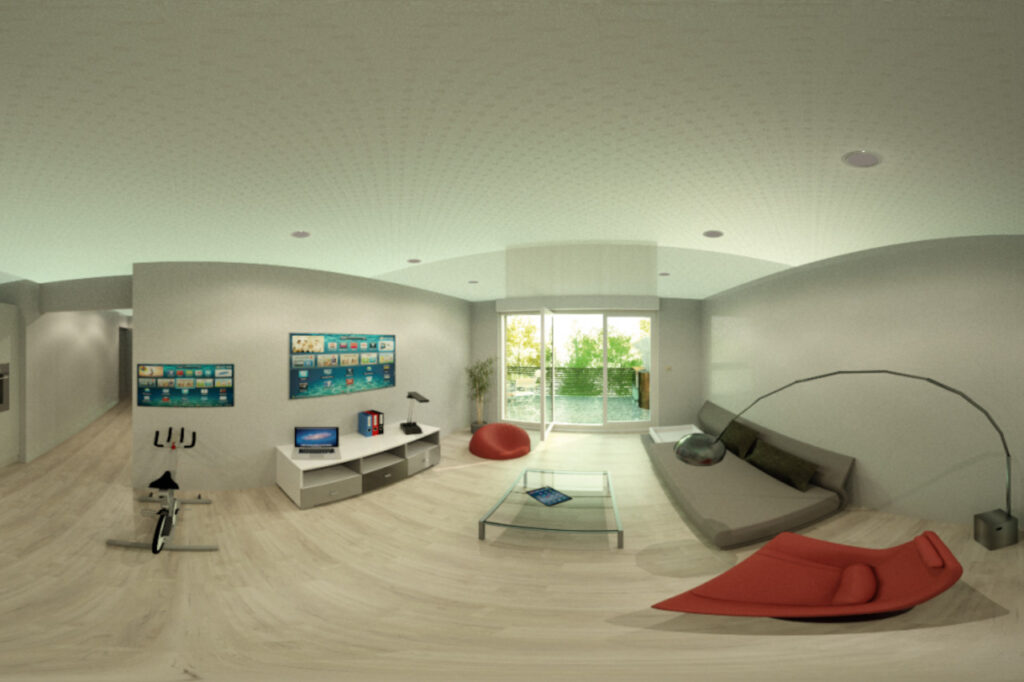
It’s 7:00 a.m., and your alarm goes off. You head to the bathroom. The day’s weather forecast and your current playlist appear on the mirror. In the kitchen, a tablet displays your schedule for the day and suggests ideas for things to do tonight. On the fridge, there’s a shopping list automatically generated based on what you’ve already used up.
We’re not in an episode of the famous sci-fi series *Black Mirror*, but in the test apartment for the *Human at Home* (HUT) project—a home equipped with about 100 sensors that collect data on its occupants’ behaviors and habits. For example, the smart floor will provide information on how they move around the apartment, their gait, and other indicators of well-being—such as eating habits, potential musculoskeletal issues, and body posture—which can then be combined with the environmental data collected.
There will also be sensors related to the apartment (temperature, atmospheric pressure), to outdoor environmental parameters (humidity, pollution), and so-called “societal” sensors related to language, social media usage, and so on.“We need to define the contours of the future apartment we don’t want,” explains Alain Foucaran, director of the Institute of Electronics and Systems (IES) and initiator of the project alongside Malo Depincé, deputy director of the Dynamique du droit laboratory. “Instead of letting the GAFAM [ Google, Amazon, Facebook, Apple, and Microsoft] tell us what’s good for us, it’s better to let the humanities and social sciences do so.”
An experience that is “one of a kind”
To carry out this ambitious project, the two researchers have assembled a consortium of twelve laboratories. Alongside the so-called“hard”sciences, such as computer science, the consortium includes linguists, economists, anthropologists, psychologists, and marketing specialists… In all, some sixty researchers are involved in a project of rare scope for the humanities.
The experiment will last three years, with a new group of residents moving in each year.“There are similar projects where people stay for a day or two, but not long-term,” explains Malo Depincé.“This is a one-of-a-kind experiment; all existing living labs focus on a technological challenge, whereas ours is a challenge related to usage,” continues Alain Foucaran.
“The challenge is to create a sort of inventory of‘what is accepted or acceptable, interesting or not to the occupant, ’ explains Malo Depincé. ‘We’ll surely have conditional interests. “I’m interested if… I agree, provided that….”’”With this in mind, the first residents selected will be students.“They don’t have the same reservations as our generation at all,” comments Alain Foucaran. A master off switch will, however, allow the apartment to be disconnected at the occupants’ request.
Inform and Protect
It’s also a legal challenge, since the second objective of the experiment is to create“a catalog of everything a home can learn about its occupants.” “We browse the internet every day, agree to terms of service that are too long or too complicated to read, and use smart speakers ‘in a way that’s a far cry frominformed consent—or without even realizing that this information is passing through a third party—Google, Amazon, Apple,’” laments Malo Depincé.
The occupants of the connected apartment will be“informed of the existence of each sensor, of all the information that will be collected, and of how it may be processed by a computer system.” The experiment should enable legal experts to consider the legal tools needed not only to inform consumers simply and effectively about the nature of the data they provide but also to protect them regarding how that data will be used.“There are benefits that cannot be denied, but we must ask ourselves about the trade-offs of artificial intelligence,” concludes Malo Depincé.
Theater Hut
Hut Théâtre aims to explore the potential conflicts that may arise between tech users and others who are more reserved. This scientific-cultural project was launched by Alain Foucaran and Nicolas Dubourg (director of the Théâtre de la Vignette) as a side project to the main experiment. Over the course of several months, researchers from the consortium will have the opportunity to express their positive or negative preconceptions regarding the situations they encounter in the smart apartment. Two actors will then present them with various improvisations, which the researchers will use as a basis to collaboratively write a play that will likely be staged at the Théâtre de la Vignette university theater in May 2019. This, too, is a first-of-its-kind experience.
For more information:
- Human at Home: Toward a Smart Human Habitat, 2021
- "Science Is Fun" Podcast: From the Smart Homes of Tomorrow to the Technologies of the Past, 2021
- Podcast "A l’UM la science": From the "Human at Home" Project to "Sud de Sciences," 2022
- Game-Changing Data, 2023
Check out theUM podcasts, now available on your favorite platform (Spotify, Deezer, Apple Podcasts, Amazon Music, etc.).