[LUM#9] An Introduction to Interferon
Virologist at the Montpellier Institute for Infectious Disease Research (IRIM), Caroline Goujon has been leading a research team studying interferon since 2015. Interferon is a molecule secreted by our cells that is essential for fighting off pathogens, yet its mechanisms of action remain poorly understood.
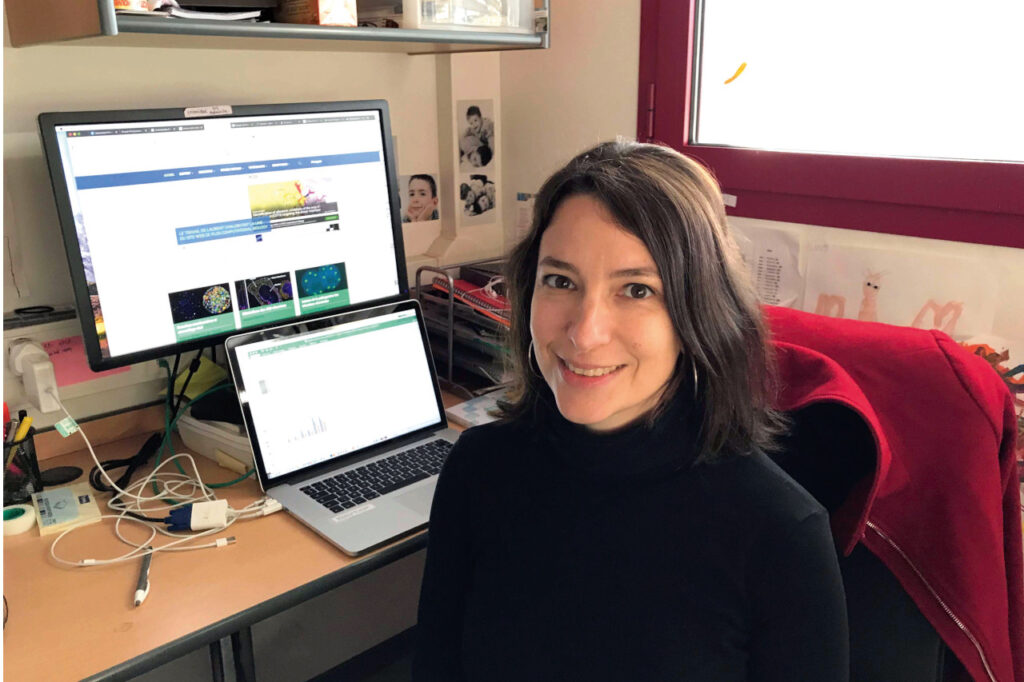
Her journey with interferon began nearly ten years ago in the United Kingdom. At the time, Caroline Goujon was a postdoc following an exemplary—and almost novel-like—career path that took her from a vocational diploma tothe Cochin Institute. There, she worked alongside “passionatelecturers who loved sharing their knowledge and really set me on the right path.” It was a path to success, as the following year she enrolled at the École Normale Supérieure de Lyon before heading to England.
Fascinated by viruses and “their ability to hijack the entire cellular machinery for their own benefit,” she specialized in HIV, until she had this unexpected discovery: “I stumbled upon some fascinating data by chance during my experiments. That’s when I became interested in the effect of interferon on host cells.”
Through a Series of Experiments
Upon her return to France seven years later, she passed the competitive exam to become a research fellow, secured funding for young researchers, and assembled her own team to study interferon. It must be said that interferon has everything it takes to inspire passion. A natural antiviral, this molecule secreted by our cells has the incredible power to protect us against viruses and bacteria without relying on antibodies. How does it work?
Produced by the cell when a pathogen invades, interferon binds to the cell’s surface as well as to those of neighboring cells and sends out an alarm signal that triggers genetic reprogramming in each of them.“These cells exposed to interferon will express about a hundred genes, a handful of which will encode proteins capable of fighting the infection,” the biologist points out.
A race against time
Here’s the theory:“In real life, it’s a race against time, ”explains Caroline Goujon. “A virus like the flu multiplies very quickly. Interferon helps limit its spread, but it’s not enough.” As a result , we get sick.
Hence the importance for scientiststo “identify this handful of genes capable of inhibiting viral replication”in order to better understand how they work. The ultimate goal isthe “distant hope” of paving the way for new therapies. In “the very special atmosphere [ of her] confined laboratory, and the calm”—so deeply appreciated—of a one-on-one encounter between the virus and interferon, the researcher knows: “Potentially, the solution lies within us.”
Check out theUM podcasts, now available on your favorite platform (Spotify, Deezer, Apple Podcasts, Amazon Music, etc.).